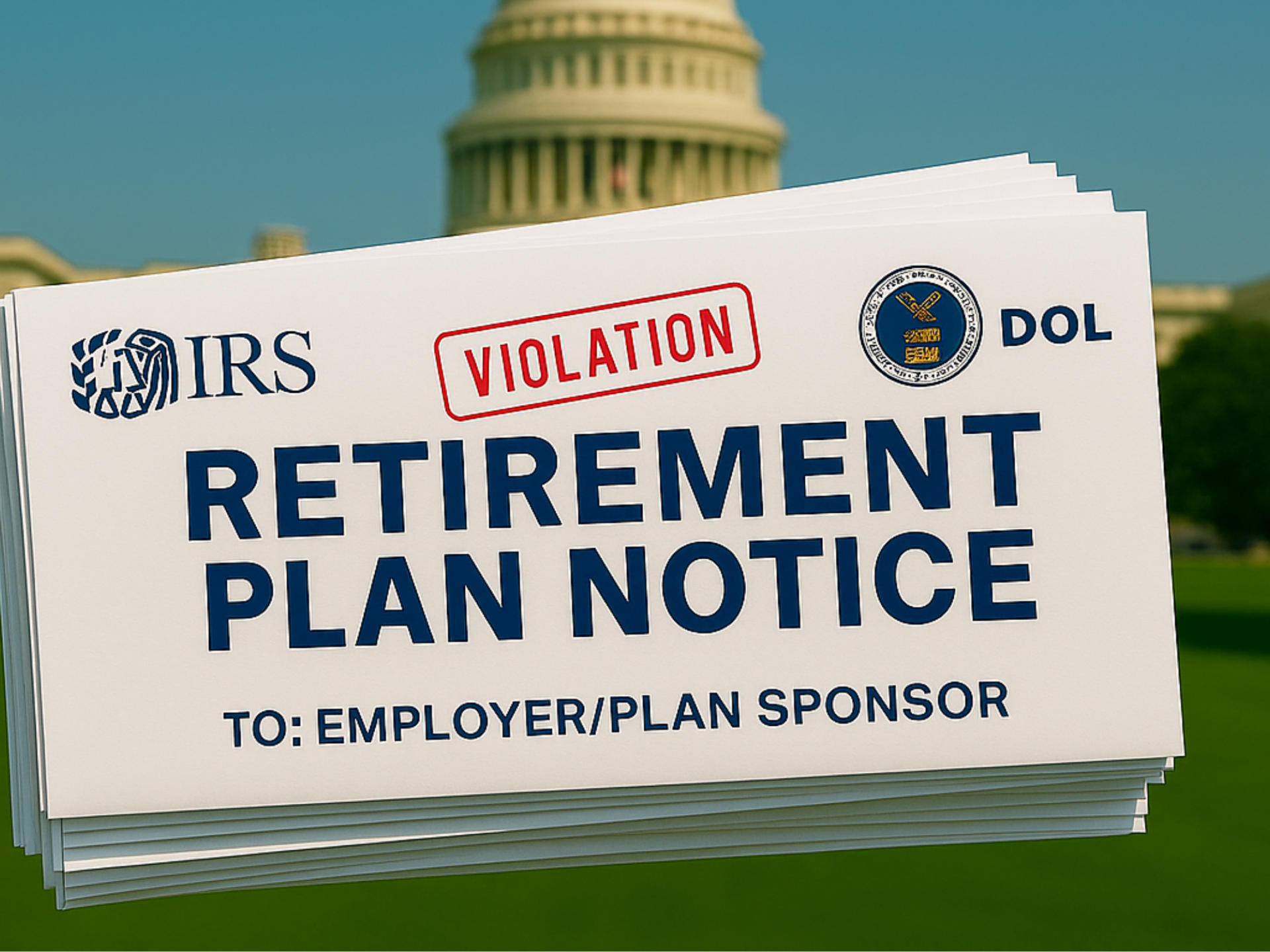
Getting an Internal Revenue Service (IRS) or Department of Labor (DOL) notice about your retirement plan can feel overwhelming.
This is not the time for guesswork. How you handle this now will directly impact the cost, complexity, and resolution of the potential issue. A notice like this is rarely the full story—it’s a signal that something may need attention, so how it’s handled next is critical. Some notices are just informational, so how do you know for certain?
Most business owners immediately ask: what does the notice mean, who do I go to, how serious is this, and how do I fix it?
The good news is that most retirement plan compliance issues are fixable. The difference comes down to how quickly you act and whether the correction is handled correctly from the start.
Why Businesses Turn to Specialists for Retirement Plan Corrections
When an IRS or DOL notice arrives, most businesses focus on fixing the issue listed in the letter. The notice is often just the starting point; it brings attention to an issue that can usually be resolved with the right approach.
Issues like a failed compliance test, missed Form 5500 filing, contribution errors, or improperly excluded employees rarely occur in isolation. In many cases, one failure points to broader compliance gaps, and a partial fix can create as much risk as the original issue.
Many providers can identify a problem, but correction requires more than awareness. It requires identifying the full scope of correction, choosing the right correction method, applying it correctly, and documenting it in a way that holds up under audit.
Businesses turn to specialists for clarity, accurate correction, and confidence that the issue is fully resolved.
Acting quickly matters but getting it right is what protects the business.
Why You Received an IRS or DOL Notice
The IRS and DOL actively monitor employer-sponsored retirement plans through Form 5500 filings, compliance testing, and reporting requirements. When something does not meet regulatory requirements, a notice is issued. In most cases, the issue traces back to a small number of common gaps.
Most notices are triggered by a few clear issues, such as:
- Not filing your Form 5500 on time (or not filing it at all)
- Depositing employee contributions too long after the payday
- Not including employees who should have been eligible for the plan
- Failing required annual tests that ensure the plan is fair to all employees (like ADP/ACP testing)
- Calculating employer or matching contributions incorrectly
- Forgetting to update your plan documents when rules change
- Operating the plan differently than what the plan document says
Business changes can also cause problems, for example:
- Hiring employees but still operating a Solo 401(k)
- Owning multiple businesses without coordinating plan testing
- Using a ROBS plan but not maintaining ongoing requirements like filings or employee access
What Happens If You Ignore It
Ignoring an IRS or DOL notice increases both financial and compliance risk. What starts as a manageable issue can quickly escalate into a more complex and costly problem.
Unresolved retirement plan compliance issues can lead to increased penalties, expanded correction requirements, and heightened fiduciary exposure. In more serious situations, the tax-qualified status of the plan itself can be at risk.
Acting early keeps more correction options on the table and significantly reduces both cost and disruption.
How Retirement Plan Issues Get Fixed
There is no universal solution to retirement plan corrections. The right approach depends entirely on the nature of the compliance failure.
Some issues can be resolved internally with proper documentation and adjustments. Others require formal correction through IRS or DOL programs such as EPCRS (Employee Plans Compliance Resolution System) or DFVCP (U.S. Department of Labor’s delinquent filer voluntary correction program).
At a high level, every successful correction follows the same path:
- Identify the root compliance issue
- Select the appropriate correction method
- Execute with complete documentation and reporting
Where businesses run into trouble are not recognizing the issue correctly and completely or applying the wrong fix. That is where additional risks are introduced.
Who Should Handle Retirement Plan Notices
Retirement plan compliance is highly technical, and corrections must align with strict IRS and DOL guidelines. This is not an area where trial and error work in your favor.
Working with an experienced retirement plan compliance specialist ensures the issue is fully understood, the correct correction program is used, and the process is completed accurately. Just as importantly, it ensures the fix holds up under scrutiny.
Leading Retirement Solutions focuses on resolving IRS and DOL retirement plan issues efficiently and correctly.
We support businesses by correcting Form 5500 filing issues, resolving ADP and ACP testing failures, and managing IRS and DOL correction programs from start to finish. Our approach is structured, precise, and focused on minimizing both risk and disruption.
The goal is not only to fix the immediate problem, but to strengthen the plan’s operational and compliance framework moving forward.
Real-World Results
Avoiding a Filing Delay Before It Happened
A client engaged LRS for Form 5500 preparation. During our review, we identified a missed profit?sharing allocation that would have delayed filing and increased compliance risk. We corrected the issue ahead of submission, allowing the client to file accurately and on time—without disruption.
Turning a Failed Test into a Clean Resolution
In another case, a client failed ADP and ACP testing. We developed a compliant correction strategy using a QNEC and managed the process from start to finish. The result was a smooth, fully resolved outcome with the plan back in compliance.
Correcting Missed Enrollments During Rapid Growth
A client expanded quickly, adding multiple employee groups across new locations. Several eligible employees were not enrolled in the plan’s automatic enrollment. We identified the issue and implemented a compliant fix, including employer contributions to make up for missed deferrals, bringing the plan back into compliance and making affected employees whole.
The Bottom Line
If you receive an IRS or DOL retirement plan notice, what you do next matters more than the notice itself.
Do not ignore it. Do not delay. And do not attempt to navigate it without the right expertise.
Most retirement plan compliance issues can be fixed. The key is following the correct process and resolving the issue the right way the first time.
Take the Next Step
If you need help resolving an IRS or DOL notice, correcting a Form 5500 issue, or ensuring your retirement plan remains compliant, now is the time to act.
Schedule a consultation with Leading Retirement Solutions to gain clarity, resolve the issue, and move forward with confidence.