

Last updated
What does an IRS letter about a retirement plan usually mean?
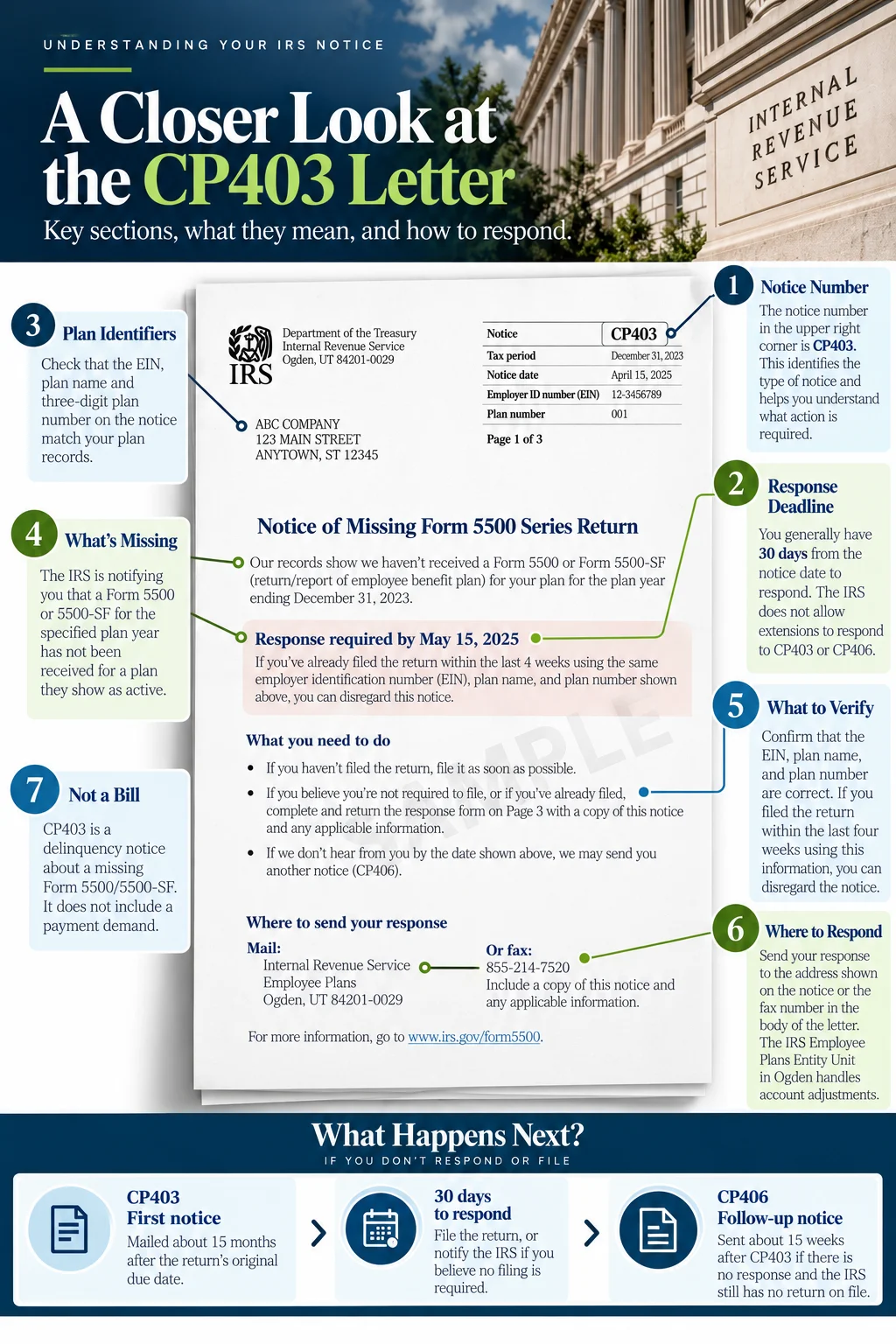
A letter from the IRS about a retirement plan is not necessarily an audit. The IRS publishes explanations for a set of notices it sends about a plan’s annual return, the Form 5500 series: reminders that a return may be due, requests for a return its records show as missing, decisions on extension requests, and penalty notices for returns filed late or incomplete. Each notice carries a number, such as CP403 or CP283, in the upper right corner, and the IRS’s notice lookup can be searched by that number.
The number is the most useful thing on the page. It identifies what the IRS is asking for, how long there is to respond and, for plans that missed a filing, which voluntary relief programs may still be available. The Department of Labor (DOL) has its own process for late annual reports, and a written notice from the DOL changes which options remain. This guide sets out the notices plan sponsors most often receive, what each one asks for and where each one falls in that sequence.
The notices plan sponsors most often receive
| Notice | Sent by | What it means | What it asks for |
|---|---|---|---|
| CP403 | IRS | IRS records show a Form 5500 or 5500-SF not filed for a plan the IRS shows as active. Mailed 15 months after the return’s original due date. Not a bill. | Confirmation that the return was filed, a filed return, or an explanation. A reply within the 30-day response date shown on the notice. |
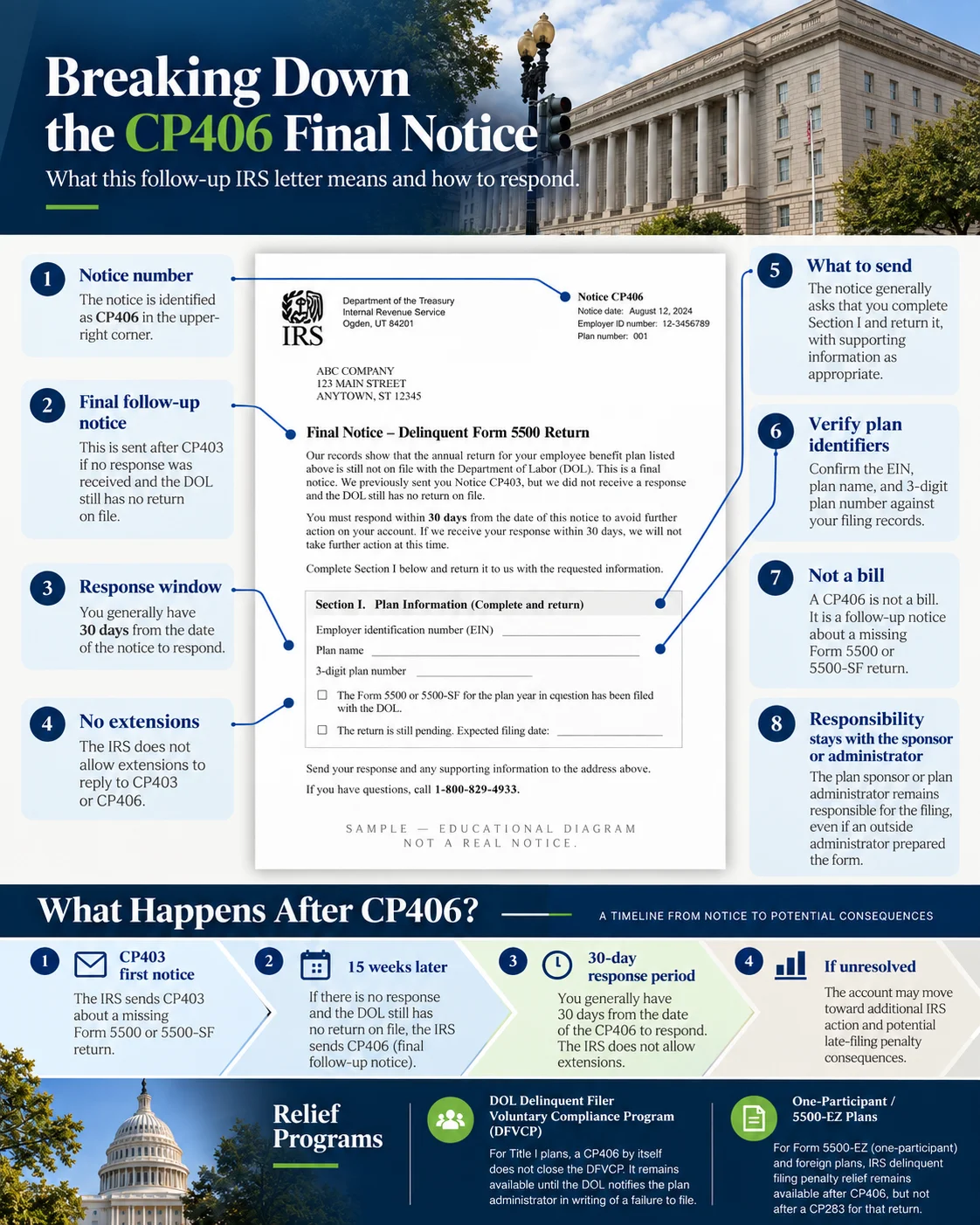
| CP406 | IRS | Final notice for the same missing return, mailed 15 weeks after the CP403 if there was no response and the DOL still has no return. | Section I of the notice completed and returned. A response within 30 days to prevent further action on the account. |
| CP214 | IRS | A reminder for plans that previously filed Form 5500-EZ. | No response. A reminder of the filing requirement for one-participant and foreign plans. |
| CP216F | IRS | An extension request on Form 5558 was approved. | No response. The return is due by the new date on the notice. |
| CP216H | IRS | An extension request was denied because Form 5558 arrived after the return’s normal due date. | The return filed promptly. The IRS treats a return filed after the normal due date as late. |
| CP283 | IRS | A penalty was charged on a Form 5500 series return filed late or incomplete. | Payment, any missing information, or a signed statement requesting removal of the penalty with the reason the return was late. |
| Letter 854C | IRS | A request for penalty relief based on reasonable cause was denied, with the appeal procedure explained. | Review of the appeal procedure described in the letter. |
| Compliance statement | IRS | The IRS approved the correction method proposed in a Voluntary Correction Program submission. | The approved correction completed within the period the statement sets, generally 150 days. |
| Notice of Intent to Assess a Penalty | DOL | A DOL notice concerning a late or missing annual report. The DOL lists recipients as ineligible for its reduced-penalty program. | The response set out in the notice. |
Sources: IRS, filing notices for Forms 5500, 5500-SF, 5500-EZ or 5558; IRS, Understanding your CP283 notice; IRS, Form 5500-EZ penalty relief FAQs; IRS, Voluntary Correction Program; DOL, Delinquent Filer Voluntary Compliance Program.
How a missing Form 5500 moves through the IRS notice sequence
A Form 5500 series return is generally due on the last day of the seventh month after the plan year ends, July 31 for a calendar-year plan, according to the IRS Form 5500 Corner. An extension can be requested on Form 5558. If the IRS has no record of the return, its notices follow a set timetable:
- Due dateReturn due. Last day of the seventh month after the plan year ends, or the extended date if Form 5558 was received on time.
- +15 monthsCP403 mailed. The delay allows time for the DOL to process timely filed returns. The notice sets a 30-day response date.
- +15 weeksCP406 mailed if there was no response to the CP403 and the DOL still has not received the return.
- +30 daysResponse window on the CP406. The IRS states that a response within 30 days prevents further action on the account. It does not grant extensions to reply to either notice.
Source: IRS, filing notices for Forms 5500, 5500-SF, 5500-EZ or 5558.
Two practical points follow from the IRS’s own explanations. A CP403 can cross in the mail with a return that was recently filed: the IRS states that a return filed within the last four weeks, using the same employer identification number, plan name and plan number shown on the notice, allows the CP403 to be disregarded. And a CP403 can trace to a mismatch rather than a missing return. If a return was filed under a different EIN, plan name or plan number, the IRS asks for Section I of the notice and a statement explaining the difference.
An example with dates
Applying the IRS timetable to a calendar-year plan whose 2024 return was due July 31, 2025, with no extension requested and no return on the IRS’s record:
| Step | Approximate timing |
|---|---|
| 2024 Form 5500 due | July 31, 2025 |
| CP403 mailed, 15 months after the due date | Around October 31, 2026 |
| CP403 response date | 30 days from the notice, as shown on it |
| CP406 mailed, 15 weeks after the CP403 | Around mid-February 2027 |
| CP406 response window | 30 days, as shown on the notice |
Calculated from the intervals the IRS publishes for CP403 and CP406. Actual mailing dates and response dates are those printed on each notice.
The example also shows why a CP403 can arrive long after the underlying deadline: by the time the first IRS notice is mailed, the return has been overdue for more than a year, and IRS late filing penalties are calculated per day.
Reading the notice against the plan’s filing records
Before any reply, the notice has to be matched to the plan’s records. The IRS points to three things it compares: the employer identification number, the plan name and the three-digit plan number. Filed returns can be located through the DOL’s EFAST2 system, described in our guide to finding and downloading Form 5500 filings.
The IRS notice explanations cover several situations that are common in practice:
- The return was filed but under different identifiers. The IRS asks for the notice with Section I completed and a statement explaining why the details differ.
- The plan ended in an earlier year. The IRS treats a plan as having filed its final return only when that return has the final return box checked and shows zero participants and zero assets at year-end. If the earlier return does not show both, the IRS states that it will not show a final return on record, and the return may need to be amended or filing continued until the plan has no assets and no participants.
- The plan is exempt and filed in error in the past. The IRS asks for Section II of the notice and an explanation of the exemption that applies.
- The notice arrived in error. The IRS asks for a copy of the notice and a statement explaining why.
Responsibility for the filing sits with the plan sponsor or plan administrator. The IRS notes that a sponsor may contract with an outside administrator to prepare the form, but that the sponsor or plan administrator remains responsible for its accuracy and signs it, and that the service contract shows whether form preparation is included.
Penalties the notices refer to
Late or incomplete returns can draw penalties from both agencies, and the IRS notes that an incomplete return is not considered filed until it is complete.
| Penalty | Applies to | Amount | Source |
|---|---|---|---|
| IRS late filing penalty, IRC 6652(e) | Form 5500 series returns due after December 31, 2019 | $250 a day, up to $150,000 per plan year | IRS filing notices page; CP283 page |
| IRS late filing penalty, returns due before 2020 | Earlier returns | $25 a day, up to $15,000 | CP283 page |
| DOL civil penalty for late or incomplete annual reports | Plans subject to Title I of ERISA | A daily amount adjusted for inflation each year; see the DOL’s current adjustment | IRS filing notices page; DOL |
Sources: IRS, filing notices; IRS, Understanding your CP283 notice. The DOL penalty is adjusted annually, so it is linked rather than stated here.
Which penalties apply depends on the type of plan. The IRS’s table shows pension plans exposed to both IRS and DOL penalties and all Form 5500-EZ filers exposed to IRS penalties.
Which notice closes which relief program
Both agencies run voluntary programs that reduce penalties for late annual returns, and each program stops being available at a specific point. In many cases, the notice number is critical because eligibility for certain relief programs depends on the type of notice received.
| Relief program | Who it covers | Still available after | Closed by |
|---|---|---|---|
| DOL Delinquent Filer Voluntary Compliance Program (DFVCP) | Plan administrators with Form 5500 or 5500-SF filing obligations under Title I of ERISA | IRS CP403 or CP406, which are IRS notices | Written notice from the DOL of a failure to file, including a Notice of Intent to Assess a Penalty |
| IRS penalty relief program for Form 5500-EZ | One-participant plans and foreign plans, which are not subject to Title I and cannot use DFVCP | CP403 or CP406 | A CP283 penalty notice for that return |
| IRS reasonable cause relief | Filers with an acceptable reason the return was late or incomplete | A CP283, by signed statement | A denial, communicated by Letter 854C |
Sources: DOL, DFVCP; DOL, DFVCP fact sheet; IRS, Form 5500-EZ delinquent filing penalty relief FAQs; IRS, CP283.
Three details from the agencies’ own guidance are easy to miss:
- DFVCP relief carries over to IRS penalties. The IRS states that it will not impose its late filing penalties on Form 5500 or 5500-SF filers eligible for DFVCP relief if they also file Form 8955-SSA with the delinquent return, as described in IRS Notice 2014-35.
- One-participant plans use a different program. The DOL lists Form 5500-EZ filers and one-participant plans as ineligible for DFVCP, and the IRS runs its own penalty relief program for late Form 5500-EZ returns, which the IRS states remains available after a CP403 or CP406 but not after a CP283 for that return.
- A denied reasonable cause request ends the IRS program for that return. The IRS states that once a reasonable cause request is denied and the penalty assessed, the same delinquent return is not eligible for its penalty relief program.
The DOL program works on published per-filing and per-plan caps, with a basic daily amount, and the DOL’s program page lists the current figures and its online calculator. Which program fits a particular plan, and whether it is still open, depends on the plan’s type and the notices already received.
Letters that confirm rather than question
Not every IRS letter about a plan signals a problem. Three are routine or favorable:
- CP216F confirms that a Form 5558 extension request was approved and gives the new due date.
- CP214 is a filing reminder for plans that previously filed Form 5500-EZ, and the IRS states that no response is needed.
- A favorable determination letter is issued at a plan sponsor’s request and, according to the IRS, expresses the IRS’s opinion that the plan is qualified in form under section 401(a), giving the employer reliance on that point. The IRS notes that employers are generally not required to apply for one, and that employers adopting a pre-approved plan typically rely on the opinion letter issued to the plan’s provider instead.
A favorable letter speaks to the plan document. How the plan has been operated is a separate question, and operational failures are corrected under EPCRS, described below.
When the letter points to a plan error rather than a filing
Some notices, and some reviews prompted by a notice, surface an operational problem in the plan itself: a missed contribution, an eligibility error, a plan document that was not updated. The IRS corrects these through the Employee Plans Compliance Resolution System (EPCRS), governed by Revenue Procedure 2021-30. The IRS EPCRS overview describes three programs:
| Program | When it is used | IRS involvement |
|---|---|---|
| Self-Correction Program (SCP) | Certain failures, where the sponsor has established practices and procedures designed to promote compliance | No IRS submission and no fee |
| Voluntary Correction Program (VCP) | Any time before an audit | A submission and user fee; the IRS approves the correction in a compliance statement |
| Audit Closing Agreement Program (Audit CAP) | While the plan is under audit | A sanction paid and the failure corrected under a closing agreement |
Source: IRS, EPCRS overview, page updated July 31, 2026.
Which program is available depends on the failure, the plan’s procedures and whether an audit has begun. The correction methods themselves, and how they apply to a given plan, are covered in our guide to 401(k) plan mistakes and IRS correction options.
After a VCP submission: the compliance statement
When the IRS approves a correction submitted under VCP, it issues a compliance statement. According to the IRS Voluntary Correction Program page, the statement provides that, if the approved correction is completed within 150 days, the IRS will generally not seek to disqualify the plan because of the failures disclosed. The IRS also notes the statement’s limits: it does not protect the plan from other failures the IRS may find during an audit or a determination letter review, and it does not affect participants’ or beneficiaries’ rights under the plan. The IRS advises keeping the statement with the plan’s records.
What a response to an IRS notice typically includes
The IRS’s general guidance on notices, and its explanations for each retirement plan notice, point to a consistent set of elements in a response:
- The notice itself, with the section the IRS specifies completed, since several retirement plan notices ask for Section I, II or III depending on the situation.
- A written statement explaining the plan’s position, whether that is a filed return under different identifiers, a final return, an exemption or disagreement with a penalty.
- Supporting documents, such as the filed return or its EFAST2 filing record.
- The address or fax number on the notice. For CP403 and CP406 notices, the IRS states that only its employee plans entity unit in Ogden can adjust accounts.
- A copy kept with the plan’s records, along with any reply received.
The IRS notice lookup describes the general approach for any notice: review it carefully, keep it, and act by the due date if a response is requested.
Where the Department of Labor fits
The IRS and the DOL share the Form 5500, but they administer different parts of it. The DOL’s civil penalties apply to annual reports required under Title I of ERISA, and its reduced-penalty program is open only until the DOL notifies the plan administrator in writing of a failure to file, which is why an IRS notice and a DOL notice about the same return lead to different options. Our article on IRS and DOL notices discusses how notices from either agency are handled once the underlying issue is identified.
Questions plan sponsors ask about IRS letters
Is a CP403 a penalty notice?
No. The IRS describes CP403 and CP406 as requests for a missing or non-filed return and states that they are not bills. Penalties are communicated separately, for example by a CP283.
Can the deadline to respond to a CP403 be extended?
The IRS states that it does not allow extensions to reply to a CP403 or CP406.
Does a CP403 end eligibility for the DOL’s late filer program?
Not by itself. DFVCP eligibility ends when the DOL notifies the plan administrator in writing of a failure to file. A CP403 is an IRS notice.
Can a one-participant plan use the DOL’s late filer program?
No. The DOL lists Form 5500-EZ filers and one-participant plans as ineligible. The IRS has a separate penalty relief program for late Form 5500-EZ returns.
The plan was terminated. Why is the IRS still sending notices?
The IRS shows a final return on record only when the return has the final return box checked and shows zero participants and zero assets at year-end. A plan that ended without such a return may continue to receive notices. Our plan termination services page describes the steps involved in closing a plan.
Who is responsible for responding if an outside administrator prepares the Form 5500?
The IRS states that the plan sponsor or plan administrator is responsible for the filing and its accuracy, even where an outside administrator prepares it. The service contract shows what the administrator’s role includes.
How Leading Retirement Solutions helps
Leading Retirement Solutions’ consulting and correction services include support for the IRS Self-Correction Program, Voluntary Correction Program and Audit Closing Agreement Program, the DOL’s Delinquent Filer Voluntary Compliance Program, reasonable cause letters for delinquent filers and Form 5500 late filing correction. Ongoing plan administration is described on its own page. Employers may wish to consult their tax professional and ERISA counsel regarding their specific circumstances. To talk through a notice, contact our team.
Sources
Every rule in this article comes from the IRS and Department of Labor sources below, each opened and read in September 2026. Figures that change each year are linked rather than printed.
Internal Revenue Service
- IRS filing notices for Forms 5500, 5500-SF, 5500-EZ or 5558CP403, CP406, CP214, CP216F and CP216H: what each means, timing, response windows and sections; no extensions to reply; final return conditions; sponsor responsibility; IRS and DOL penalty exposure; DFVCP relief carrying over to IRS penalties under Notice 2014-35; the Ogden unit that adjusts accounts.Page last reviewed or updated July 23, 2026
- Understanding your CP283 noticeWhat a CP283 means; payment and missing information; penalty amounts before and after 2020; requesting removal with a signed statement.Page last reviewed or updated July 23, 2026
- Understanding your CP216F noticeApproval of a Form 5558 extension request.Checked September 2026
- Form 5500-EZ delinquent filing penalty relief frequently asked questionsThe IRS relief program for one-participant and foreign plans; availability after CP403 or CP406 but not after CP283; Letter 854C on denial of reasonable cause relief.Page last reviewed or updated August 26, 2026
- Understanding your IRS notice or letterLocating the CP or LTR number and the general approach to responding.Page last reviewed or updated May 26, 2026
- Form 5500 CornerThe Form 5500 due date and the Form 5558 extension.Page last reviewed or updated July 20, 2026
- EPCRS overviewSCP, VCP and Audit CAP; Revenue Procedure 2021-30 as the governing guidance.Page last reviewed or updated July 31, 2026
- Voluntary Correction Program (VCP) general descriptionThe compliance statement, the 150-day correction period and the statement’s limits.Page last reviewed or updated March 6, 2026
- Scope and benefit of a favorable determination, opinion or advisory letterWhat a favorable determination letter covers; that employers are generally not required to apply; reliance on opinion letters for pre-approved plans.Checked September 2026
U.S. Department of Labor, EBSA
- Delinquent Filer Voluntary Compliance (DFVC) ProgramProgram eligibility and exclusions, including one-participant plans, Form 5500-EZ filers and recipients of a Notice of Intent to Assess a Penalty; current penalty caps and calculator.Checked September 2026
- Delinquent Filer Voluntary Compliance Program fact sheetEligibility limited to administrators not yet notified in writing by the DOL of a failure to file.Fact sheet dated January 2013
Last reviewed