Plan Sponsor Guide · Updated October 2026
A 403(b) and a 401(k) are similar workplace retirement plans. In both, employees defer part of their pay before tax or as Roth contributions, under one shared annual limit, and the employer may also contribute. The main differences are who can sponsor each plan, how the money is invested, how employee deferrals are tested, and whether ERISA applies. The Code limits 403(b) sponsorship to public schools, 501(c)(3) organizations, churches, and employers of certain ministers.1, 3, 4, 7
- Any tax-exempt organization, including a 501(c)(3), may sponsor a 401(k). A 501(c)(3) may offer a 403(b), a 401(k), or both. State and local governments may not start a new 401(k).
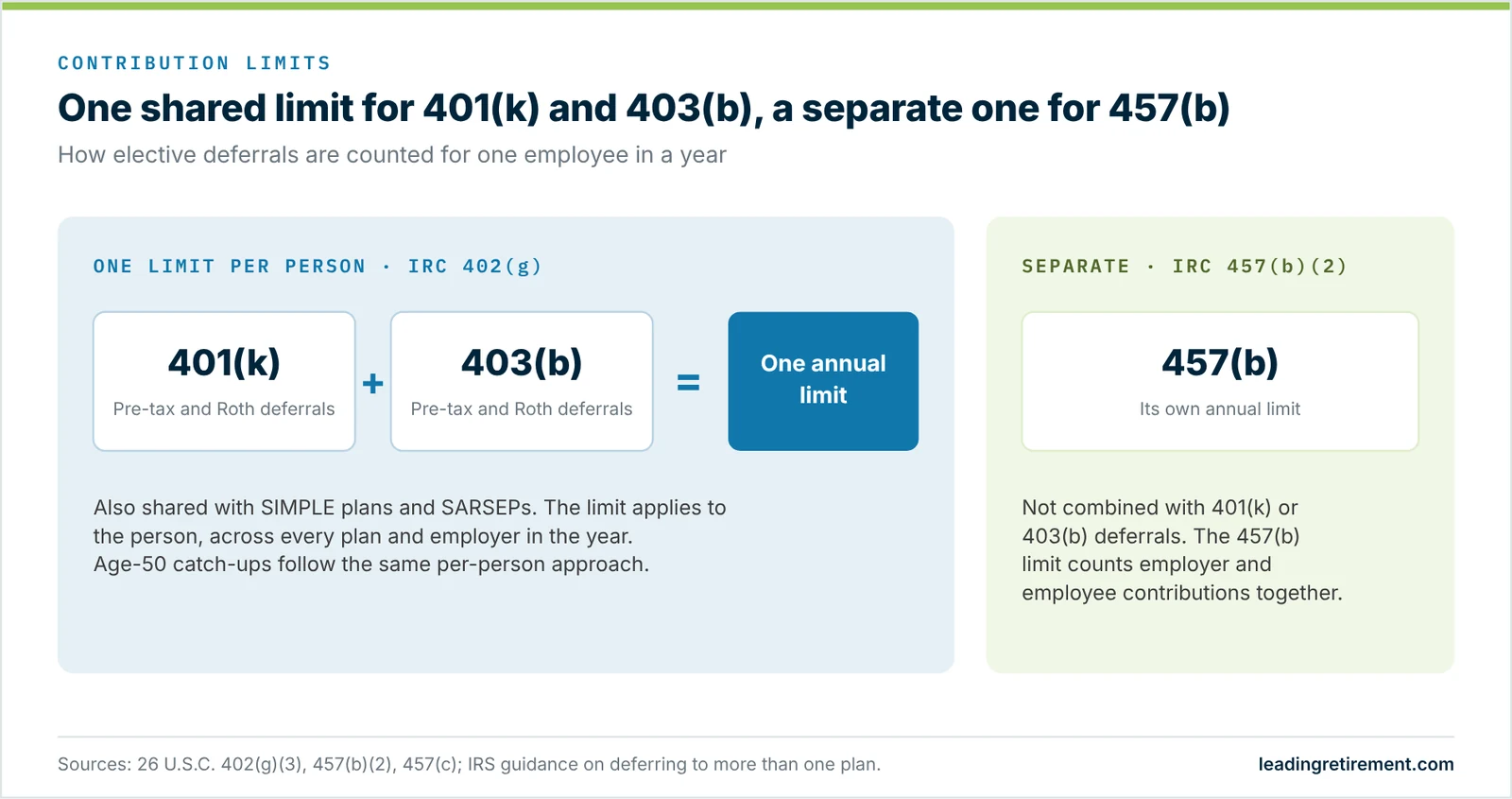
- Deferrals to a 401(k) and a 403(b) count toward one annual limit per person. A 457(b) has its own separate limit.
- 403(b) money is held in annuity contracts or mutual fund custodial accounts. A 401(k) holds its assets in a trust.
- A 403(b) replaces the 401(k) deferral test with a universal availability rule. Employer contributions in most private 403(b) plans are tested much like those in a 401(k).
- A 401(k) sponsored by a private employer is typically covered by ERISA. Governmental plans and many church plans are generally excluded from Title I of ERISA, and so are some salary-deferral-only 403(b) programs.
- 403(b) vs. 401(k) at a Glance
- What the Two Plans Have in Common
- Who Can Offer Each Plan
- Contribution Limits and Catch-Ups
- Investments
- Nondiscrimination Testing
- Eligibility and Automatic Enrollment
- ERISA and Form 5500
- Withdrawals, Loans, and Taxes
- The Plans by the Numbers
- Where the 457(b) Fits
- Offering Both a 403(b) and a 401(k)
- Frequently Asked Questions
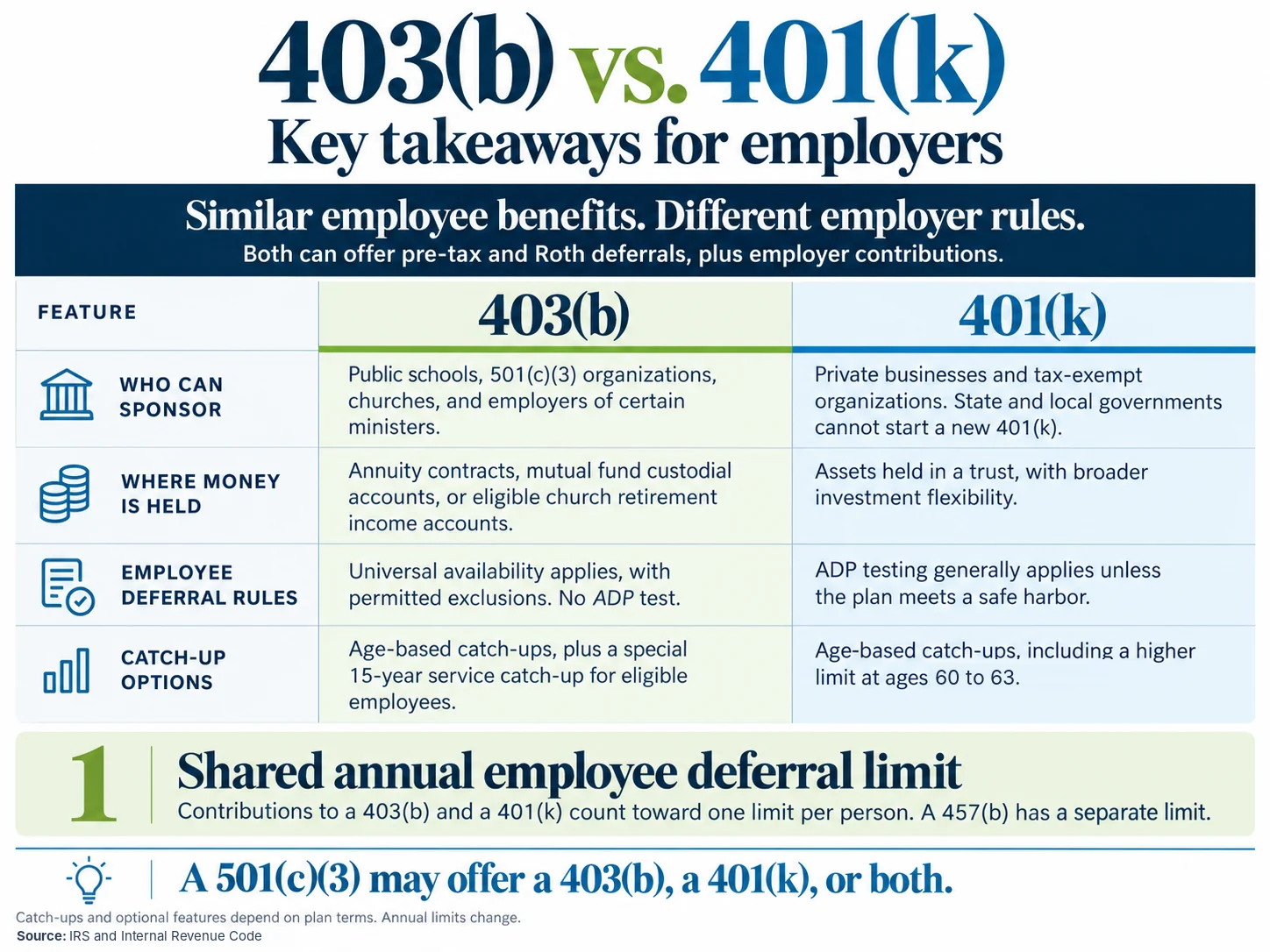
403(b) vs. 401(k) at a Glance
| Feature | 403(b) | 401(k) |
|---|---|---|
| Who may sponsor | Public schools, colleges, and universities; 501(c)(3) organizations; churches; employers of certain ministers1, 4 | Private businesses and tax-exempt organizations. State and local governments only if the plan was adopted before May 6, 19863 |
| Where the money is held | Annuity contracts, mutual fund custodial accounts, or church retirement income accounts1, 4 | A trust3 |
| Employee deferral limit | One per-person limit shared across both plan types, set each year by the IRS6, 7, 8 | |
| Catch-up contributions | Age 50 and over, ages 60 to 63, and a 15-year service catch-up, if the plan allows6, 9 | Age 50 and over and ages 60 to 63, if the plan allows9 |
| Testing of employee deferrals | Universal availability rule; no ADP test4, 11 | ADP test, unless the plan has a Safe Harbor Matching Provision3, 12 |
| Testing of employer contributions | 401(a)(4), 401(m), 410(b), and related rules, except in governmental and church plans2, 4 | 401(a)(4), 401(m), 410(b), and related rules3, 12 |
| ERISA | Depends on the sponsor and design. Governmental plans and many church plans are generally excluded from Title I13, 14 | Typically covered when sponsored by a private employer13 |
| Automatic enrollment for new plans | Required for most plans established after December 29, 2022, for plan years after 2024, with exceptions17 | |
| Loans and hardship withdrawals | Optional in both. Hardship withdrawals follow similar rules2, 18, 21 | |
| 10% additional tax before 59½ | Applies to both unless an exception applies19, 20 | |
Plan features in this table are available only if the plan document provides for them. Annual dollar limits are on the IRS cost-of-living adjustments page and our contribution limits guide.
What the Two Plans Have in Common
The IRS describes a 403(b) as “similar to a 401(k) plan maintained by a for-profit entity.”1 For an employee, the experience is similar. Both plans let employees defer part of their salary before income tax, and both may offer a designated Roth option, with contributions taxed now and qualified distributions paid tax-free later.1, 12 In both, the employer may add matching or nonelective contributions under the plan’s terms, and the same per-person deferral limit applies.7
Payout rules are similar too. Employee deferrals in either plan can be paid after severance from employment, death, disability, age 59½, or a hardship, if the plan allows it. The 10% additional tax on early distributions applies to both, and both are subject to required minimum distributions.3, 4, 20, 26 Most of the differences sit on the employer’s side of the plan.
Who Can Offer Each Plan
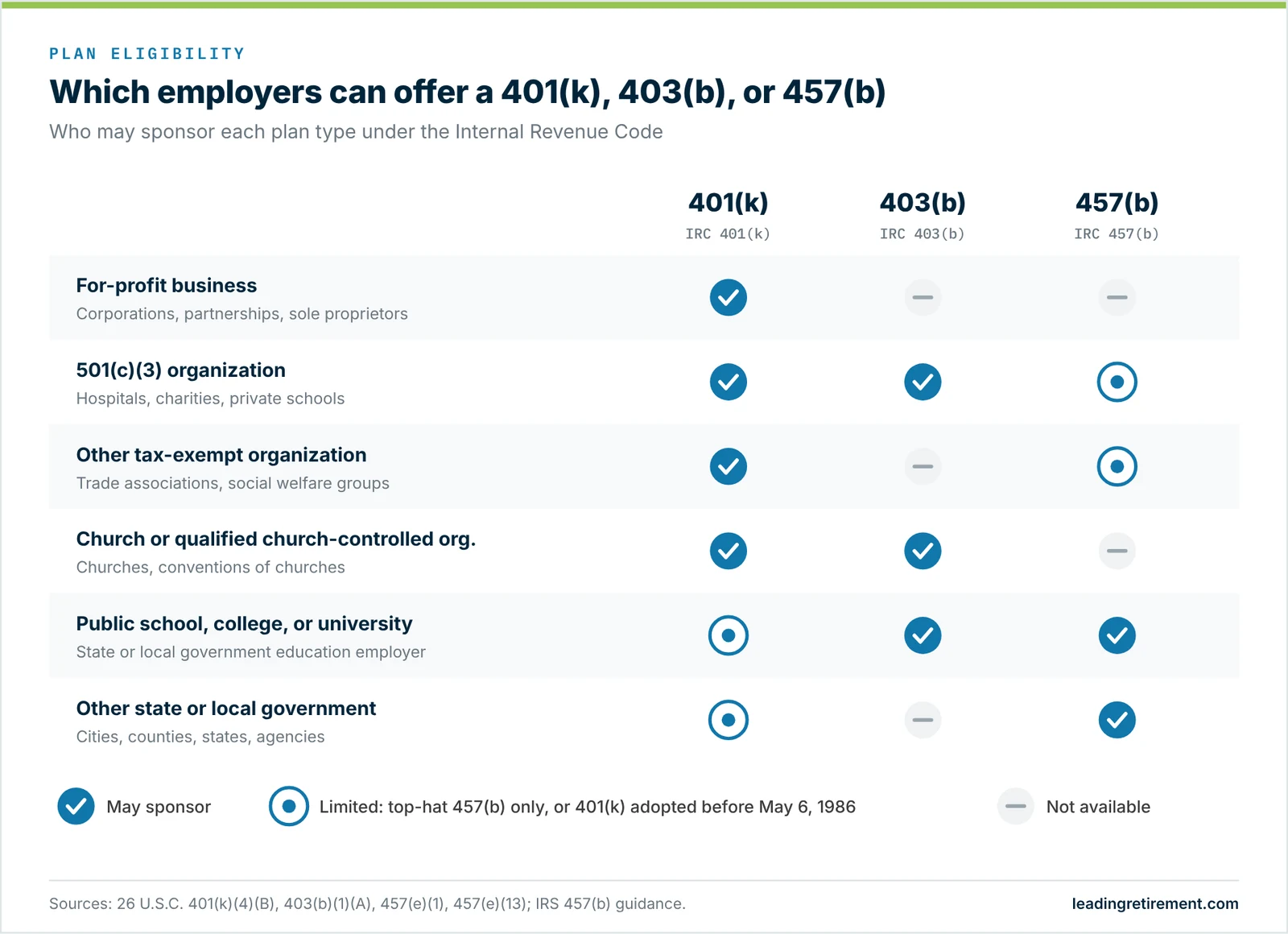
The Internal Revenue Code limits 403(b) sponsorship to three settings: a 501(c)(3) organization, a state or local government employer for employees of a public educational organization, and certain ministers.4 In the IRS’s words, “Only public educational institutions or 501(c)(3) tax-exempt organizations may establish a 403(b) plan,” along with churches.1, 2
A 401(k) is open to more employers. Since plan years beginning after December 31, 1996, “any organization exempt from tax” may include a 401(k) arrangement in its plan, which covers 501(c)(3) organizations and churches as well as other tax-exempt groups.3 State and local governments are the exception. A 401(k) maintained by a government employer is not a qualified arrangement unless it was adopted before May 6, 1986. The IRS notes that governments “can provide similar tax-favored retirement benefits for their employees through a 457(b) plan.”3, 22
Contribution Limits and Catch-Ups
The annual limit on employee deferrals belongs to the person, not the plan. In the IRS’s words, it is “your individual limit each calendar year no matter how many plans you’re in,” and it is aggregated across 401(k), 403(b), SIMPLE, and SARSEP plans.7 An employee who defers to a 403(b) at one job and a 401(k) at another counts both toward the same total. Both limits are adjusted for inflation each year and are listed on the IRS cost-of-living page.8
A second federal limit caps total annual additions, which counts employee deferrals and employer contributions together. Catch-up contributions do not count toward it.2, 28 For a 403(b), that limit is measured against the employee’s includible compensation for the most recent year of service.2
Catch-up contributions
- Age 50 and over. Available in both plans, if the plan allows them.9
- Ages 60 through 63. A higher catch-up limit applies in both plans for employees who turn 60, 61, 62, or 63 during the year, starting in 2025.9, 28
- Roth catch-ups for higher earners. In both plans, participants whose prior-year FICA wages from the employer were above an indexed threshold make catch-ups as Roth contributions. The statute took effect in 2024, the IRS transition period ended December 31, 2025, and the final regulations apply from 2027, with a reasonable, good-faith standard before then. How the requirement applies depends on the plan’s provisions and any required amendments.9, 10, 28
- The 15-year catch-up. Only a 403(b) offers it. An employee with at least 15 years of service with a qualified organization, such as a school, hospital, or church, may defer above the regular limit, subject to annual and lifetime caps, if the plan allows it.6, 7
Investments
A 401(k) holds its assets in a trust, and the Code does not limit it to particular asset types. Investment choices are governed by ERISA’s duties of prudence and diversification.3, 29 Unlike a 401(k), a 403(b) is limited by statute to specified funding arrangements, including annuity contracts, mutual fund custodial accounts, and retirement income accounts for eligible church employees. The IRS describes the first two as “an annuity contract, which is a contract provided through an insurance company,” and “a custodial account, which is an account invested in mutual funds.”1, 4
The SECURE 2.0 Act amended the tax code to allow 403(b) custodial accounts to invest in collective investment trusts, for amounts invested after December 29, 2022.4 The companion changes to federal securities laws have not been enacted, so the tax-code change alone does not make collective investment trusts available as a 403(b) investment option. A bill containing those changes, H.R. 3383, passed the House of Representatives on December 11, 2025, and was referred to the Senate Committee on Banking, Housing, and Urban Affairs on December 15, 2025. As of October 2026, it had not become law.27, 32 Our 403(b) guide charts how that shows up in the asset mix of each plan type.
Nondiscrimination Testing
401(k). Employee deferrals are tested each year under the actual deferral percentage (ADP) test, which compares deferral rates of highly compensated employees with everyone else. Matching and after-tax contributions are tested under the actual contribution percentage (ACP) test.3, 12 A 401(k) plan with a Safe Harbor Matching Provision generally eliminates ADP and ACP testing and often eliminates top-heavy testing, in exchange for a required employer contribution. Safe harbor contributions may be subject to different vesting requirements than other employer contributions.3, 12
403(b). Employee deferrals are not ADP tested. Instead, the universal availability rule applies: if any employee may defer, all employees must be allowed to, apart from a short list of excludable groups in the regulations, which our 403(b) guide covers.4, 11 Employer contributions in a 403(b) that is neither governmental nor a church plan must satisfy rules similar to those a 401(k) follows for them, including sections 401(a)(4), 401(m), and 410(b).2, 4
Our guide to defined contribution plans explains how ADP, ACP, coverage, and top-heavy testing work in a 401(k).
Eligibility and Automatic Enrollment
A 401(k) may require employees to reach age 21 and complete one year of service before joining, and since 2025 it must also open deferrals to long-term, part-time employees with two consecutive years of at least 500 hours.3 In a 403(b), universal availability sets the eligibility rule for deferrals, and ERISA’s long-term, part-time rule extends to ERISA-covered 403(b) plans for plan years beginning after December 31, 2024.4, 11, 30
SECURE 2.0 requires most 401(k) and 403(b) plans established after December 29, 2022 to enroll eligible employees automatically, starting at 3% to 10% of pay and increasing each year, for plan years beginning after December 31, 2024. Plans established before that date, governmental and church plans, employers in existence for less than three years, employers with 10 or fewer employees, and SIMPLE 401(k) plans are excepted.17 These rules remain subject to IRS and Treasury guidance; the regulations were in proposed form as of October 2026.17
ERISA and Form 5500
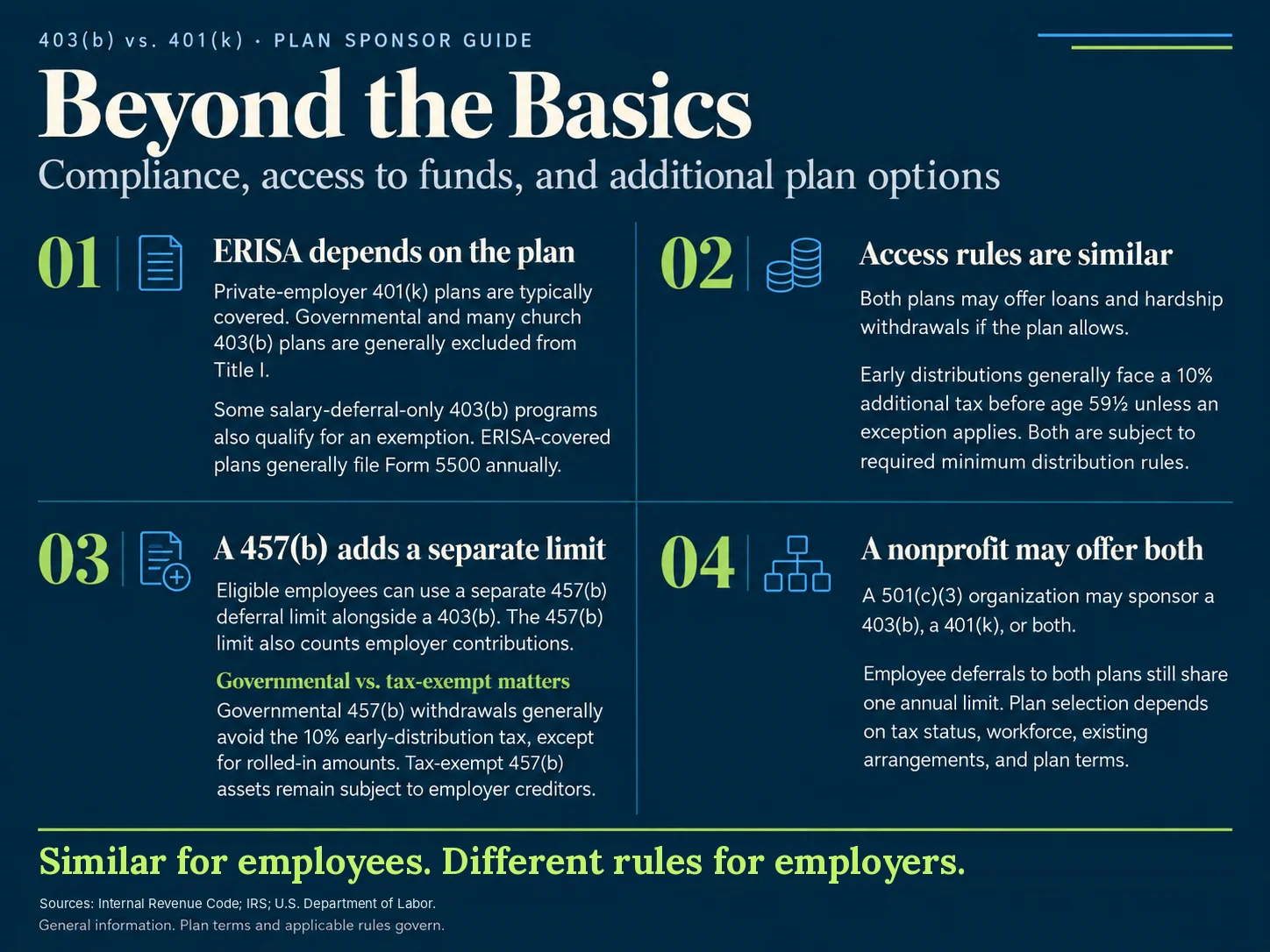
A 401(k) sponsored by a private employer is typically an ERISA plan, with ERISA’s fiduciary, disclosure, and reporting duties. 13 A 403(b) depends on who sponsors it and how it is designed. Governmental plans and many church plans are generally excluded from Title I of ERISA.13 A 403(b) program funded only by employee salary deferrals can also fall outside ERISA, but only if participation is completely voluntary, the employer’s involvement stays within the narrow list of activities in the Department of Labor regulation, and the employer receives no consideration beyond reasonable expense reimbursement.14
ERISA-covered 403(b) plans file Form 5500 each year on a basis similar to 401(k) plans, and large ERISA-covered 403(b) plans have filed audited financial statements since the 2009 plan year.15, 16 Whether a particular plan needs an independent audit depends on its filing classification, participant count, asset characteristics, and satisfaction of applicable waiver conditions. Our Form 5500 filing requirements guide explains the details.
Withdrawals, Loans, and Taxes
Withdrawal rules are similar in the two plans. In a 401(k), deferrals may be paid after severance from employment, death, disability, plan termination, age 59½ in a profit-sharing plan, or hardship.3 In a 403(b), the Code lists age 59½, severance from employment, death, disability, and hardship, and a terminating 403(b) distributes its assets to participants.2, 4 Both plans may, but are not required to, offer hardship withdrawals and loans, and since 2024 a 403(b) may pay hardship withdrawals from earnings and certain employer contributions, as a 401(k) may.2, 4, 21 Benefits are paid when permitted under the plan document and applicable law.
The 10% additional tax applies to early distributions from both plans unless an exception applies, and both are subject to required minimum distributions.20, 26 Our guide to 401(k) withdrawal rules covers hardship reasons, the rule of 55, and the full list of exceptions.
The Plans by the Numbers
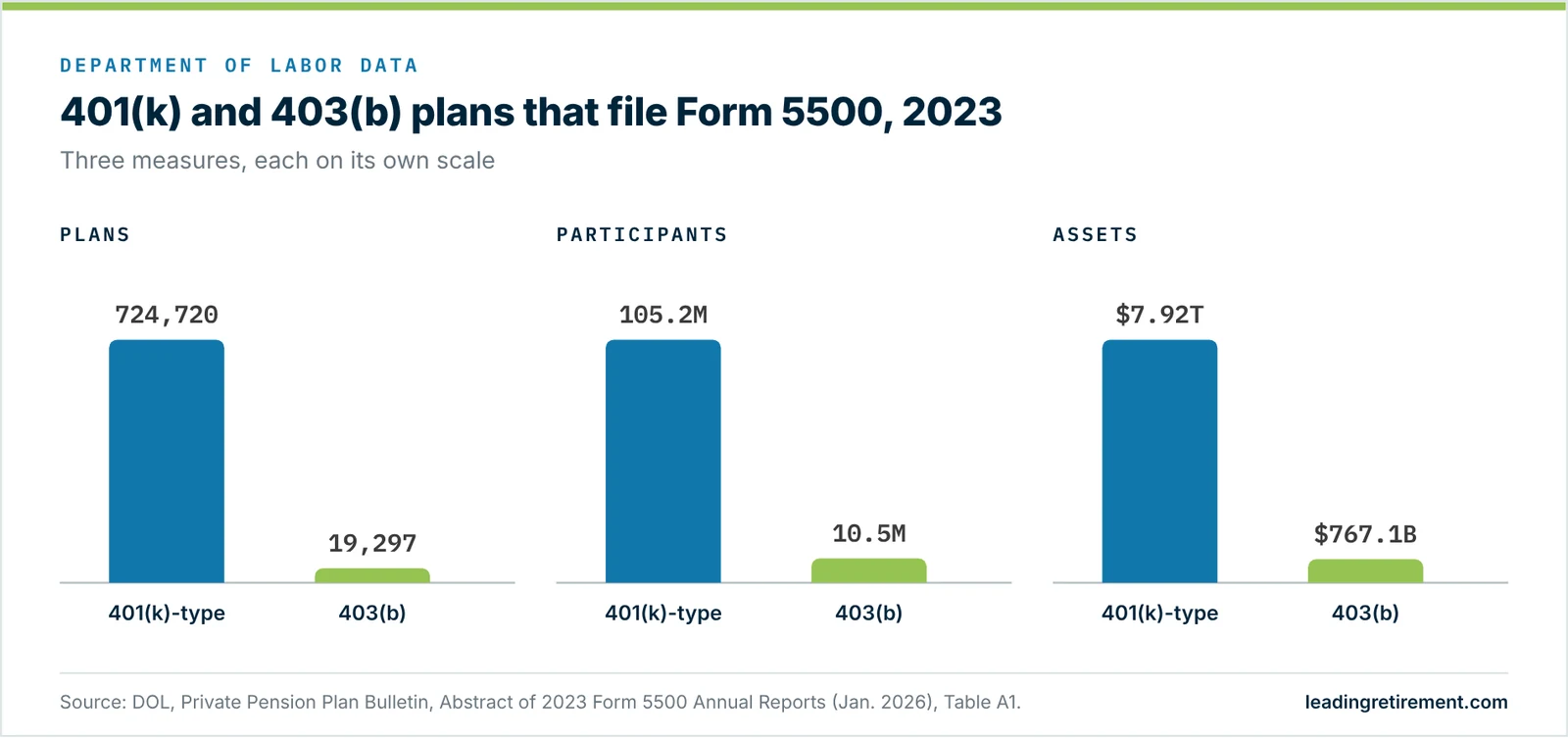
Department of Labor data shows how differently the two plan types are used. For 2023, 724,720 401(k)-type plans and 19,297 403(b) plans filed Form 5500. The 403(b) plans covered about 10.5 million participants and held about $767 billion.24 Those 403(b) figures leave out governmental and non-electing church plans, which do not file, so they understate the total.
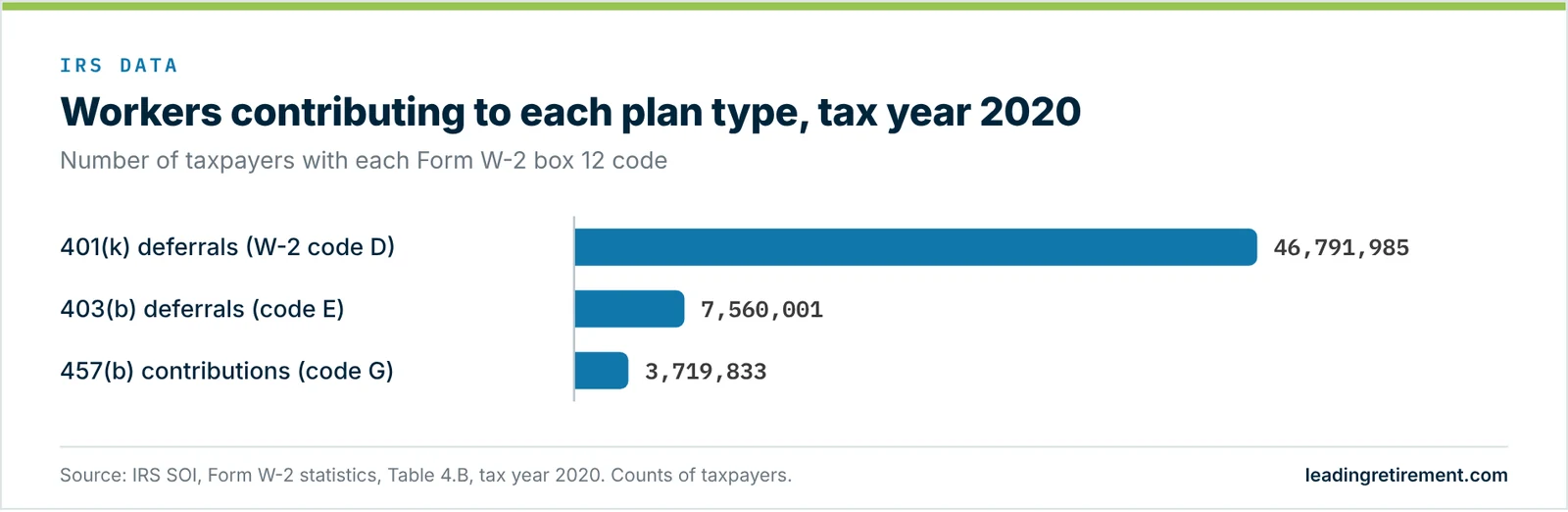
IRS wage data gives a broader count that includes public employers. For tax year 2020, about 7.6 million workers had 403(b) deferrals on their Form W-2, compared with about 46.8 million with 401(k) deferrals and about 3.7 million with 457(b) contributions.25
Where the 457(b) Fits
Public schools, hospitals, and some nonprofits offer a 457(b) alongside a 403(b), which is why “403(b) vs. 457(b)” is a common comparison. A 457(b) can be sponsored by a state or local government or by a tax-exempt organization, but not by a church or a qualified church-controlled organization.5 A tax-exempt organization’s 457(b) must be unfunded and, in practice, limited to “a select group of management or highly compensated employees.”23
| Feature | 403(b) | Governmental 457(b) |
|---|---|---|
| Deferral limit | Shared with 401(k) and other plans | Separate limit, which also counts employer contributions7, 31 |
| Special catch-up | 15-year service catch-up | Catch-up in the three years before normal retirement age, in place of the age-50 catch-up if larger5, 7 |
| In-service events | Age 59½, hardship | Age 59½, unforeseeable emergency5 |
| 10% additional tax | Applies before 59½ unless an exception applies | Does not apply, except to amounts rolled in from other plans or IRAs19, 20 |
| Nondiscrimination testing | Universal availability; employer contributions tested in most private plans | No coverage or nondiscrimination testing22 |
| ERISA | Depends on the sponsor and design | Not covered (governmental plan)13 |
Because the 457(b) limit is separate, an employee eligible for both a 403(b) and a 457(b) may defer up to the full limit in each, if both plans allow it.7 A tax-exempt organization’s 457(b) follows different rules. Its assets remain subject to the employer’s general creditors, it cannot be rolled over to other plans, and it does not permit age-50 catch-ups or loans.23, 31
Offering Both a 403(b) and a 401(k)
A 501(c)(3) organization may maintain both plans. The 403(b) statute lets the employer exclude from universal availability any employee who participates in the organization’s 401(k), and the IRS lists employees who participate in “a 401(k) or 457(b) plan or in another 403(b) plan of the employer” among those who may be excluded.1, 4, 11 Department of Labor statistics count a small number of plans that show both 401(k) and 403(b) characteristics.24 Employees in both plans still share one deferral limit.7
How each plan applies to a given organization depends on its tax status, its workforce, its existing arrangements, and the terms of its plan documents. These are questions an organization typically reviews with its plan administrator and legal counsel.
Leading Retirement Solutions supports 401(k), 403(b), defined benefit, cash balance, money purchase, and church plans, as well as multiple employer and pooled employer plans. Our plan administration team provides ongoing administration and compliance support for both 401(k) and 403(b) plans and helps plan sponsors coordinate with their recordkeepers and payroll providers. Request a proposal to talk through your plan.
The answers below summarize general rules for educational purposes. How they apply to a particular plan depends on the plan document and the plan’s facts.
Frequently Asked Questions
What is the main difference between a 403(b) and a 401(k)?
The biggest difference is who can offer each plan. A 403(b) is limited to public schools, 501(c)(3) organizations, churches, and employers of certain ministers, while a 401(k) is open to private businesses and tax-exempt organizations. The plans also differ in how money is invested, how deferrals are tested, and whether ERISA applies.1, 3, 4
Is a 403(b) the same as a 401(k)?
No, but the two are similar. The IRS describes a 403(b) as “similar to a 401(k) plan maintained by a for-profit entity,” with pre-tax and Roth deferrals under the same shared limit.1, 7
Can a nonprofit offer a 401(k)?
In many cases, yes. Since plan years beginning after December 31, 1996, any tax-exempt organization may include a 401(k) arrangement in its plan. State and local governments are the exception.3
Can I contribute to both a 401(k) and a 403(b)?
In many cases, yes, if both plans allow it, but deferrals to both count toward one annual limit per person.7
Can I contribute to a 403(b) and a 457(b) at the same time?
In many cases, yes. A 457(b) has a separate limit that is not combined with 403(b) deferrals, so an eligible employee may defer up to the full limit in each, if both plans allow it.7
Do 403(b) plans have nondiscrimination testing?
Employee deferrals in a 403(b) are not ADP tested; they follow the universal availability rule. Employer contributions in 403(b) plans other than governmental and church plans are tested under rules similar to those for a 401(k).2, 4
What is a 403(b) loan?
A loan from the participant’s own 403(b) account, repaid with interest under the plan’s terms and the limits in section 72(p) of the Code. A 403(b) plan “may, but is not required to, allow loans.”2, 21
Do new 403(b) plans have to auto-enroll employees?
Most new 403(b) and 401(k) plans established after December 29, 2022 must, for plan years after 2024. Governmental and church plans, new and small employers, and plans established before that date are excepted. The rules remain subject to IRS and Treasury guidance, which was in proposed form as of October 2026.17
Does the 10% early withdrawal tax apply to a 457(b)?
Not to a governmental 457(b), except for amounts attributable to rollovers from another type of plan or an IRA. It does apply to 401(k) and 403(b) plans.19, 20
Related Reading
- What is a 403(b) plan and how does it work, the full guide to 403(b) rules.
- 401(k) withdrawal rules, on hardship withdrawals and the 10% additional tax.
- Safe harbor plans, on 401(k) plans with a Safe Harbor Matching Provision.
- Form 5500 filing requirements, on annual reporting for ERISA plans.
- 2026 contribution limits, for current dollar limits.
Sources
Every substantive statement above is drawn from the following primary sources. Numbers in the text refer to this list. Links were verified at the time of writing.
- IRSIRC 403(b) tax-sheltered annuity plans. Last reviewed January 30, 2026. Link
- IRSRetirement plans FAQs regarding 403(b) tax-sheltered annuity plans. Last reviewed August 10, 2026. Link
- U.S. Code26 U.S.C. 401, including subsections (a)(9), (k)(2), (k)(3), (k)(4)(B), (k)(12), and (m), with the Pub. L. 99-514 and Pub. L. 104-188 notes. Official GPO edition. Link
- U.S. Code26 U.S.C. 403, including subsections (b)(1), (b)(7), (b)(9), (b)(11), (b)(12), and (b)(17), with SECURE 2.0 notes. Official GPO edition. Link
- U.S. Code26 U.S.C. 457, including subsections (b), (c), (d), (e)(1), and (e)(13). Official GPO edition. Link
- U.S. Code26 U.S.C. 402(g), Limitation on exclusion for elective deferrals, including (g)(3) and (g)(7). Official GPO edition. Link
- IRSHow much salary can you defer if you’re eligible for more than one retirement plan? Last reviewed February 26, 2026. Link
- IRSCOLA increases for dollar limitations on benefits and contributions. Last reviewed August 24, 2026. Link
- IRSRetirement topics: Catch-up contributions. Last reviewed May 7, 2026. Link
- Federal RegisterCatch-Up Contributions, final regulations, T.D. 10033, 90 FR 44527, September 16, 2025. Link
- eCFR26 CFR 1.403(b)-5, Nondiscrimination rules, paragraph (b), universal availability. Link
- IRS401(k) plan overview. Last reviewed August 4, 2026. Link
- U.S. Code29 U.S.C. 1003, ERISA section 4, Coverage. Official GPO edition. Link
- eCFR29 CFR 2510.3-2(f), Tax sheltered annuities (Department of Labor safe harbor). Link
- U.S. Department of Labor2025 Instructions for Form 5500. Link
- U.S. Department of LaborField Assistance Bulletin No. 2009-02, Annual reporting requirements for 403(b) plans, July 20, 2009. Link
- U.S. Code and Federal Register26 U.S.C. 414A, Requirements related to automatic enrollment; and Automatic Enrollment Requirements Under Section 414A, proposed rule, January 14, 2025. Link
- eCFR26 CFR 1.401(k)-1(d)(3), Hardship distributions. Link
- U.S. Code26 U.S.C. 72(t), 10-percent additional tax on early distributions, including (t)(9). Official GPO edition. Link
- IRSRetirement topics: Exceptions to tax on early distributions. Last reviewed December 11, 2025. Link
- IRSRetirement plans FAQs regarding loans. Last reviewed February 26, 2026. Link
- IRS457(b) plans for state or local governments: Key characteristics. Last reviewed February 26, 2026. Link
- IRSNon-governmental 457(b) deferred compensation plans. Last reviewed August 4, 2026. Link
- U.S. Department of LaborPrivate Pension Plan Bulletin, Abstract of 2023 Form 5500 Annual Reports, Tables A1 and D1. January 2026. Link
- IRS Statistics of IncomeIndividual information return Form W-2 statistics, Table 4.B, tax year 2020. Link
- IRSRetirement topics: Required minimum distributions (RMDs). Last reviewed April 8, 2026. Link
- U.S. House of RepresentativesH.R. 3383, INVEST Act of 2025, as passed by the House, December 11, 2025, section 202. Link
- U.S. Code26 U.S.C. 414(v), Catch-up contributions, including (v)(2)(B), (v)(3), and (v)(7). Official GPO edition. Link
- U.S. Code29 U.S.C. 1104, ERISA section 404, Fiduciary duties. Official GPO edition. Link
- U.S. Code29 U.S.C. 1052(c), ERISA section 202(c), long-term part-time employees. Official GPO edition. Link
- IRSComparison of tax-exempt 457(b) plans and governmental 457(b) plans. Last reviewed August 1, 2026. Link
- Congress.govH.R. 3383, Incentivizing New Ventures and Economic Strength Through Capital Formation Act of 2025, all actions. Latest action December 15, 2025: received in the Senate and referred to the Committee on Banking, Housing, and Urban Affairs. Checked October 23, 2026. Link
About Leading Retirement Solutions. Leading Retirement Solutions is an independent, women-owned third-party administrator based in Seattle that provides plan design analysis, administration, and compliance support to employers in all 50 states.
Provided for general information only and not legal, tax, or investment advice. How these rules apply to a particular plan depends on the plan document and the plan’s facts. Dollar limits change each year; see the IRS pages linked above for current figures. For questions about a specific situation, consult a tax professional or legal counsel.