Plan Sponsor Guide · Updated October 2026
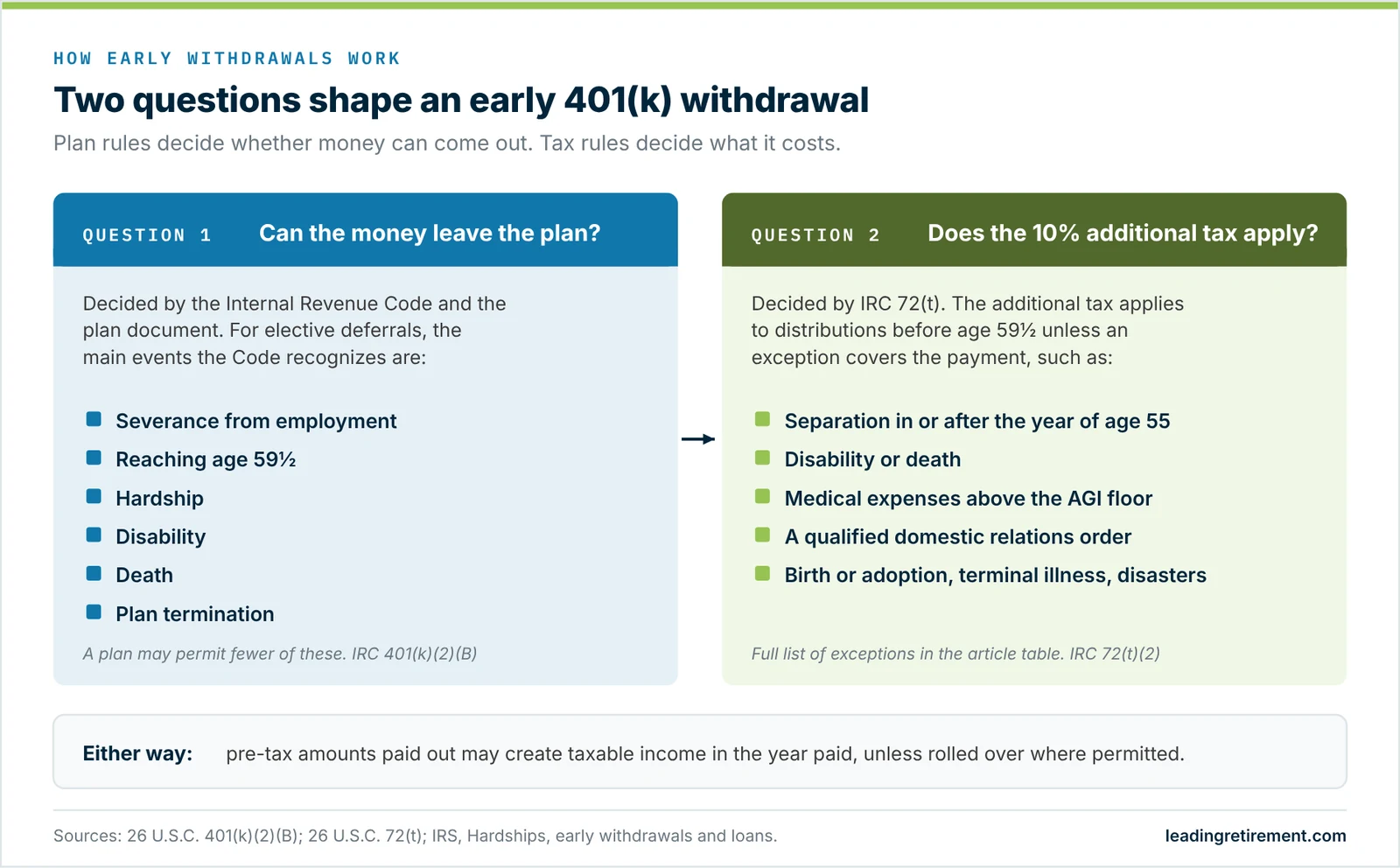
Elective deferrals generally may be distributed only following an event permitted by the Code and included in the plan’s terms, including leaving the employer, reaching age 59½, disability, death, plan termination, or a hardship. A separate tax rule then decides whether a payment before age 59½ carries a 10% additional tax or fits an exception.1, 2, 6
- Two separate rule sets generally must be considered when evaluating an early 401(k) distribution. Plan and Code rules decide whether money can leave the plan. Section 72(t) decides whether the 10% additional tax applies.
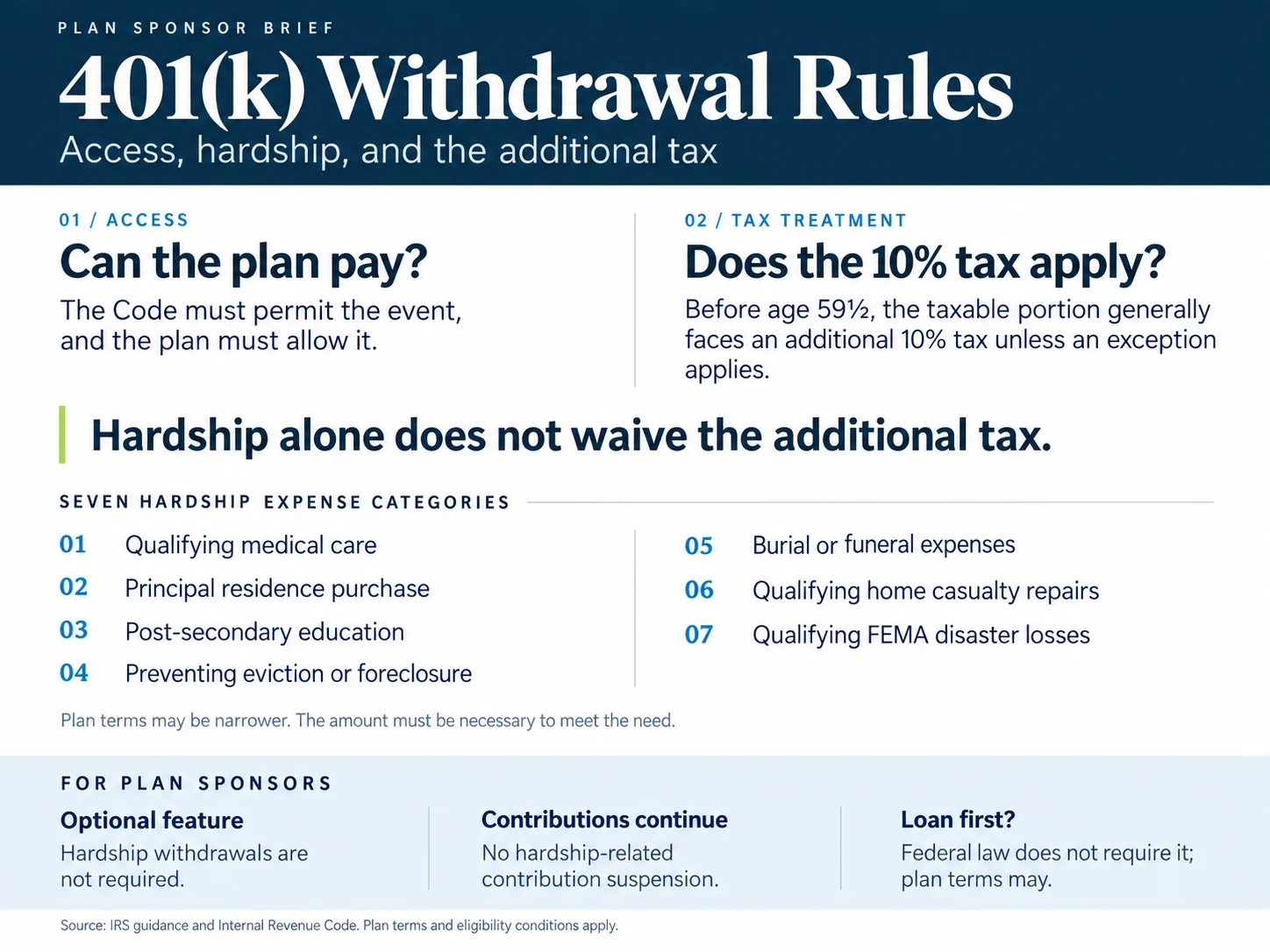
- Hardship withdrawals are optional. A plan that offers them sets its own objective standards, and many use the seven expenses the Treasury regulation treats as an immediate and heavy financial need.
- A plan may not stop an employee’s contributions after a hardship withdrawal made on or after January 1, 2020, and since the 2019 plan year, taking a plan loan first has been a plan choice rather than a federal requirement.
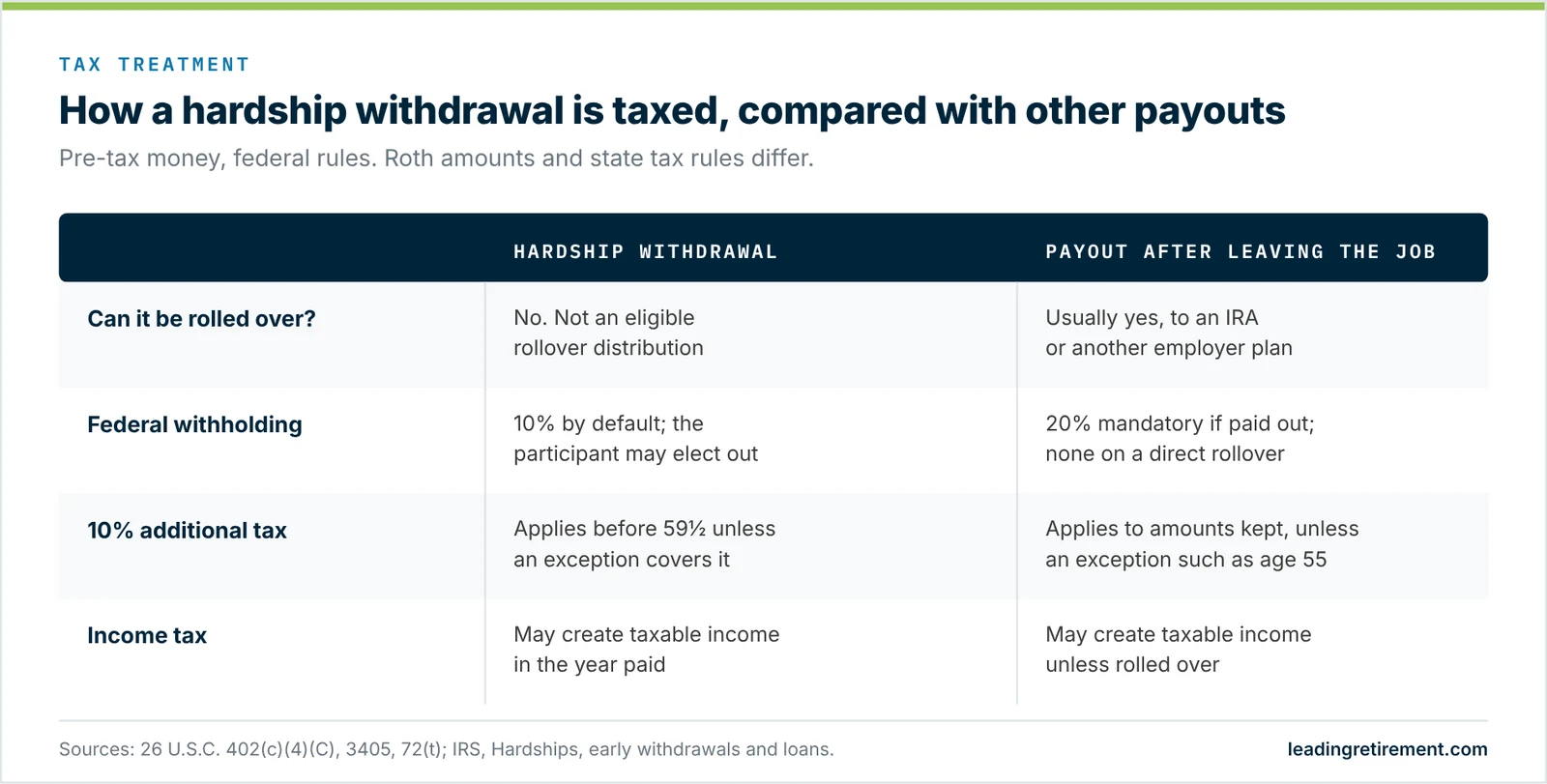
- A hardship withdrawal is not itself an exception to the 10% additional tax, and it cannot be rolled over.
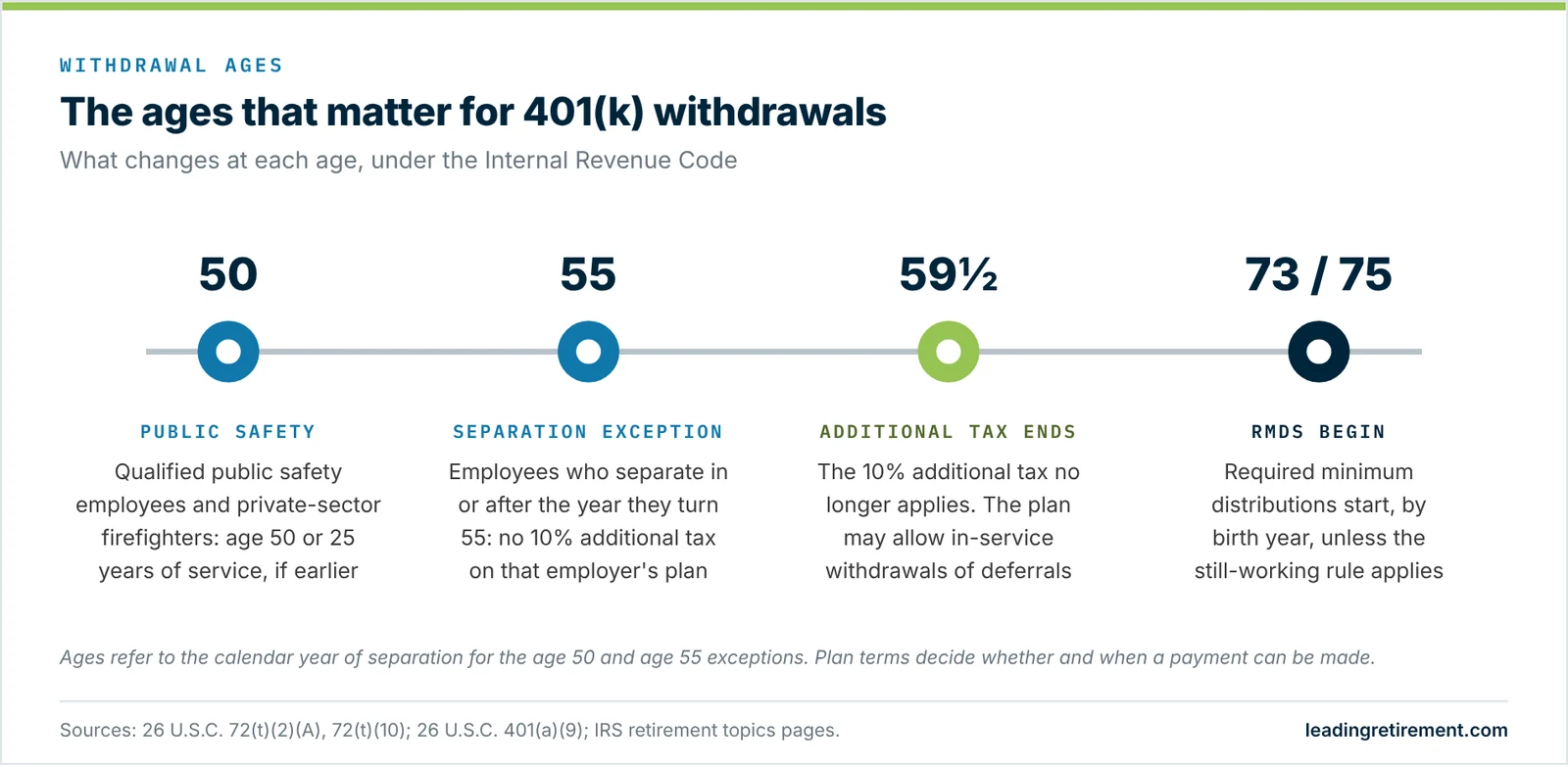
- The “rule of 55” is an exception to the additional tax for qualifying distributions from the employer plan after the participant separates from service in or after the calendar year he or she reaches age 55. It does not apply to distributions from an IRA.
- The Two Questions Behind an Early 401(k) Withdrawal
- When a 401(k) Plan Can Pay Out
- Hardship Withdrawals
- SECURE Act and SECURE 2.0 Withdrawal Options
- The 10% Additional Tax on Early Withdrawals
- The Rule of 55
- Substantially Equal Periodic Payments (72(t) Payments)
- Age 59½ and In-Service Withdrawals
- How a 401(k) Withdrawal Is Processed and Taxed
- Required Minimum Distributions
- What Plan Sponsors Are Responsible For
- Frequently Asked Questions
The Two Questions Behind an Early 401(k) Withdrawal
When an employee asks to take money out of a 401(k) before retirement, two separate sets of rules are considered.
The first is whether the plan may pay the money at all. For elective deferrals, section 401(k)(2)(B) of the Internal Revenue Code lists the events that allow a distribution, and the plan document decides which of those events the plan recognizes.1, 2 The second is what the payment costs in tax. Pre-tax money that is paid out may create taxable income for the participant, and section 72(t) adds a 10% additional tax to the taxable part of a distribution made before age 59½ unless an exception applies.6, 7
The two questions are answered separately. An exception to the additional tax, such as the rule of 55, does not by itself allow a plan to make a payment. A permitted payment, such as a hardship withdrawal, does not by itself avoid the additional tax.
When a 401(k) Plan Can Pay Out
Under the Code and the Treasury regulation, amounts attributable to elective deferrals may not be distributed before one of these events:1, 2
- the employee’s severance from employment, death, or disability;
- in a profit-sharing or stock bonus plan, reaching age 59½;
- in a profit-sharing or stock bonus plan, the employee’s hardship;
- termination of the plan without a successor defined contribution plan, paid as a lump sum; and
- for a qualified reservist, the date the reservist is ordered or called to active duty for the required period.
The regulation adds that deferrals may not be paid “on account of any event not described” in that list, “such as completion of a stated period of plan participation or the lapse of a fixed number of years.”2 Severance from employment means the employee “ceases to be an employee of the employer maintaining the plan.”2
The Code also treats certain SECURE Act and SECURE 2.0 distributions, covered below, as meeting these restrictions when a plan offers them.6, 9 Within those limits, a plan may permit fewer events, and the IRS notes that a plan “may, but is not required to, provide for hardship distributions.”3 Which withdrawals an employee can actually take depends on the plan document and the summary plan description. Employer contributions that are not deferrals, such as a regular match or profit-sharing contribution, can follow broader in-service rules if the plan defines them, which the IRS describes in its hardship issue snapshot.4
When a plan pays deferrals before a permitted event, the regulation treats it as having a nonqualified cash or deferred arrangement, and the IRS treats a distribution the plan does not allow as an operational failure that needs correction.2, 19
Hardship Withdrawals
A hardship withdrawal is a distribution made because of an employee’s financial hardship. If a 401(k) plan offers one, the Treasury regulation applies two tests: the distribution must be made on account of “an immediate and heavy financial need,” and it must be “necessary to satisfy the financial need.” Both determinations must follow “nondiscriminatory and objective standards set forth in the plan.”2
What counts as an immediate and heavy financial need
The regulation says the need is judged on “all the relevant facts and circumstances.” Funeral expenses for a family member would typically qualify; buying a boat or a television would typically not. A need can still qualify “even if it was reasonably foreseeable or voluntarily incurred.”2
To give plans a clear standard, the regulation lists seven expenses that are deemed to be an immediate and heavy financial need:2
medical care that would be deductible under section 213(d), for the employee, a spouse, dependents, or a primary beneficiary under the plan;
costs directly related to buying the employee’s principal residence, not including mortgage payments;
tuition, related fees, and room and board for up to the next 12 months of post-secondary education for the employee, a spouse, children, dependents, or a primary beneficiary;
payments needed to prevent eviction from the principal residence or foreclosure on its mortgage;
burial or funeral expenses for a deceased parent, spouse, child, dependent, or primary beneficiary;
repairs to damage to the principal residence that would qualify for the casualty loss deduction; and
expenses and losses, including lost income, from a disaster declared by FEMA, if the employee’s principal residence or principal place of work was in the area designated for individual assistance.
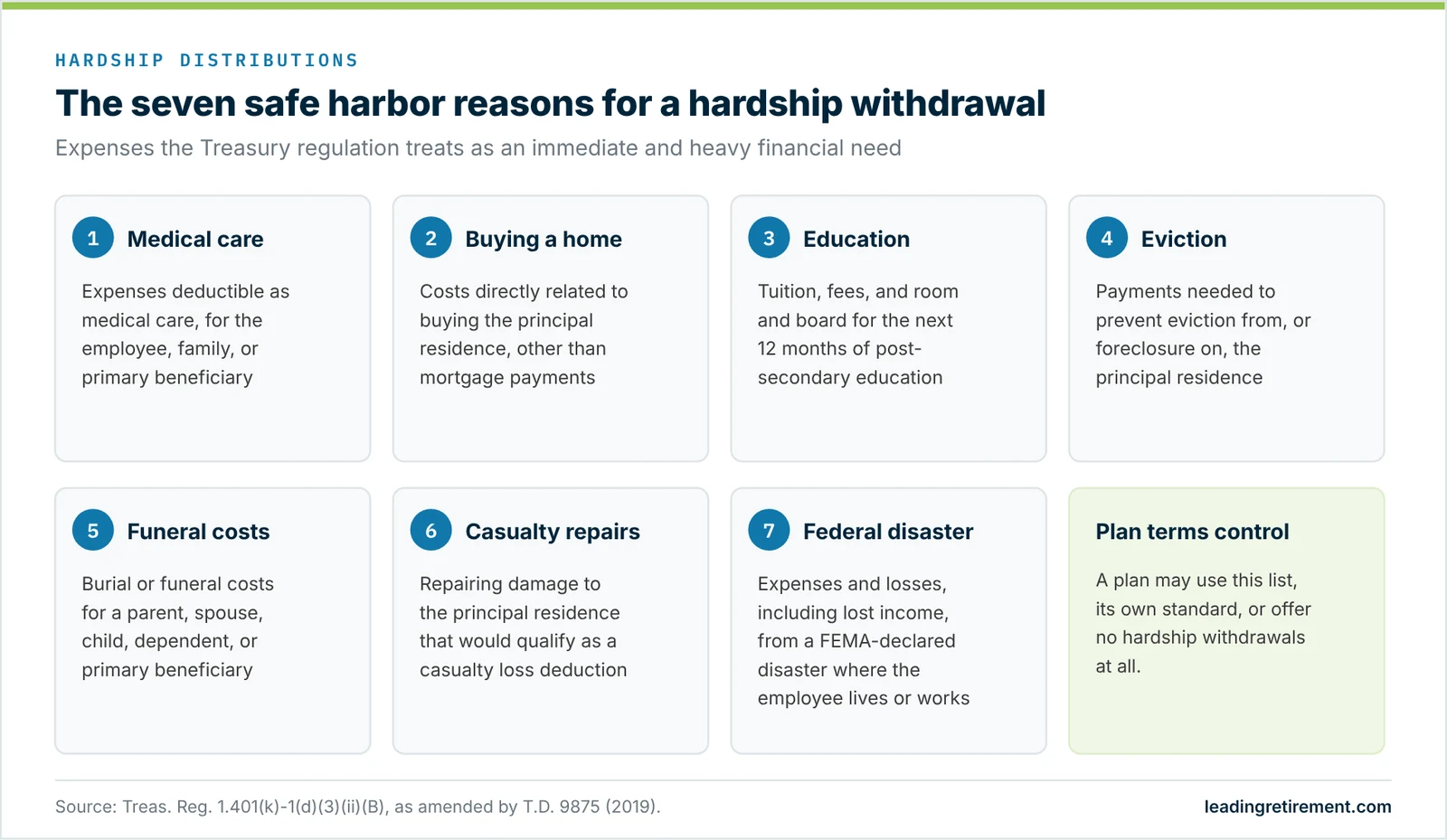
The seventh category, federally declared disasters, was added by the 2019 final regulations.2, 5 A plan can also use a shorter list. The IRS gives the example of a plan that allows hardship withdrawals for medical or funeral expenses but not for a home purchase or tuition.3
When a withdrawal is “necessary”
The amount withdrawn cannot exceed the need, although it may include the federal, state, or local income taxes and penalties reasonably expected to result from the distribution.2 In addition, the regulation requires that:2
- the employee has taken all other currently available distributions under the employer’s plans, other than hardship distributions;
- the employee represents in writing, which can be electronic, that he or she has insufficient cash or other liquid assets reasonably available to meet the need; and
- the plan administrator does not have actual knowledge that contradicts that representation.
What changed in 2019 and 2020
The Bipartisan Budget Act of 2018 led to final regulations, published in September 2019, that changed how hardship withdrawals work.5 Three changes matter most to sponsors:
- No contribution suspension. For distributions made on or after January 1, 2020, a plan may not suspend an employee’s elective or employee contributions as a condition of a hardship withdrawal.2, 3
- Loans first is optional. Federal law no longer requires an employee to take an available plan loan before a hardship withdrawal. A plan may still choose to require one.1, 2, 3
- More money sources. Plans may allow hardship withdrawals from elective deferrals, qualified nonelective and qualified matching contributions, safe harbor contributions, and earnings on those amounts. A plan may limit which of these sources are available.3, 5
Some older plan documents, forms, and payroll procedures still reflect the pre-2020 rules, including the six-month stop on contributions.2, 19
Employee self-certification under SECURE 2.0
SECURE 2.0 permits a plan administrator to rely on the employee certifications described in the statute, subject to the statutory conditions and any later IRS or Treasury guidance. Under section 312, the certification covers that the distribution is for a deemed hardship expense, is not more than the amount needed, and that the employee has no other reasonably available means to meet the need, for plan years beginning after December 29, 2022.1 As of October 2026, final implementing regulations had not been issued. Plan sponsors should coordinate the certification process with their document provider, recordkeeper, and legal counsel.
Documentation and frequency
The IRS tells sponsors to keep “a record of all information used to determine whether a participant was eligible for a hardship distribution and the amount distributed was the amount necessary to alleviate the hardship.”19 On examination, IRS agents are directed to review the plan document, the hardship forms and signatures, the records used to establish the hardship and its amount, the employee’s written representation, and the Form 1099-R reporting.4
Neither the Code nor the regulation sets a maximum number of hardship withdrawals. Each request has to meet the plan’s standards on its own facts. The IRS lists patterns it treats as warning signs, including many requests from one group, requests from different employees that look identical, and hardship withdrawals taken only by highly compensated employees.19
SECURE Act and SECURE 2.0 Withdrawal Options
The SECURE Act of 2019 and the SECURE 2.0 Act of 2022 added several kinds of distribution that a plan may choose to offer. Each is exempt from the 10% additional tax, although the distribution may still create taxable income, apart from Roth amounts.6, 9, 10, 11, 12 The IRS has confirmed in its guidance that each of these features is optional for the plan.9, 10, 11, 12
| Distribution type | Key conditions |
|---|---|
| Emergency personal expense IRC 72(t)(2)(I) |
For “unforeseeable or immediate financial needs relating to necessary personal or family emergency expenses.” One per calendar year, up to the lesser of $1,000 or the vested balance above $1,000. The IRS notes the $1,000 is not indexed for inflation. The administrator may rely on the employee’s written certification.6, 9 |
| Domestic abuse victim IRC 72(t)(2)(K) |
Within one year of abuse by a spouse or domestic partner, up to the lesser of an inflation-adjusted dollar limit or 50% of the vested balance. The current limit is in the IRS’s annual cost-of-living notice. Not available from plans subject to the qualified joint and survivor annuity rules.6, 9, 13 |
| Qualified disaster recovery IRC 72(t)(2)(M), (t)(11) |
Up to $22,000 per federally declared major disaster for an individual whose principal residence was in the disaster area and who sustained an economic loss. Income may be spread over three years.6 |
| Birth or adoption IRC 72(t)(2)(H) |
Up to $5,000 per child, taken within one year of the birth or finalized adoption. Each parent may take one for the same child.6, 11 |
| Terminal illness IRC 72(t)(2)(L) |
For an employee certified by a physician as terminally ill. This is an exception to the additional tax only. The IRS states it does not create a new distributable event, so the employee must already qualify for a payment, such as a hardship or disability distribution.6, 10 |
| Long-term care premiums IRC 72(t)(2)(N) |
For premiums on certified long-term care insurance, up to an inflation-adjusted annual limit, for distributions made after December 29, 2025. The statute does not provide the three-year repayment treatment available for certain other SECURE Act and SECURE 2.0 distributions.12, 13 |
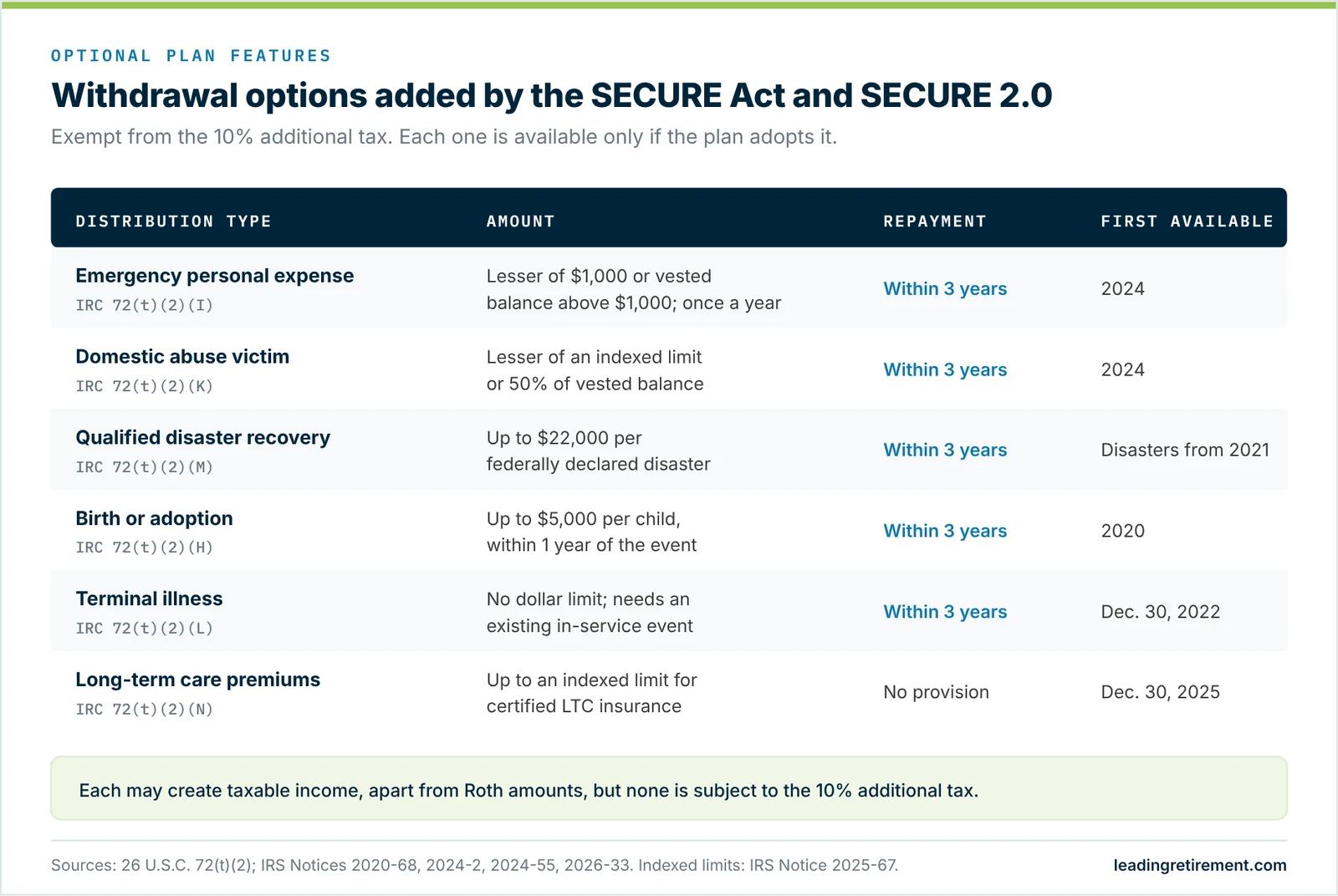
Most of these distributions may be repaid to the plan within three years. Emergency personal expense, domestic abuse victim, birth or adoption, and qualified disaster recovery distributions are not eligible rollover distributions, so the mandatory 20% withholding on rollover-eligible payments does not apply to them.6, 9 December 31, 2026 generally applies to certain SECURE Act and SECURE 2.0 amendments for applicable nongovernmental plans under IRS guidance. However, amendment deadlines vary based on the provision, plan type, and whether an amendment is required or discretionary, and later deadlines may apply; for example, IRS Notice 2026-33 set December 31, 2027 for the long-term care feature. Plan sponsors should confirm the applicable amendment requirements and deadlines with their document provider or legal counsel.10, 12 How each feature applies to a particular plan depends on the plan’s provisions and any required amendments.
Several SECURE 2.0 provisions described here remain subject to applicable IRS and Treasury guidance, and some have not yet been addressed by regulations. Fixed dollar amounts in this section reflect federal law and IRS guidance available as of October 2026. Inflation-indexed limits may change annually, and whether a plan offers any of these distributions depends on the plan’s terms.
The 10% Additional Tax on Early Withdrawals
Section 72(t) increases the tax on a distribution from a qualified retirement plan by “10 percent of the portion of such amount which is includible in gross income.”6 In the IRS’s words, amounts withdrawn before age 59½ are “called ‘early’ or ‘premature’ distributions,” and the additional tax applies “unless an exception applies.”7 The IRS calls it an additional tax; many consumer sources call it the early withdrawal penalty.
Hardship is not one of the exceptions. A hardship withdrawal before 59½ avoids the additional tax only if it also fits a separate exception, such as the exception for unreimbursed medical expenses above the adjusted gross income threshold.3, 7
When the 10% additional tax does not apply
| Exception | 401(k) and other qualified plans | IRAs | Code section |
|---|---|---|---|
| Age 59½ or older | Yes | Yes | 72(t)(2)(A)(i) |
| Separation from service in or after the year of age 55 (age 50 or 25 years of service for qualified public safety employees and private-sector firefighters) | Yes | No | 72(t)(2)(A)(v), (t)(10) |
| Death | Yes | Yes | 72(t)(2)(A)(ii) |
| Total and permanent disability | Yes | Yes | 72(t)(2)(A)(iii) |
| Substantially equal periodic payments (in a plan, only after separation from service) | Yes | Yes | 72(t)(2)(A)(iv), (t)(3)(B) |
| Unreimbursed medical expenses above 7.5% of AGI | Yes | Yes | 72(t)(2)(B) |
| Qualified domestic relations order, to an alternate payee | Yes | n/a | 72(t)(2)(C) |
| IRS levy on the plan | Yes | Yes | 72(t)(2)(A)(vii) |
| Qualified reservist called to active duty | Yes | Yes | 72(t)(2)(G) |
| Birth or adoption | Yes | Yes | 72(t)(2)(H) |
| Emergency personal expense | Yes | Yes | 72(t)(2)(I) |
| Domestic abuse victim | Yes | Yes | 72(t)(2)(K) |
| Terminal illness | Yes | Yes | 72(t)(2)(L) |
| Qualified disaster recovery | Yes | Yes | 72(t)(2)(M) |
| Long-term care insurance premiums | Yes | n/a | 72(t)(2)(N) |
| Timely corrective distributions of excess contributions or deferrals | Yes | n/a | 401(k)(8)(D), 401(m)(7)(A), 402(g)(2)(C) |
| Permissible withdrawal from an automatic enrollment arrangement | Yes | Some | 414(w)(1)(B) |
| ESOP dividend pass-through | Yes | n/a | 72(t)(2)(A)(vi) |
| Higher education, first-time home purchase, or health insurance while unemployed | No | Yes | 72(t)(2)(D), (E), (F) |
Based on section 72(t) and IRS guidance, including Notices 2024-2 and 2026-33.6, 7, 10, 12 Rollovers completed within the allowed period are not taxed and are not subject to the additional tax.7
How the additional tax is reported
The plan reports the distribution on Form 1099-R. Under the IRS instructions, the payer uses code 1, “early distribution, no known exception,” for many distributions that may in fact qualify for an exception, including hardship-related medical distributions and most of the SECURE 2.0 distribution types.17 The participant then reports the additional tax, or claims the exception, on Form 5329 with his or her tax return.18 IRS Statistics of Income data shows how common this is.
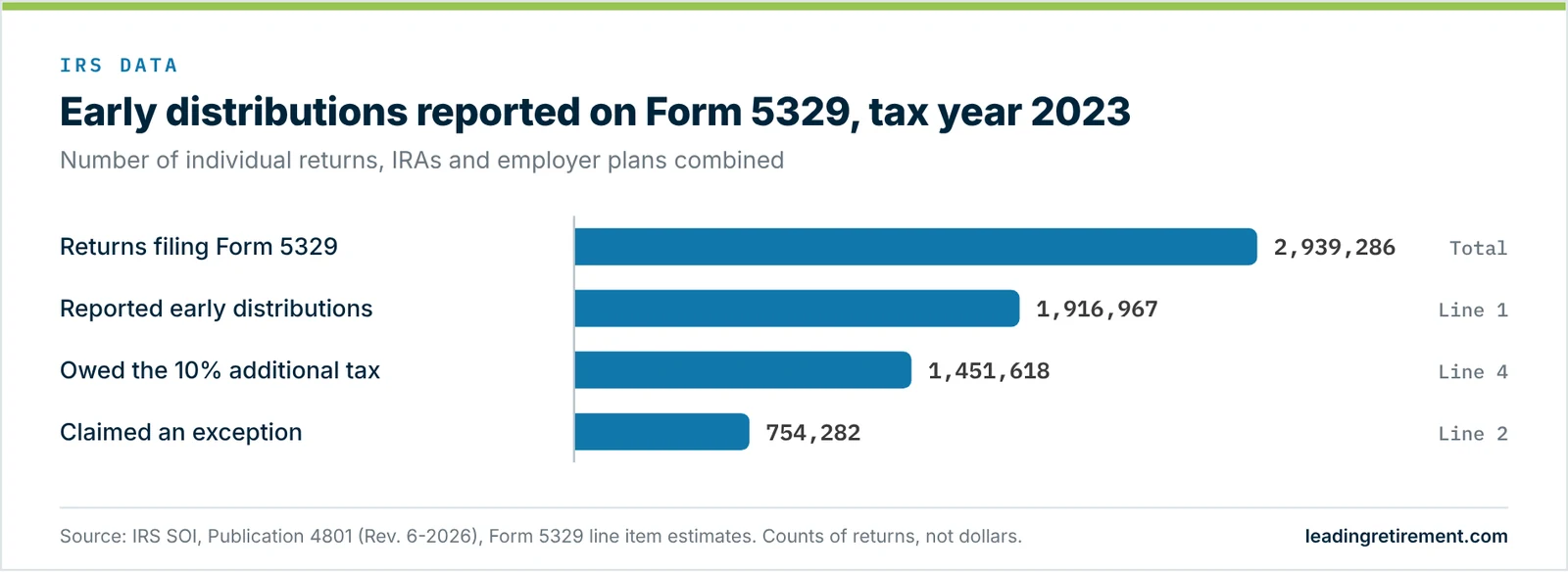
For tax year 2023, about 1.92 million individual returns reported early distributions on Form 5329, and about 1.45 million reported the 10% additional tax.21 These are counts of returns that combine IRAs and employer plans, so they do not isolate 401(k) withdrawals.
The Rule of 55
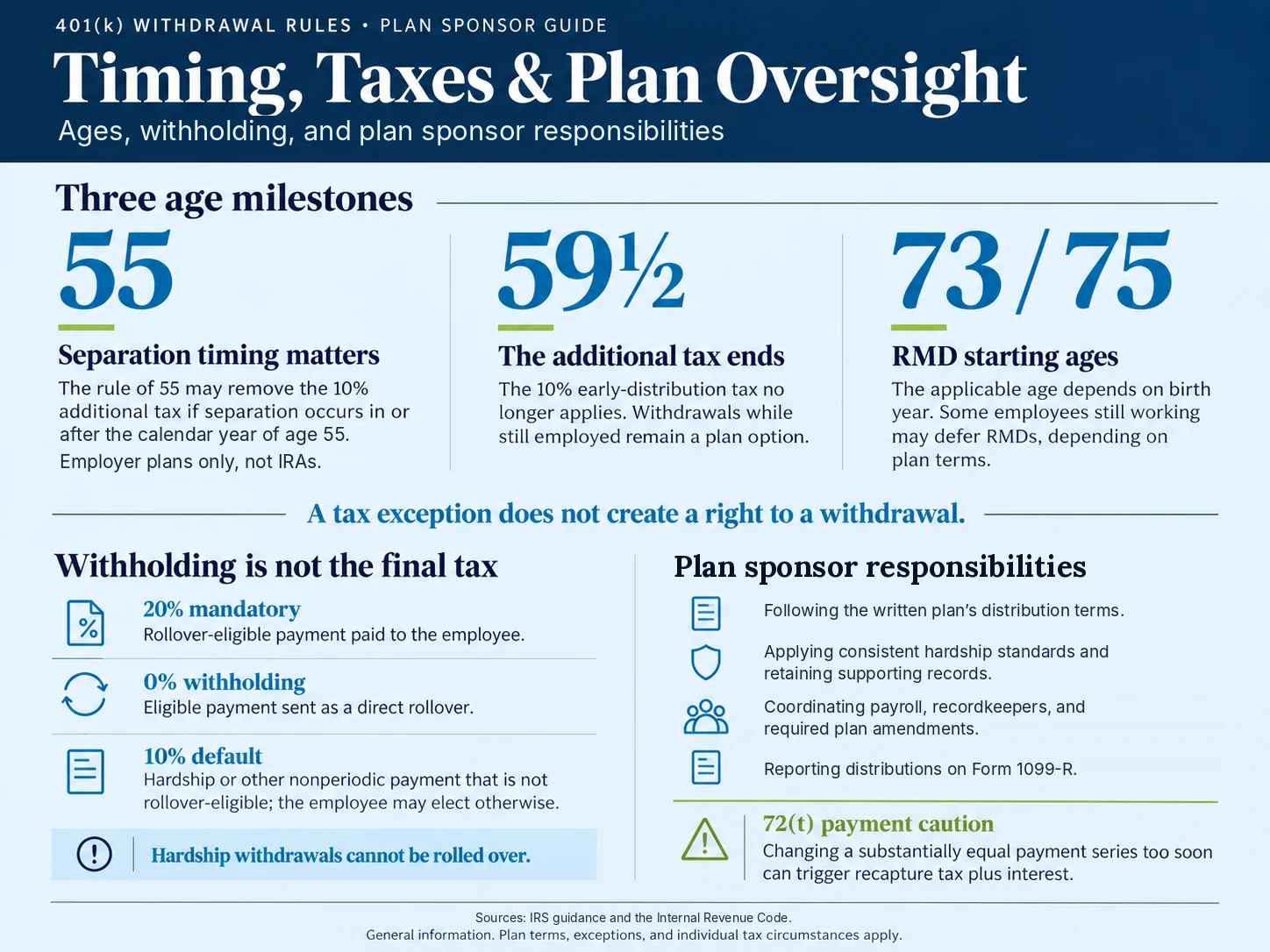
The “rule of 55” is the common name for the exception in section 72(t)(2)(A)(v), which covers distributions “made to an employee after separation from service after attainment of age 55.”6 IRS Publication 575 explains the timing: the 10% additional tax does not apply to distributions “from a qualified retirement plan after your separation from service in or after the year you reached age 55.”8
- The year of separation is what counts. An employee who leaves in the calendar year he or she turns 55, or later, can qualify. The Publication 575 example describes an employee who left at 49 and took a distribution in the year he turned 55; the exception did not apply because he separated before that year.8
- It applies to the employer plan, not IRAs. The exception applies to qualifying distributions from the employer plan after the participant separates from service in or after the calendar year the participant reaches age 55. It does not apply to distributions from an IRA, including a later IRA distribution of money previously rolled over from the employer plan.6, 8, 16
- Earlier ages for some employees. For qualified public safety employees in a governmental plan, and for private-sector firefighters, the age is 50 or 25 years of service under the plan, whichever comes first. SECURE 2.0 added the 25-year alternative, private-sector firefighters, and state and local corrections officers and forensic security employees, for distributions after December 29, 2022.6, 16
Can an employer deny the rule of 55?
The rule of 55 is a tax exception, not a right to a payment. It decides whether the additional tax applies to a distribution the plan makes. Whether and how the plan pays after separation, for example as a lump sum, in installments, or as partial withdrawals, depends on the plan document. Severance from employment is a permitted distribution event under the Code, and in many cases a plan pays benefits to former employees on request, but the timing and forms of payment follow the plan’s terms.1, 2 An employee weighing a withdrawal under this exception can confirm the plan’s options with the plan administrator and the tax effect with a tax professional.
Substantially Equal Periodic Payments (72(t) Payments)
Another exception covers distributions that are part of a series of substantially equal periodic payments, often called 72(t) payments or a SEPP. Under section 72(t)(2)(A)(iv), the payments are made at least annually over the life or life expectancy of the employee, or the joint lives or life expectancies of the employee and a beneficiary.6 For payments from a 401(k) or other employer plan, the IRS states that “the taxpayer must be separated from service with the employer maintaining the plan before the payments begin.” That condition does not apply to IRAs.6, 25
IRS Notice 2022-6 describes three methods for setting the payment amount: the required minimum distribution method, the fixed amortization method, and the fixed annuitization method. The two fixed methods use an interest rate no higher than the greater of 5% or 120% of the federal mid-term rate for either of the two months before payments begin. The notice replaced Revenue Ruling 2002-62 for series beginning on or after January 1, 2023.26
Once payments begin, the series cannot be modified before the later of the fifth anniversary of the first payment or age 59½, other than because of death or disability. The one permitted change is a one-time switch from a fixed method to the required minimum distribution method. A modification before then can trigger a recapture tax under section 72(t)(4), equal to the additional tax the exception avoided on earlier payments, plus interest.6, 25, 26 Whether a plan can pay installments that fit a series depends on the forms of payment its plan document offers.
Age 59½ and In-Service Withdrawals
Two things change at age 59½. It is the age at which the 10% additional tax stops applying, and it is the age at which a profit-sharing 401(k) plan may allow employees who are still working to withdraw their deferrals.1, 6 The second is a plan option. An employee who reaches 59½ can take an in-service withdrawal only if the plan provides for one.
Pension plans follow a different rule. Since plan years beginning after December 31, 2019, a defined benefit or money purchase plan may permit in-service distributions at age 59½, down from 62, under the Bipartisan American Miners Act of 2019, which was enacted alongside the SECURE Act.1, 4 A money purchase plan may not pay benefits on account of hardship.2 Our guide to defined contribution and defined benefit plans covers how the two plan types differ.
How a 401(k) Withdrawal Is Processed and Taxed
An employee who wants to withdraw from a 401(k) generally starts with the plan administrator or recordkeeper, who supplies the plan’s distribution or hardship application. The IRS has confirmed that completing a plan’s application process and providing required documentation are permissible conditions on a hardship withdrawal.5 From there, several federal rules shape the payment.
The rollover notice
Before paying an eligible rollover distribution, the plan administrator must provide a written explanation of the direct rollover option, the withholding rules, and the 60-day rollover rule, under section 402(f).14 The IRS published updated safe harbor model notices in Notice 2026-13, reflecting SECURE 2.0 changes.16 Hardship withdrawals, and the emergency, domestic abuse, birth or adoption, and disaster recovery distributions, are not eligible rollover distributions, so the notice requirement does not apply to them.6, 9, 14
Federal income tax withholding
| Type of payment | Federal withholding |
|---|---|
| Eligible rollover distribution paid to the employee | 20% mandatory withholding. The employee cannot elect out.8, 15 |
| Eligible rollover distribution paid as a direct rollover | No withholding.8, 15 |
| Hardship withdrawal or other nonperiodic payment that is not rollover-eligible | 10% by default. The employee may elect no withholding or ask for more.8, 15 |
The plan administrator is responsible for withholding unless it directs the payor to withhold and provides the required information.15 Withholding is not the final tax. The participant’s actual liability is settled on his or her tax return.
Rollovers and repayment
A hardship withdrawal cannot be rolled over to an IRA or another plan, and unlike a loan it is not repaid. The IRS notes that it “permanently reduces the employee’s account balance under the plan.”3, 14 The tax treatment of a distribution from a designated Roth account depends on whether the distribution is qualified and on the portion attributable to contributions and earnings. A qualified distribution is generally tax-free. The tax treatment of a nonqualified Roth distribution depends on the participant’s circumstances.3
Spousal consent
Most 401(k) profit-sharing plans are exempt from the qualified joint and survivor annuity rules if the plan pays the full death benefit to the surviving spouse and the participant does not elect a life annuity. A plan may still require spousal consent under its own terms or for money transferred from a pension plan, and the IRS tells its examiners to check hardship forms for spousal consent where it applies.1, 4, 24
Loans and small balances
A plan loan is a separate feature from a withdrawal. A loan is not treated as a distribution, but a default that reduces the account is.2 Loan limits and repayment rules are covered in our article on retirement plan loans, and the cash-out of small balances after an employee leaves is covered in our defined contribution plan guide.22
Required Minimum Distributions
At the other end of the timeline, required minimum distributions begin at the applicable age set by SECURE 2.0, which is 73 and rises to 75 for individuals who reach age 74 after 2032, or later for some employees who are still working, depending on the plan.1, 23 Our guide to RMD deadlines covers the timing rules in detail.
What Plan Sponsors Are Responsible For
The employer that sponsors the plan is responsible for operating it according to its written terms, including its distribution rules. The IRS 401(k) Fix-It Guide lists hardship distributions that “weren’t made properly” among the common plan mistakes, and its advice for avoiding them is direct: “Be familiar with your plan document’s hardship provisions and ensure that you follow the provisions in operation. Ensure that your plan administrators and payroll offices share the plan’s hardship distribution information.”19
- Plan language. Optional SECURE and SECURE 2.0 distribution features need plan language. December 31, 2026 typically applies to certain SECURE Act and SECURE 2.0 amendments for applicable nongovernmental plans, but deadlines vary by provision and plan type, and later deadlines may apply.10, 12
- Consistent standards. Hardship determinations follow the plan’s objective, nondiscriminatory standards.2
- Payroll and recordkeeper coordination. Payroll systems and recordkeeping platforms work together on distributions. A six-month contribution stop left over from the pre-2020 rules may be an operational error under the current regulation.2, 19
- Records. Hardship files support the plan on examination.4, 19
- Reporting. Distributions are reported on Form 1099-R using the code the instructions require.17
If a distribution was made that the plan did not allow, the Fix-It Guide describes corrections that may include a retroactive amendment, in limited situations, or repayment by the participant with earnings. The IRS Employee Plans Compliance Resolution System provides self-correction, voluntary correction, and audit closing agreement programs, and which one is available depends on the error and the plan’s procedures.19, 20
Leading Retirement Solutions supports 401(k), 403(b), defined benefit, cash balance, money purchase, and church plans, as well as multiple employer and pooled employer plans. Our plan administration team provides ongoing administration and compliance support, including distribution and hardship review under the plan’s terms, and helps plan sponsors coordinate with their payroll provider and recordkeeper. Request a proposal to talk through your plan.
The answers below summarize general rules for educational purposes. How they apply to a particular plan depends on the plan document and the plan’s facts, and the tax consequences of a withdrawal depend on the participant’s circumstances.
Frequently Asked Questions
What are the 401(k) withdrawal rules?
Elective deferrals can be paid only after an event the Code allows, such as severance from employment, death, disability, age 59½, hardship, or plan termination, and only if the plan provides for it. Payments before age 59½ may also carry a 10% additional tax unless an exception applies.1, 2, 6
What qualifies for a hardship withdrawal from a 401(k)?
An immediate and heavy financial need, under the plan’s standards. The Treasury regulation deems seven expenses to qualify: medical care, buying a principal residence, post-secondary tuition, preventing eviction or foreclosure, funeral costs, casualty repairs to the home, and FEMA-declared disaster losses. A plan may allow fewer.2, 3
Can I withdraw from my 401(k) while still working?
In many cases, yes, if the plan offers in-service withdrawals. A plan may allow deferrals to be withdrawn at age 59½ or for a hardship, and may allow other employer money out under broader rules. The distribution may create taxable income for the participant, although the tax consequences depend on the type of distribution and the participant’s circumstances.1, 4
How many hardship withdrawals can you take?
Federal rules do not set a number. Each request has to meet the plan’s standards and be limited to the amount needed. The IRS looks more closely at patterns of repeated or identical requests.2, 19
Do you have to take a 401(k) loan before a hardship withdrawal?
Not under federal law. Since 2019, the Code provides that a hardship distribution does not fail “solely because the employee does not take any available loan.” A plan may still require it.1, 3
Is there a penalty on a 401(k) hardship withdrawal?
Hardship is not an exception to the 10% additional tax, so a hardship withdrawal before age 59½ may be subject to it unless another exception applies, such as the one for large unreimbursed medical expenses. The withdrawal may also create taxable income, apart from Roth contributions, and the tax consequences depend on the participant’s circumstances.3, 7
What is the rule of 55?
An exception to the 10% additional tax for qualifying distributions from the employer plan after the participant separates from service in or after the calendar year he or she reaches age 55. Qualified public safety employees and private-sector firefighters may use age 50 or 25 years of service. It does not apply to distributions from an IRA, including money previously rolled over from the employer plan.6, 8
At what age can you withdraw from a 401(k) without a penalty?
At 59½, the 10% additional tax no longer applies. Earlier payments can avoid it if an exception applies, such as separation from service in or after the year of age 55, disability, or death.6, 7
What is the 72(t) rule?
Section 72(t) is the Code section that imposes the 10% additional tax on early distributions and lists its exceptions. “72(t) payments” usually means one of those exceptions: a series of substantially equal periodic payments, which from an employer plan can begin only after the employee separates from service.6, 25
Can a hardship withdrawal be paid back or rolled over?
In most cases, no. A hardship distribution is not an eligible rollover distribution, and it is not repaid to the plan. IRS Publication 575 notes one exception: a qualified disaster recovery distribution made on account of a hardship can be repaid. Some other SECURE 2.0 distributions, such as emergency personal expense and birth or adoption distributions, may be repaid within three years.3, 6, 8, 14
Can an employer stop my contributions after a hardship withdrawal?
Not as a condition of the withdrawal. For distributions made on or after January 1, 2020, the regulation prohibits a plan from suspending contributions because of a hardship withdrawal.2
Related Reading
- What is a 403(b) plan, including when 403(b) money can be paid.
- Defined contribution and defined benefit plans, covering limits, testing, and distributions.
- Retirement plan loans, on borrowing from a plan instead of withdrawing.
- RMD deadlines, on required minimum distributions.
- 2026 contribution limits, for current dollar limits.
Sources
Every substantive statement above is drawn from the following primary sources. Numbers in the text refer to this list. Links were verified at the time of writing.
- U.S. Code26 U.S.C. 401, Qualified pension, profit-sharing, and stock bonus plans, including subsections (a)(9), (a)(11), (a)(31), (a)(36), (k)(2)(B), (k)(10), and (k)(14). Official GPO edition. Link
- eCFR26 CFR 1.401(k)-1, Certain cash or deferred arrangements, paragraph (d), Distribution limitation. Link
- IRSRetirement plans FAQs regarding hardship distributions. Last reviewed February 26, 2026. Link
- IRSIssue snapshot: Hardship distributions from 401(k) plans. Last reviewed April 8, 2026. Link
- Federal RegisterHardship Distributions of Elective Contributions, Qualified Matching Contributions, Qualified Nonelective Contributions, and Earnings, final regulations, T.D. 9875, 84 FR 49651, September 23, 2019. Link
- U.S. Code26 U.S.C. 72, Annuities; certain proceeds of endowment and life insurance contracts, subsections (p) and (t). Official GPO edition. Link
- IRSRetirement topics: Exceptions to tax on early distributions. Last reviewed December 11, 2025. Link
- IRSPublication 575 (2025), Pension and Annuity Income. Link
- IRSNotice 2024-55, Emergency personal expense distributions and domestic abuse victim distributions. Link
- IRSNotice 2024-2, Miscellaneous changes under the SECURE 2.0 Act, Q&A F-10, F-12, and J-1. Link
- IRSNotice 2020-68, Guidance on the SECURE Act, including qualified birth or adoption distributions. Link
- IRSNotice 2026-33, Qualified long-term care distributions, June 8, 2026. Link
- IRSNotice 2025-67, 2026 cost-of-living adjustments, including the domestic abuse victim and long-term care distribution limits. Link
- U.S. Code26 U.S.C. 402, Taxability of beneficiary of employees’ trust, subsections (c)(4) and (f). Official GPO edition. Link
- U.S. Code26 U.S.C. 3405, Special rules for pensions, annuities, and certain other deferred income. Official GPO edition. Link
- IRSNotice 2026-13, Safe harbor explanations: eligible rollover distributions, Internal Revenue Bulletin 2026-6. Link
- IRSInstructions for Forms 1099-R and 5498 (2026). Last reviewed June 23, 2026. Link
- IRSAbout Form 5329, Additional Taxes on Qualified Plans (including IRAs) and Other Tax-Favored Accounts. Last reviewed August 3, 2026. Link
- IRS401(k) Plan Fix-It Guide: Hardship distributions weren’t made properly. Last reviewed November 16, 2025. Link
- IRSEPCRS overview. Last reviewed July 31, 2026. Link
- IRS Statistics of IncomePublication 4801, Individual Income Tax Returns Line Item Estimates, 2023 (Rev. 6-2026), Form 5329. Link
- IRSRetirement topics: Loans. Last reviewed February 26, 2026. Link
- IRSRetirement topics: Required minimum distributions (RMDs). Last reviewed April 8, 2026. Link
- IRSRetirement topics: Qualified joint and survivor annuity. Last reviewed July 31, 2026. Link
- IRSSubstantially equal periodic payments. Last reviewed July 23, 2026. Link
- IRSNotice 2022-6, Determination of substantially equal periodic payments. Link
About Leading Retirement Solutions. Leading Retirement Solutions is an independent, women-owned third-party administrator based in Seattle that provides plan design analysis, administration, and compliance support to employers in all 50 states.
Provided for general information only and not legal, tax, or investment advice. How these rules apply to a particular plan depends on the plan document and the plan’s facts. Inflation-adjusted amounts change each year; see the IRS pages linked above for current figures. For questions about a specific situation, consult a tax professional or legal counsel.