

Contribution limits guide · Reviewed September 2026
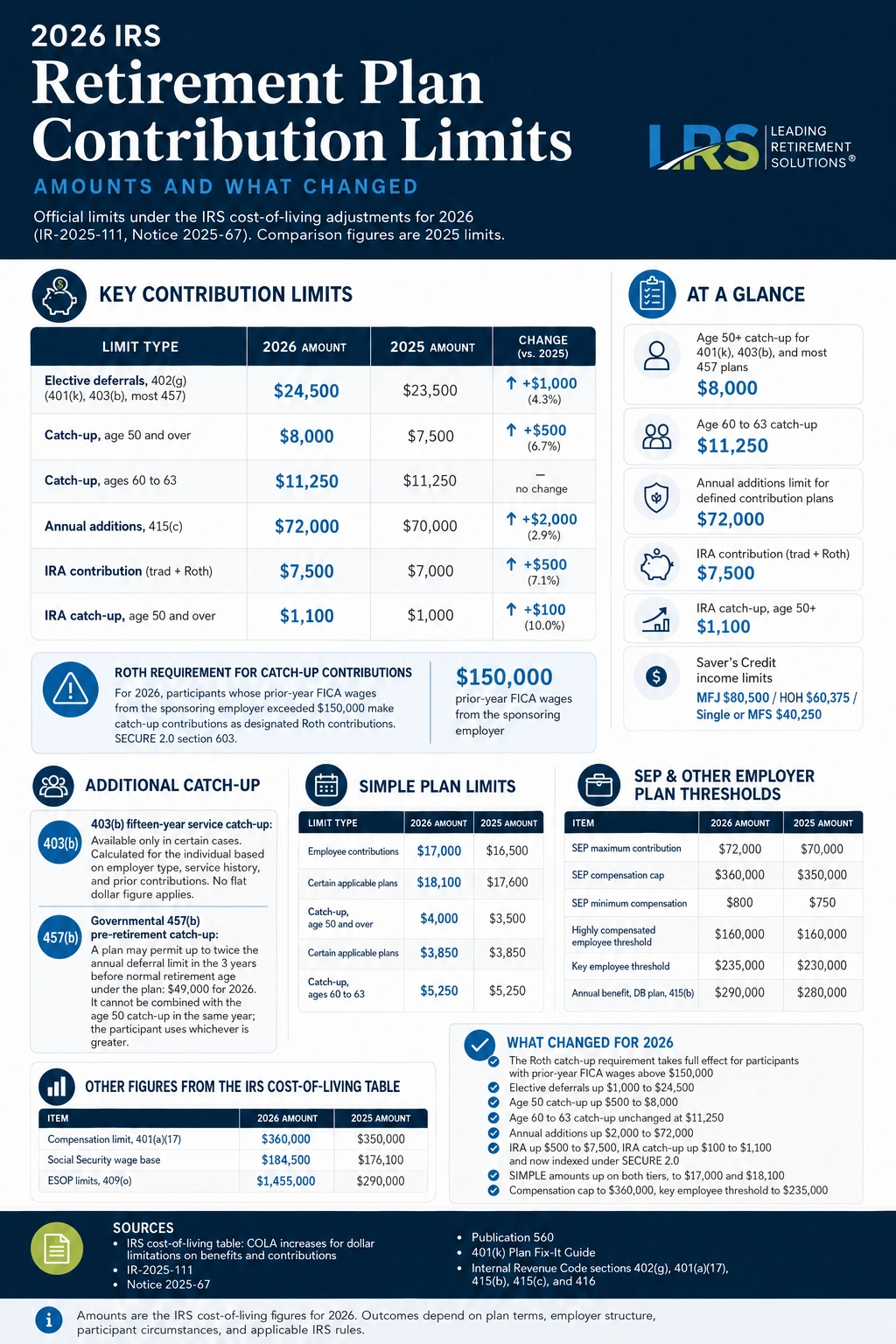
For 2026, a participant may defer up to $24,500 to a 401(k), 403(b) or governmental 457(b) plan, with an additional $8,000 catch-up at age 50 and over. Total annual additions to one account are capped at $72,000, and the IRA limit is $7,500. Each figure is up from 2025.
The limits are adjusted each autumn for the following year. The 2026 amounts come from the IRS cost-of-living table, which reflects Notice 2025-67 and was announced in IR-2025-111 on the same day. The tables below give the 2026 figure alongside the 2025 figure it replaced, so the change is visible rather than assumed.
Three changes matter more than the inflation adjustments this year: the Roth catch-up requirement for higher earners takes full effect, the age 60 to 63 catch-up stays at its 2025 level while the standard catch-up rises, and several SIMPLE amounts moved. Those are covered below the tables.
2026 Contribution Limits at a Glance
| Limit | 2026 | 2025 |
|---|---|---|
| Elective deferrals, 401(k), 403(b), governmental 457(b), section 402(g) | $24,500 | $23,500 |
| Catch-up contributions, age 50 and over | $8,000 | $7,500 |
| Catch-up contributions, ages 60 to 63 | $11,250 | $11,250 |
| Deferrals plus catch-up, age 50 and over | $32,500 | $31,000 |
| Deferrals plus catch-up, ages 60 to 63 | $35,750 | $34,750 |
| Annual additions to one account, section 415(c) | $72,000 | $70,000 |
| Compensation taken into account, section 401(a)(17) | $360,000 | $350,000 |
| IRA contributions, traditional and Roth | $7,500 | $7,000 |
| IRA catch-up, age 50 and over | $1,100 | $1,000 |
Every figure above is published in the IRS cost-of-living table and announced in IR-2025-111, which states each 2026 amount alongside the 2025 amount it replaced. The underlying notice is Notice 2025-67.
Catch-Up Contributions, and the Roth Requirement That Now Applies
The standard catch-up rose, the age 60 to 63 catch-up did not
The catch-up limit for participants aged 50 and over is $8,000 for 2026, up from $7,500. The higher catch-up for participants who turn 60, 61, 62 or 63 during the year is $11,250, the same figure as 2025. The gap between the two therefore narrowed.
The age-based figures do not stack. A participant who turns 60 through 63 during 2026 uses the $11,250 figure instead of the $8,000 figure, not in addition to it. A participant who turns 64 during the year returns to the $8,000 catch-up. The IRS sets this out on its catch-up contributions page.
Higher earners make catch-up contributions on a Roth basis
This is the change with the most operational consequence for 2026. A participant whose prior-year FICA wages from the plan’s sponsoring employer exceeded $150,000 makes catch-up contributions as designated Roth contributions. The threshold was $145,000 as originally enacted and is adjusted for inflation.
Two practical points follow. The test uses Social Security wages from the sponsoring employer for the prior year, which appears in Box 3 of the participant’s Form W-2, rather than total compensation or wages from another employer. Participants whose catch-up contributions must be made on a Roth basis may be affected if the plan does not currently offer a designated Roth feature. How the requirement is implemented depends on the plan’s provisions and any required amendments.
403(b) and 457(b) Plans: Two Additional Catch-Ups
Both plan types share the $24,500 deferral limit and the age-based catch-ups above. Each also has a further catch-up of its own, which is where the arithmetic stops matching a 401(k).
The 403(b) fifteen-year service catch-up
Employees with at least fifteen years of service with certain employers may be eligible to make additional contributions to a 403(b) plan beyond the regular age 50 catch-up. The IRS notes the provision on its catch-up contributions page. Eligibility depends on the type of employer, the service history, and amounts contributed in prior years, so it is calculated for the individual rather than applied as a flat figure.
The 457(b) pre-retirement catch-up
A governmental 457(b) plan may permit a special catch-up in the three years before the participant’s normal retirement age under the plan, allowing up to twice the annual deferral limit. On the 2026 figure that is $49,000. It cannot be combined with the age 50 catch-up in the same year: a participant eligible for both uses whichever is greater.
SIMPLE Plan Limits
| SIMPLE limit | 2026 | 2025 |
|---|---|---|
| Employee contributions | $17,000 | $16,500 |
| Employee contributions, certain applicable plans | $18,100 | $17,600 |
| Catch-up, age 50 and over | $4,000 | $3,500 |
| Catch-up, age 50 and over, certain applicable plans | $3,850 | $3,850 |
| Catch-up, ages 60 to 63 | $5,250 | $5,250 |
The two-tier structure comes from SECURE 2.0, which permits a higher contribution amount for certain applicable SIMPLE plans. Which tier applies to a given plan depends on conditions in the statute rather than on an employer election alone, and the IRS sets out the SIMPLE rules for smaller employers in Publication 560.
SEP and Other Employer Plan Thresholds
| 2026 threshold | Amount | What it applies to |
|---|---|---|
| SEP maximum contribution | $72,000 | The same figure as the section 415(c) annual additions limit |
| SEP compensation cap | $360,000 | The same figure as the section 401(a)(17) compensation limit |
| SEP minimum compensation for participation | $800 | The earnings threshold at which an employee becomes eligible |
| Highly compensated employee threshold | $160,000 | Applied to compensation for a plan year to determine status for the following plan year, used in ADP and ACP testing |
| Key employee threshold | $235,000 | Used in the top-heavy determination under Code section 416 |
| Annual benefit, defined benefit plan, section 415(b) | $290,000 | The limit on the benefit payable, the mirror of the annual additions limit |
Ownership is a separate route to highly compensated employee status, independent of pay, so the $160,000 figure does not settle the question on its own. Testing is covered in our overview of defined contribution plans, and a safe harbor design removes the ADP test where its conditions are met.
Other Figures Published in the Same Table
Two further sets of figures appear in the annual cost-of-living release and come up in plan administration, though neither is a contribution limit.
The Social Security taxable wage base is $184,500 for 2026. It matters here because integrated or permitted disparity allocation formulas use it, and because the Roth catch-up test runs on FICA wages rather than total compensation.
The employee stock ownership plan figures are $1,455,000 and $290,000 for 2026. These are the amounts used in applying the distribution period rules under Code section 409(o), and they apply to plans holding qualifying employer securities.
The Saver’s Credit Income Limits
The Retirement Savings Contributions Credit, generally called the Saver’s Credit, is available to lower and moderate income taxpayers who contribute to a retirement plan or IRA. The income limits for 2026 are:
| Filing status | 2026 income limit | 2025 |
|---|---|---|
| Married filing jointly | $80,500 | $79,000 |
| Head of household | $60,375 | $59,250 |
| Single, and married filing separately | $40,250 | $39,500 |
The credit is claimed by the individual on their own return rather than administered by the plan, but it is one of the reasons plan participation matters at lower income levels, and it appears in participant communications for that reason.
What Changed for 2026
- The Roth catch-up requirement took full effect. Participants with prior-year FICA wages above $150,000 from the sponsoring employer now make catch-up contributions on a Roth basis. The requirement was enacted in SECURE 2.0 and its application was delayed to give plans time to prepare.
- The standard catch-up rose and the age 60 to 63 catch-up did not. $8,000 against $7,500, while $11,250 stayed put.
- Elective deferrals rose $1,000 to $24,500, and annual additions rose $2,000 to $72,000.
- The IRA limit rose for the first time in two years, from $7,000 to $7,500, and the IRA catch-up rose from $1,000 to $1,100. The IRA catch-up is now indexed under SECURE 2.0, having been fixed at $1,000 for years.
- SIMPLE amounts moved on both tiers, with the standard employee limit rising to $17,000 and the higher applicable amount to $18,100.
- Compensation and testing thresholds rose. The compensation cap moved to $360,000 and the key employee threshold to $235,000.
Provisions that took effect in earlier years continue to apply, including the age 60 to 63 catch-up, the automatic enrollment requirement for plans established after December 29, 2022, covered in our article on automatic enrollment, and the reduced service condition for long-term part-time employees.
How the Limits Work Together
One participant, several plans
The section 402(g) deferral limit follows the individual for the calendar year. The section 415(c) annual additions limit applies per plan, subject to aggregation rules that treat related employers as a single employer. A participant with genuinely unrelated employers can therefore have two separate $72,000 limits but only one $24,500 deferral limit.
The compensation cap changes the formula, not the contribution
The $360,000 compensation limit is often read as a cap on what a highly paid participant can receive. It is not. It caps the compensation figure a plan may use in its allocation formula. A plan contributing 10 percent of pay allocates 10 percent of $360,000 for a participant earning $500,000, not 10 percent of $500,000. The participant can still receive up to the full $72,000 in annual additions if other contribution sources reach it.
The limits are per participant, and monitored per payroll
The deferral limit applies to the individual and the annual additions limit to the account, so neither is tested at the plan level. In practice both are monitored across the year rather than checked once, because a participant who front-loads deferrals can reach the section 402(g) limit before the final payroll and, in a plan whose match is calculated per pay period without a true-up, stop receiving match for the remainder of the year. Whether a plan trues up at year end is a plan document question.
Employer deductions are a separate limit
Code section 404 limits what an employer may deduct for contributions to a qualified plan for a taxable year, and that limit is calculated differently from the section 415(c) annual additions limit. A contribution can be within the annual additions limit and still exceed the deduction limit. The IRS covers the deduction rules for smaller employers in Publication 560.
Correcting an excess
Where deferrals across all plans exceeded the section 402(g) limit for a calendar year, the excess and its earnings are distributed by April 15 of the following year. That deadline and the rest of the plan year calendar are set out in our guide to retirement plan deadlines. Where a limit was exceeded and not corrected in time, the IRS correction routes are described in its 401(k) Plan Fix-It Guide and our consulting and correction services cover the formal programs.
Where the limits come from
The deferral limit is set by Code section 402(g) and the annual additions and benefit limits by Code section 415, which requires the amounts to be adjusted annually for cost-of-living increases. That is why the figures change most years and occasionally hold steady: the adjustment is formula-driven and rounds to set increments, so a limit can stay flat when the calculated increase does not clear the rounding threshold. The age 60 to 63 catch-up holding at $11,250 for 2026 is an example.
When the Next Update Comes
The IRS publishes the following year’s limits in the autumn, generally late October or early November, in a notice numbered for that year and an accompanying news release. The 2027 figures will appear on the same cost-of-living page when they are released, and this article is updated at that point rather than replaced.
Applying the current limits correctly across deferrals, matching, profit sharing and testing is part of ongoing plan administration and recordkeeping. For employers considering a plan or a different design, establishing a new plan and changing an existing one cover the options, and our team can help employers understand how current contribution limits may apply to their retirement plan and administrative processes.
Questions That Come Up on Contribution Limits
What is the 401(k) contribution limit for 2026?
$24,500 in elective deferrals, up from $23,500 for 2025. Participants aged 50 and over may contribute an additional $8,000, for a total of $32,500. Participants who turn 60, 61, 62 or 63 during 2026 may contribute an additional $11,250 instead, for a total of $35,750. The figures come from the IRS cost-of-living table for 2026, which reflects Notice 2025-67.
What is the total 401(k) contribution limit including employer contributions?
$72,000 for 2026, up from $70,000 for 2025. This is the section 415(c) annual additions limit and it covers everything allocated to one participant’s account for the year: elective deferrals, employer matching and nonelective contributions, after-tax contributions, and reallocated forfeitures. Catch-up contributions sit outside it, so a participant eligible for the age 50 catch-up can receive up to $80,000 in total.
What is the IRA contribution limit for 2026?
$7,500 for traditional and Roth IRAs combined, up from $7,000 for 2025, with an additional $1,100 catch-up contribution at age 50 and over, up from $1,000. The IRA catch-up is now indexed for inflation under SECURE 2.0, having been fixed at $1,000 for many years. The IRA limit is separate from the workplace plan deferral limit.
Do I have to make catch-up contributions as Roth in 2026?
If prior-year FICA wages from the plan’s sponsoring employer exceeded $150,000, then yes. Catch-up contributions are made as designated Roth contributions for those participants. The test uses Social Security wages from the sponsoring employer for the prior year, shown in Box 3 of the Form W-2, rather than total compensation or wages from a different employer. Participants whose catch-up contributions must be made on a Roth basis may be affected if the plan does not currently offer a designated Roth feature. How the requirement is implemented depends on the plan’s provisions and any required amendments.
What is the catch-up contribution limit for ages 60 to 63?
$11,250 for 2026, the same as 2025. It replaces the $8,000 standard catch-up rather than adding to it, so the combined figure is $35,750. A participant who turns 64 during the year returns to the $8,000 catch-up. The higher limit applies to most 401(k), 403(b) and governmental 457(b) plans.
What is the highly compensated employee threshold for 2026?
$160,000. The figure is applied to compensation for a plan year to determine highly compensated status for the following plan year, and it is used in ADP and ACP nondiscrimination testing. Ownership is a separate route to the same status, independent of pay, so the dollar figure does not settle the question on its own.
What is the SIMPLE plan contribution limit for 2026?
$17,000 for most SIMPLE plans, up from $16,500, with a catch-up of $4,000 at age 50 and over and $5,250 for ages 60 to 63. A higher amount of $18,100 applies to certain applicable SIMPLE plans under a change made by SECURE 2.0, with a catch-up of $3,850 at age 50 and over for those plans.
What is the compensation limit for 2026?
$360,000, up from $350,000 for 2025. This is the section 401(a)(17) limit on the amount of compensation that may be taken into account in a plan’s contribution and allocation formulas. Compensation above the cap is disregarded for that purpose, which is what prevents a formula expressed as a percentage of pay from producing an unlimited allocation.
When are the 2027 contribution limits announced?
The IRS publishes the following year’s limits in the autumn, generally late October or early November, in an annual notice and an accompanying news release. They appear on the IRS cost-of-living page at the same time.
What happens if I contribute more than the limit?
Where elective deferrals across all plans exceeded the section 402(g) limit for a calendar year, the excess and its earnings are distributed by April 15 of the following year. This most often affects participants who changed jobs during the year, because the limit follows the individual and neither plan necessarily sees the combined total. Where an excess was not corrected in time, the IRS maintains correction programs for the plan.
Sources
Every substantive statement above is drawn from the following. Links were verified at the time of writing.
- Internal Revenue ServiceCOLA increases for dollar limitations on benefits and contributionsThe published table of annual limits. Every 2026 figure in this article comes from here.https://www.irs.gov/retirement-plans/cola-increases-for-dollar-limitations-on-benefits-and-contributions
- Internal Revenue ServiceIR-2025-111, 401(k) limit increases to $24,500 for 2026The announcement, which states each 2026 amount alongside the 2025 amount it replaced. Every 2025 comparison figure in this article comes from here.https://www.irs.gov/newsroom/401k-limit-increases-to-24500-for-2026-ira-limit-increases-to-7500
- Internal Revenue ServiceNotice 2025-67The notice setting the 2026 cost-of-living adjustments for qualified plan limits.https://www.irs.gov/pub/irs-drop/n-25-67.pdf
- Internal Revenue ServiceRetirement topics: catch-up contributionsThe age 50 catch-up, the age 60 to 63 catch-up, and how the two interact.https://www.irs.gov/retirement-plans/plan-participant-employee/retirement-topics-catch-up-contributions
- Internal Revenue ServiceRetirement topics: contributionsHow the contribution types are treated and how the deferral and annual additions limits operate.https://www.irs.gov/retirement-plans/plan-participant-employee/retirement-topics-contributions
- Internal Revenue Service401(k) plan overviewPlan features and the testing the limits feed into.https://www.irs.gov/retirement-plans/plan-sponsor/401k-plan-overview
- Internal Revenue ServiceTypes of retirement plansThe plan structures the limits apply across.https://www.irs.gov/retirement-plans/plan-sponsor/types-of-retirement-plans
- Internal Revenue ServicePublication 560, Retirement Plans for Small BusinessThe SEP and SIMPLE rules, and the deduction limits for smaller employers.https://www.irs.gov/publications/p560
- Internal Revenue Service401(k) Plan Fix-It GuideHow to find, fix and avoid a failure to adhere to the section 402(g) limit and the other common operational mistakes.https://www.irs.gov/retirement-plans/401k-plan-fix-it-guide
- United States Code26 U.S.C. section 415, the annual additions and benefit limits, and section 402, the elective deferral rulesThe statutory basis for the limits and for the annual cost-of-living adjustment.https://uscode.house.gov/view.xhtml?req=granuleid%3AUSC-prelim-title26-section415&num=0&edition=prelim