What Is a Safe Harbor 401(k)?
Most 401(k) plans have to pass annual nondiscrimination tests, and when a plan fails, the people whose contributions get cut back are usually the owners. A safe harbor 401(k) trades a required employer contribution for a standing exemption from those tests. For a small business where the owner wants to save the full amount, that trade is often the whole reason the plan exists.
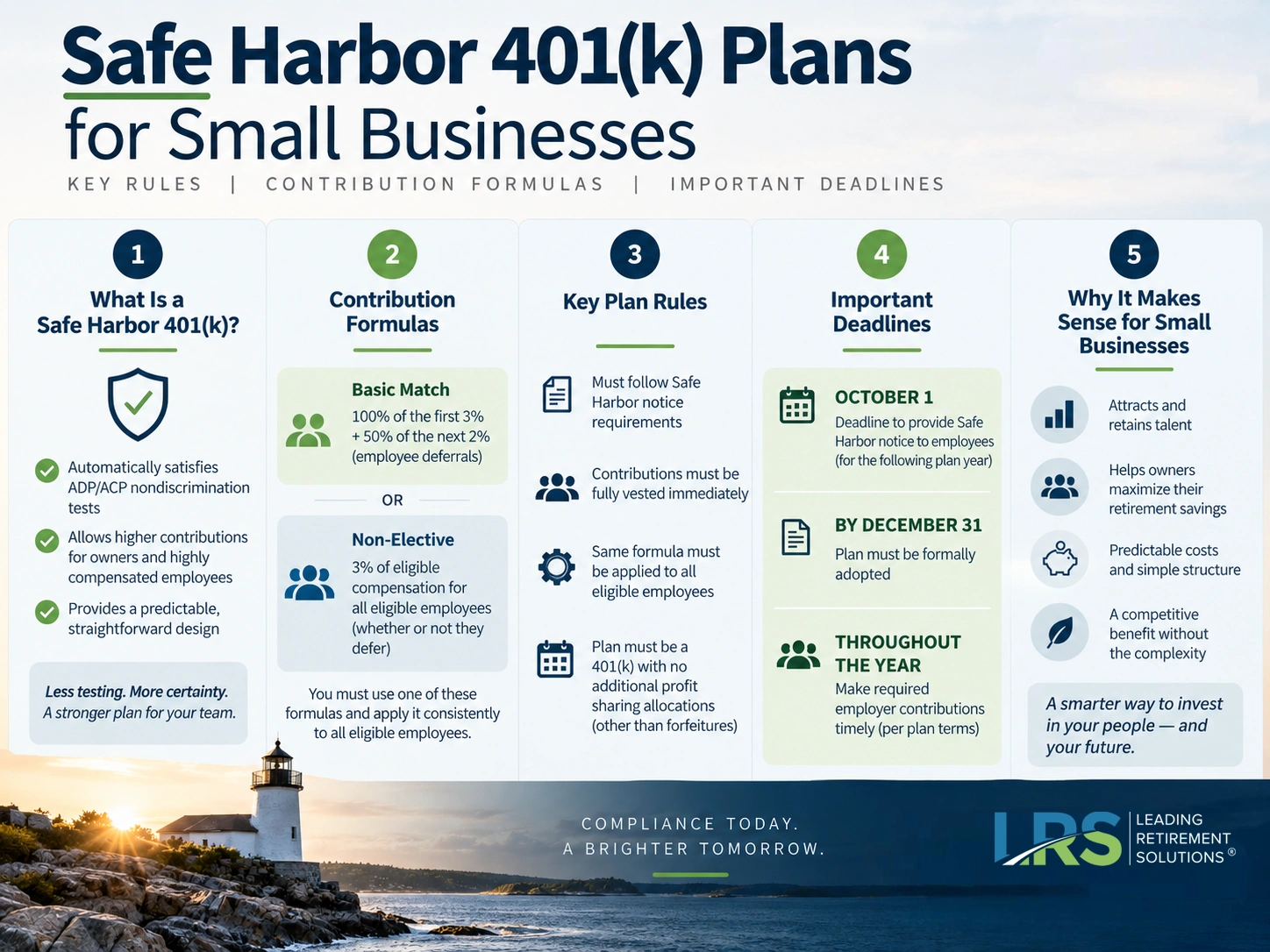
A safe harbor 401(k) is a 401(k) that meets a set of IRS conditions and, in exchange, is treated as automatically passing the annual ADP and ACP nondiscrimination tests. The conditions are a required employer contribution that meets one of the prescribed formulas, accelerated vesting on that contribution, and in some designs an annual notice to eligible employees.
Leading Retirement Solutions · Plan sponsor guide · Reviewed September 2026
There are two families. A classic safe harbor uses a matching or nonelective contribution that is 100 percent vested when made. A QACA, or qualified automatic contribution arrangement, adds automatic enrollment, permits a different matching formula, and may apply a vesting schedule of up to two years. The requirements are set out in Internal Revenue Code sections 401(k)(12), 401(k)(13) and 401(m)(11).
This guide covers the contribution formulas, the difference between the classic design and a QACA, how safe harbor compares with a SIMPLE IRA, the notice and deadline rules that decide when you can adopt one, and how automatic enrollment and state retirement mandates have changed the calculation since 2025.
What the Safe Harbor Actually Exempts You From
The exemption is specific, and it is worth being precise about which tests it covers, because the answer differs by design.
| Test | What safe harbor status does |
|---|---|
| ADP test | The actual deferral percentage test compares elective deferrals by highly compensated employees against everyone else. A safe harbor matching or nonelective contribution satisfies it. |
| ACP test | The actual contribution percentage test does the same for matching contributions. A safe harbor match satisfies it for the safe harbor match itself. A nonelective design satisfies the ADP test, and the ACP test can still apply if the plan makes other matching contributions. |
| Top-heavy minimum | A plan is top-heavy when key employees hold more than 60 percent of account balances, which triggers a required minimum contribution under section 416. A safe harbor plan is generally exempt where the plan consists solely of deferrals and safe harbor contributions. Adding profit sharing or other employer contributions can end that exemption, so the two decisions are best made together. |
Failing ADP or ACP is not a fine. It means corrective distributions to highly compensated employees, or a qualified nonelective contribution to everyone else, both after the year has closed. The IRS Fix-It Guide entry on ADP and ACP failures sets out how those corrections work.
Safe Harbor 401(k) Contribution Formulas
Every safe harbor design requires an employer contribution in one of the prescribed forms. The formulas are set in the regulations at 26 CFR 1.401(k)-3 and cannot be varied by job title, tenure, or department.
| Design | Formula | Maximum employer cost | Vesting |
|---|---|---|---|
| Basic match | 100 percent of the first 3 percent of compensation deferred, plus 50 percent of the next 2 percent. | 4 percent of compensation, reached when an employee defers 5 percent or more. | 100 percent immediately. |
| Enhanced match | Must equal or exceed the basic match at every deferral level. A match of 100 percent of the first 4 percent is the common form. Deferrals above 6 percent of compensation are not matched. | 4 percent of compensation under the common formula. | 100 percent immediately. |
| Nonelective | At least 3 percent of compensation to every eligible employee, whether or not they defer. | 3 percent of compensation for the whole eligible population. | 100 percent immediately. |
| QACA match | 100 percent of the first 1 percent of compensation deferred, plus 50 percent of the next 5 percent. Requires automatic enrollment. | 3.5 percent of compensation, reached when an employee defers 6 percent or more. | Up to a two year cliff schedule is permitted. |
| QACA nonelective | At least 3 percent of compensation to every eligible employee. Requires automatic enrollment. | 3 percent of compensation for the whole eligible population. | Up to a two year cliff schedule is permitted. |
Safe harbor is often described as requiring contributions that are fully vested when made. That is accurate for the classic design and it is not accurate for a QACA, where the regulations permit a vesting schedule of up to two years on the safe harbor contribution. Employee deferrals are always fully vested in either design. Which rule applies to your plan depends on which design your plan document adopts.
Match or nonelective
The structural difference is who receives the money. A match goes only to employees who defer, so the cost tracks participation. A nonelective goes to every eligible employee whether they participate or not, so the cost is predictable from headcount and payroll. Neither is automatically the better answer, and the deciding factor is usually your participation rate and how much certainty you want in the budget.
One practical note: if the plan is already expected to be top-heavy and owe a 3 percent minimum contribution, a 3 percent safe harbor nonelective covers similar ground while also satisfying the ADP test.
Classic Safe Harbor vs QACA
Both are safe harbor plans. The differences sit in automatic enrollment, the matching formula, and vesting.
| Classic safe harbor | QACA | |
|---|---|---|
| Automatic enrollment | Optional. | Required, at a default rate between 3 and 10 percent, escalating annually to at least 10 percent and capped at 15 percent. |
| Basic match | 100 percent of the first 3 percent, plus 50 percent of the next 2 percent. Maximum match 4%. |
100 percent of the first 1 percent, plus 50 percent of the next 5 percent. Maximum match 3.5%. |
| Nonelective option | At least 3 percent of compensation. | At least 3 percent of compensation. |
| Vesting on safe harbor contributions | 100 percent immediately. No schedule permitted. | Up to a two year cliff, or graded so that participants are fully vested at two years of service. |
| Safe harbor notice | Required for matching designs. Not required for nonelective designs for plan years beginning after December 31, 2019. | Same rule for the safe harbor notice. The separate automatic enrollment notice under section 414(w) still applies. |
| Satisfies the new plan auto-enrollment requirement | Only if automatic enrollment is added separately. | Yes, by design. |
SIMPLE IRA vs Safe Harbor 401(k)
This is the comparison small employers ask about most, usually because a SIMPLE IRA is already in place and the owner has run into its limits.
| SIMPLE IRA | Safe harbor 401(k) | |
|---|---|---|
| Employee deferral limit | The SIMPLE limit, which is materially lower than the 401(k) limit. See the IRS COLA table for current figures. | The 401(k) elective deferral limit, with catch-up contributions available at the applicable ages. |
| Employer contribution | A match of up to 3 percent of compensation, or a 2 percent nonelective, under the statutory formulas. | One of the safe harbor formulas above. |
| Vesting | Always immediate. No schedule available. | Immediate for classic designs. Up to two years for a QACA. |
| Profit sharing | Not available. | Available, subject to the top-heavy point above. |
| Loans | Not available. | Available if the plan document provides for them. |
| Roth deferrals | Available under SECURE 2.0 if the arrangement provides for them. | Available if the plan document provides for them. |
| Annual filing | No Form 5500 for the employer. | Form 5500 required. See how to obtain a copy of a plan’s Form 5500. |
Employers generally move from one to the other for one of two reasons: the deferral limit is constraining an owner who wants to save more, or the business wants vesting, loans, or profit sharing that the SIMPLE structure does not offer. The trade is more capability in exchange for a Form 5500 and a plan document. Details on each arrangement are in the IRS SIMPLE IRA plan resource and Publication 560.
Is a Safe Harbor 401(k) Right for Your Business?
There is no headcount at which the answer becomes automatic. What the design does is remove a specific uncertainty, so it fits best where that uncertainty is expensive.
Where the design tends to fit
- Owners are being limited by testing. If highly compensated employees are receiving refunds after year end, or are being told at the start of the year to defer conservatively, the safe harbor contribution buys back that capacity.
- Participation among other employees is low. The ADP test measures the gap between groups. When the wider workforce defers very little, that gap is difficult to close by encouragement alone.
- The plan is already top-heavy. Where a 3 percent minimum contribution is expected regardless, a 3 percent nonelective covers similar ground and adds testing relief.
- You intend to contribute anyway. If a match is already planned as a benefit, structuring it to meet a safe harbor formula converts a cost you were going to bear into a compliance exemption.
- You are hiring against employers that match. A fully vested match is a benefit candidates can compare directly.
Where it may not
- The employer contribution is mandatory once elected. Reducing or suspending it mid-year is possible only in limited circumstances, described below.
- Participation is already high and testing passes comfortably. The exemption is worth less when there is nothing to exempt.
- Cash flow is uncertain. A nonelective commits a percentage of total eligible payroll regardless of who participates.
Whether any of this applies to a particular business depends on its census, its participation, and the terms of its plan document. If you already sponsor a plan, changing the design is usually a matter of upgrading the existing plan rather than starting again.
Notices, Deadlines and Mid-Year Changes
The operational rules decide whether a safe harbor design is available to you this year or next, and they are the part most often discovered too late.
When you can adopt one
A new safe harbor 401(k) generally needs a plan year of at least three months, which in practice makes October 1 the working deadline for a calendar year plan in its first year. Adding a safe harbor nonelective contribution to an existing plan is more flexible. Under the SECURE Act, a plan can be amended to add a 3 percent nonelective up to 30 days before the end of the plan year. If the amendment provides at least 4 percent instead, it can be made as late as the last day of the following plan year. The IRS sets this out on its safe harbor notice page.
Which designs require a notice
For plan years beginning after December 31, 2019, the SECURE Act eliminated the safe harbor notice requirement for nonelective safe harbor designs, in both classic and QACA form. Matching designs still require the notice, generally delivered at least 30 and no more than 90 days before the start of the plan year. A QACA has a separate automatic enrollment notice obligation under section 414(w) that the SECURE Act did not remove, so a QACA nonelective plan is relieved of one notice rather than both.
Changing or stopping mid-year
Safe harbor contributions are a commitment for the plan year. Reducing or suspending them mid-year generally requires either that the employer is operating at an economic loss, or that the annual notice reserved the possibility in advance. Additional conditions apply, including advance notice to participants, contributions through the effective date of the amendment, and running the ADP and ACP tests for the full year. IRS guidance on mid-year changes to safe harbor plans covers which changes are permitted and which require an updated notice.
Who counts as highly compensated. An employee is a highly compensated employee for a plan year if they owned more than 5 percent of the business at any time during that year or the preceding year, or if their compensation from the business in the preceding year exceeded the applicable threshold. The threshold is indexed and does not change every year. The current figure is published in the IRS cost of living adjustments table, and current deferral and annual addition limits are in the 2026 IRS contribution maximums.
Safe Harbor and the Automatic Enrollment Requirement
Internal Revenue Code section 414A, added by the SECURE 2.0 Act of 2022, generally requires 401(k) and 403(b) arrangements established on or after December 29, 2022 to operate as eligible automatic contribution arrangements for plan years beginning after December 31, 2024. Section 414A(c) provides exceptions, including employers that normally employ 10 or fewer employees, businesses in existence less than three years, governmental plans and church plans. Treasury and the IRS issued proposed regulations under section 414A in January 2025.
For employers subject to Section 414A, a QACA generally incorporates the automatic enrollment features associated with the requirement, while a classic safe harbor plan may require additional automatic enrollment provisions depending on the plan’s circumstances. For an employer starting a plan now, that makes the classic and QACA comparison a different question than it was before 2025. Automatic enrollment requirements remain subject to applicable IRS and Treasury guidance. Employers should confirm current requirements when establishing or amending a plan. More on how the feature works in practice is in how automatic enrollment can level up retirement plans, and eligibility for long-term part-time employees is worth checking at the same time because it affects who has to be enrolled.
Self-Directed Safe Harbor 401(k) Plans
Safe harbor status is a testing and contribution arrangement. It does not restrict what the plan can hold. A safe harbor plan can be paired with a self-directed structure that allows participants to hold assets beyond a standard investment menu, subject to the plan document, the trustee arrangement, and the prohibited transaction rules.
Employers ask about this pairing more than the search volume suggests, usually because an owner wants both the contribution capacity that safe harbor protects and the ability to direct that money into something other than the default lineup. LRS administers plans holding non-traditional assets and can explain how a self-directed arrangement and a safe harbor design work together. More on non-traditional plans and alternative assets.
Does Your State Require You to Offer a Plan?
For a growing number of small businesses the question is no longer only whether a plan is worth offering. A number of states now require employers above a certain size to either sponsor a qualifying retirement plan or enroll their employees in a state-facilitated program. A safe harbor 401(k) is one of the designs that satisfies that requirement while also solving the testing problem, which is why the two decisions are often made together.
Some state retirement programs require additional reporting, registration, certification, or exemption steps. Requirements vary by state and should be confirmed through the applicable state program.
Check whether your state requires you to offer a retirement plan
Select a state to see who is covered, which registration deadline applies, what non-compliance costs, and how an employer-sponsored plan is treated under the state program.
The full picture for all 50 states, including deadlines and penalty schedules, is in the state retirement mandate guide for employers.
Plan Design Is Not One Size Fits All
Safe harbor plans are not a single product. The choice between a match and a nonelective, between classic and QACA, and between adding profit sharing or leaving the top-heavy exemption intact, all move together, and the right combination depends on your census and what you want the plan to do.
The Safe Harbor 401(k) plan from Leading Retirement Solutions is a design option that helps business owners maximize plan contributions while offering a benefit employees value. Whether you have hundreds of employees or are an entrepreneur just starting out, we offer customizable solutions built to meet your company goals. Employers that already sponsor a plan and want a different design can look at upgrading an existing plan, and smaller employers that want to share the administrative load often consider a pooled employer plan.
Two adjacent decisions worth making at the same time: how contributions will reach the plan each pay period, which is a question of payroll contribution processing, and who will handle the recurring work of plan administration and recordkeeping. Federal startup credits can offset part of the cost of establishing a plan, covered in tax breaks for business owners with a retirement plan.
Talk through the design before the deadline, not after it
Leading Retirement Solutions is a Seattle-based third-party administrator serving employers in all 50 states. We provide plan design analysis and administrative support to help employers compare available options.
Frequently Asked Questions
What is a safe harbor 401(k)?
A 401(k) that meets IRS conditions on employer contributions, vesting and notices, and in exchange is treated as satisfying the annual ADP and ACP nondiscrimination tests. The conditions are in Internal Revenue Code sections 401(k)(12), 401(k)(13) and 401(m)(11).
What are the safe harbor 401(k) rules?
The employer must make one of the prescribed contributions: a basic match of 100 percent of the first 3 percent deferred plus 50 percent of the next 2 percent, an enhanced match at least as generous at every level, or a nonelective contribution of at least 3 percent to all eligible employees. Those contributions must be fully vested when made in a classic design. A QACA adds automatic enrollment, permits a match of 100 percent of the first 1 percent plus 50 percent of the next 5 percent, and allows vesting of up to two years. Matching designs require an annual notice.
What are safe harbor contributions?
They are the employer contributions that buy the testing exemption. They come in two forms, a match tied to what each employee defers, or a nonelective contribution paid to every eligible employee whether they defer or not. Both are subject to the accelerated vesting rules for the design in use.
Is a safe harbor 401(k) better than a SIMPLE IRA?
They serve different situations. A SIMPLE IRA has no Form 5500 requirement and less administration. A safe harbor 401(k) allows higher employee deferrals, profit sharing, loans and a vesting schedule in QACA form. Employers typically move to a 401(k) when the SIMPLE deferral limit constrains an owner or when they want features the SIMPLE structure does not offer.
Does a safe harbor plan avoid top-heavy testing?
A safe harbor plan is generally exempt from the top-heavy minimum contribution where the plan consists solely of elective deferrals and safe harbor contributions. Adding profit sharing or other employer contributions can end that exemption, which is why the profit sharing decision and the safe harbor decision belong in the same conversation.
When is the deadline to start a safe harbor 401(k)?
A new safe harbor plan generally needs a plan year of at least three months, which makes October 1 the practical deadline for a calendar year plan in its first year. An existing plan can add a 3 percent nonelective up to 30 days before the plan year ends, or a 4 percent nonelective as late as the last day of the following plan year.
Can we stop the safe harbor contribution mid-year?
Only in limited circumstances. The employer generally has to be operating at an economic loss, or the annual notice has to have reserved the possibility in advance. Further conditions apply, including advance notice to participants and running the ADP and ACP tests for the entire plan year.
Do safe harbor contributions have to vest immediately?
In a classic safe harbor plan, yes. In a QACA, the regulations permit a vesting schedule of up to two years on the safe harbor contribution. Employee deferrals are always fully vested in either case.
Does a safe harbor 401(k) satisfy a state retirement mandate?
In the mandate states reviewed by LRS, sponsoring a qualifying retirement plan satisfies the requirement in place of enrolling employees in the state program, and a safe harbor 401(k) is a qualifying plan. Some state retirement programs require additional reporting, registration, certification, or exemption steps, so having the plan is not the same as having filed. Coverage and deadlines vary by state.
Sources and Review
Every regulatory statement in this guide traces to a primary source. No aggregators or secondary summaries were used. Each link opens the current version of the page on the issuing agency’s own site.
- Internal Revenue Service401(k) plan overviewHow safe harbor plans differ from traditional 401(k) plans, and the conditions for the top-heavy exemption.
- Electronic Code of Federal Regulations26 CFR 1.401(k)-3, Safe harbor requirementsThe contribution formulas, vesting conditions and notice requirements for traditional safe harbor plans and QACAs.
- Internal Revenue ServiceNotice requirement for a safe harbor 401(k) or 401(m) planThe elimination of the notice for nonelective designs, and the amendment deadlines for adding a 3 percent or 4 percent nonelective.
- Internal Revenue ServiceMid-year changes to safe harbor 401(k) plans and noticesWhich mid-year changes are permitted, and the conditions for reducing or suspending safe harbor contributions.
- Internal Revenue Service401(k) plan Fix-It Guide: the plan failed the ADP and ACP nondiscrimination testsWhat happens without safe harbor status, and how the corrections work.
- Internal Revenue Service401(k) plan Fix-It Guide: the plan was top-heavy and required minimum contributions were not madeThe top-heavy determination and the required minimum contribution under section 416.
- Internal Revenue ServiceCOLA increases for dollar limitations on benefits and contributionsThe current highly compensated employee threshold and annual contribution limits.
- Internal Revenue ServiceSIMPLE IRA planEmployer contribution formulas, deferral limits and features of the SIMPLE arrangement.
- Internal Revenue ServicePublication 560, Retirement Plans for Small BusinessPlan options, deduction rules and startup credits for smaller employers.
Reviewed by the LRS compliance team, September 2026. Leading Retirement Solutions is a third-party administrator serving employers in all 50 states. Provided for general information only and not legal or tax advice. Plan design, testing outcomes, vesting and deadlines depend on your plan document and the specific facts of your plan. Confirm requirements with your advisors or the applicable agency before acting.