

Last updated
What tax benefits does a business get from offering a retirement plan?
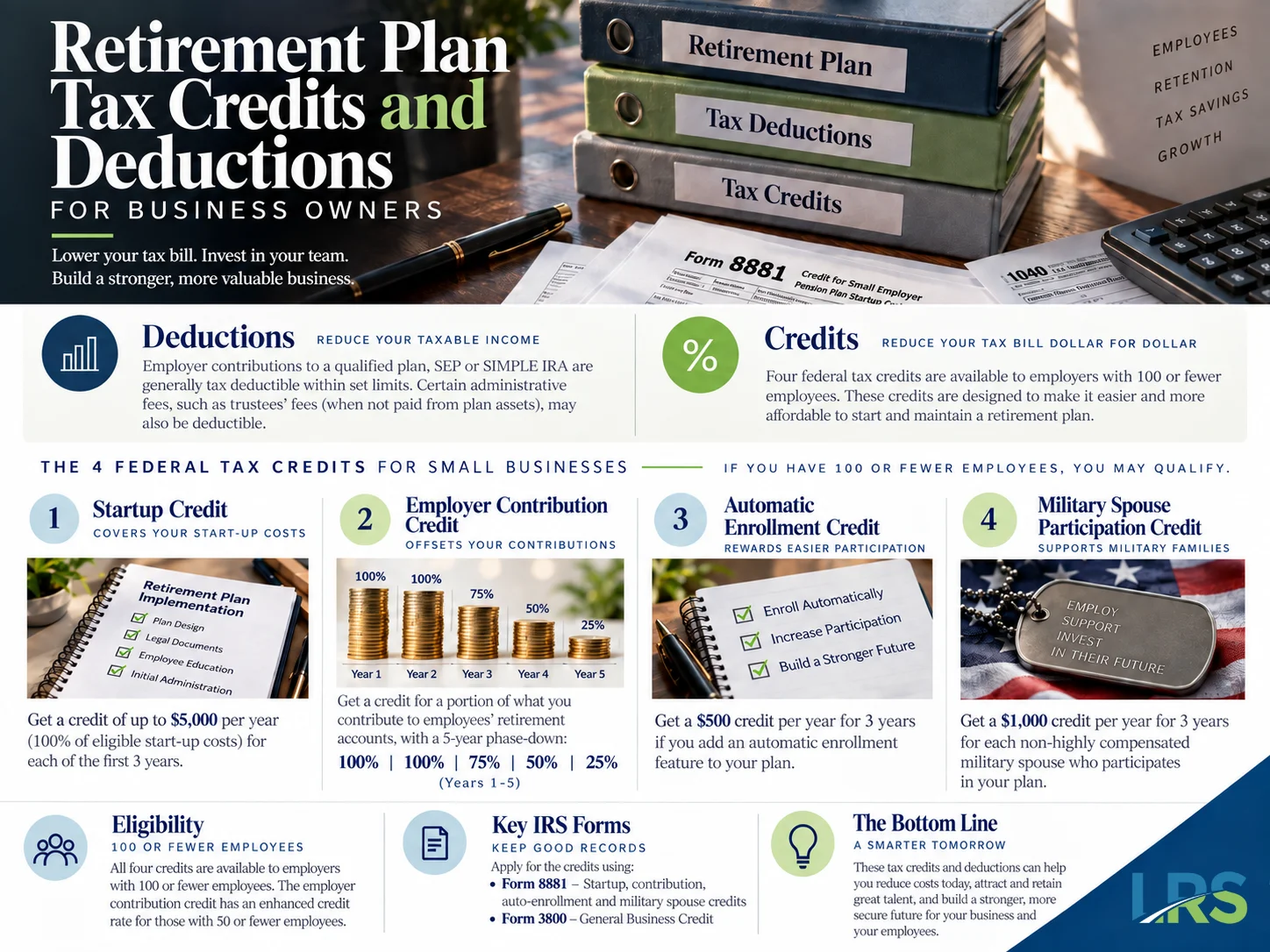
Two different federal tax benefits come with sponsoring a retirement plan, and they work in different ways. Deductions reduce the business’s taxable income: under IRS Publication 560, employer contributions to a qualified plan, SEP or SIMPLE IRA are generally deductible within set limits, and so are trustees’ fees the employer pays when plan contributions do not cover them. Credits reduce the tax itself, dollar for dollar. Four federal credits are available to employers with 100 or fewer employees, each written into the Internal Revenue Code and each claimed on IRS Form 8881.
Tax credits and deductions depend on an employer’s specific facts and tax situation, so businesses should consult their tax advisor regarding eligibility and reporting.
The credits are where most of the confusion sits. The SECURE 2.0 Act of 2022 rewrote the startup credit and added two new ones for tax years beginning after 2022, according to the Form 8881 instructions (revised December 2025), so material published about these credits before 2023 may describe rules that no longer apply. The table below summarizes all four as they currently stand; each is explained in the sections that follow.
| Credit | Code section | Who can claim it | Annual amount | How long |
|---|---|---|---|---|
| Startup cost credit | 45E | No more than 100 employees who earned at least $5,000 in the prior year; a new plan with at least one eligible non-highly compensated employee | 100% of qualified startup costs (1 to 50 employees) or 50% (51 to 100), up to the greater of $500 or the lesser of $250 per eligible non-highly compensated employee or $5,000 | First credit year and the two years after it |
| Employer contribution credit | 45E(f) | Same employer test; defined contribution plan, SEP or SIMPLE IRA, not a defined benefit plan | A declining percentage of employer contributions, up to $1,000 per employee; reduced for employers with more than 50 employees | Year the plan is established and the four years after it |
| Auto-enrollment credit | 45T | No more than 100 employees who earned at least $5,000 in the prior year; new or existing plan adding an eligible automatic contribution arrangement | $500 | First year the feature is included and the two years after it |
| Military spouse participation credit | 45AA | No more than 100 employees who earned at least $5,000 in the prior year; defined contribution plan with specific eligibility and vesting features | $200 per participating military spouse, plus up to $300 of employer contributions for that employee | Three years for each military spouse |
Sources: Instructions for Form 8881 (12/2025); IRS, Retirement plans startup costs tax credit; 26 U.S.C. 45E.
What an employer can deduct
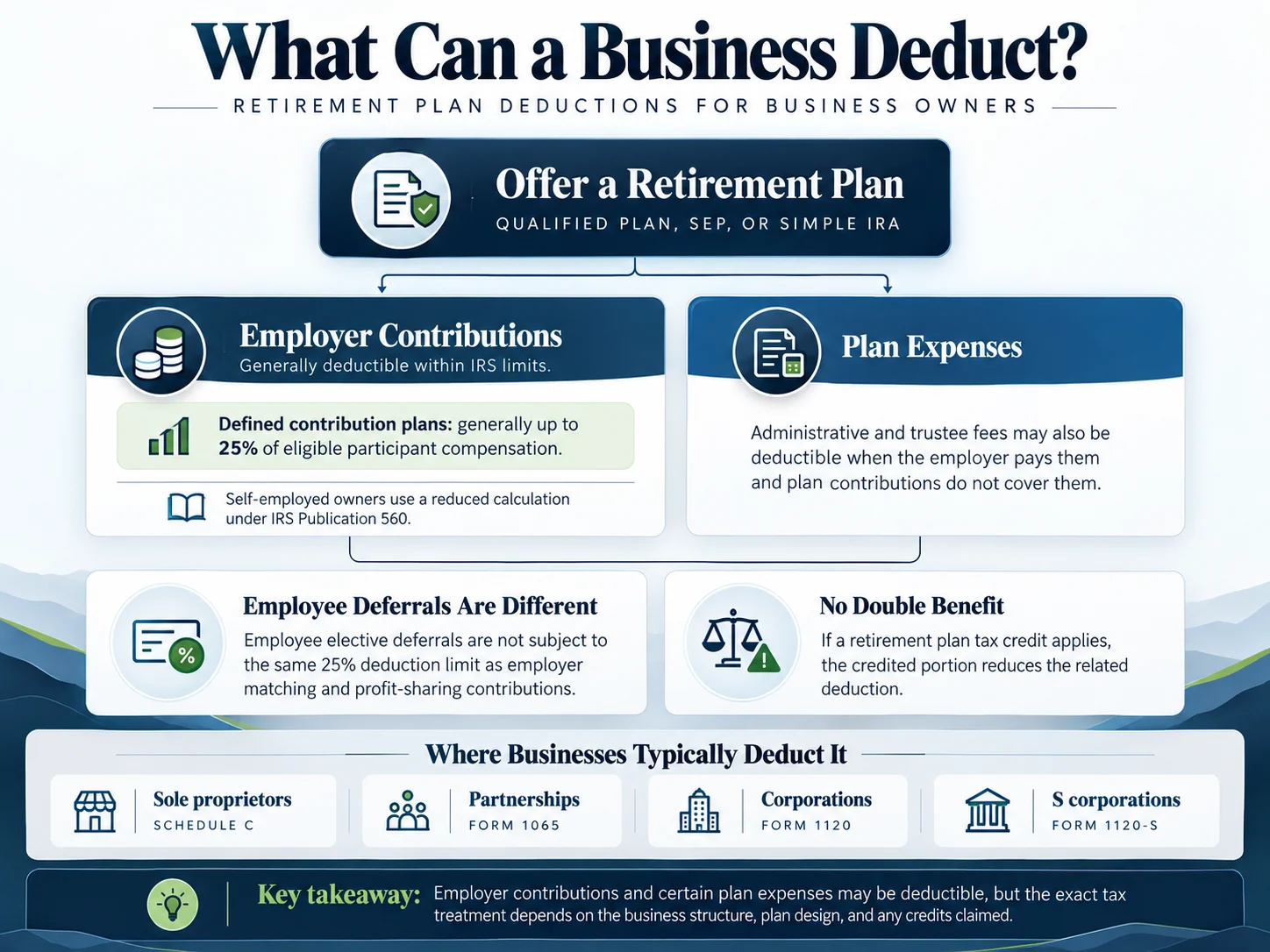
Employer contributions. Publication 560 limits the deduction for contributions to a defined contribution plan, such as a profit-sharing plan, to 25% of the compensation paid or accrued during the year to the eligible employees participating in the plan. SEP contributions are deductible up to the lesser of the contributions made or 25% of the compensation paid to participants, with each participant’s compensation capped at the annual limit. Business owners who are self-employed figure a reduced limit for contributions made on their own behalf, using the worksheets in the same publication. The annual dollar limits that apply to these calculations change each year and are set out in the current IRS contribution limits.
Are employer contributions or employee deferrals more tax deductible?
Employers sometimes ask which kind of contribution is “more deductible.” Publication 560 treats them differently for the deduction ceiling: employees’ elective deferrals are not subject to the 25% limit, while matching and profit-sharing contributions count toward it.
Plan expenses. Publication 560 also allows the employer to deduct trustees’ fees when plan contributions do not cover them. Two cautions apply once the credits below come into the picture. First, the startup credit and the employer contribution credit each reduce the related deduction, so the same dollar is not both credited and deducted (explained in How the credits interact, below). Second, the credit is measured on expenses of the employer itself. Depending on provider agreements and plan design, certain administrative expenses may be paid by the employer, from plan assets when permissible, or through investment-related fees, as the Department of Labor’s guide to plan fees also describes.
Sole proprietors deduct contributions for common-law employees on Schedule C, partnerships on Form 1065 and corporations on Form 1120 or 1120-S, with contributions for the owners themselves reported as Publication 560 describes.
What the plan means for the owner’s own taxes
The business is not the only taxpayer affected. An owner who participates in the plan receives the same tax treatment as any other participant, and for many small employers that is a large part of the reason for starting one.
- Pre-tax deferrals. According to the IRS 401(k) plan overview, elective deferrals are generally not subject to federal income tax withholding when deferred and are not reported as taxable income on the individual’s return. Deferrals and investment gains are taxed when distributed rather than as they accrue.
- Roth deferrals. A 401(k) plan may allow participants to designate deferrals as Roth. Those amounts are included in taxable income in the year of the deferral, and the IRS Roth comparison chart explains that a qualified distribution, generally one made after five years and on or after age 59½, disability or death, is not taxed.
- Self-employed owners. Sole proprietors and partners deduct contributions made for themselves on Schedule 1 of Form 1040, using the reduced limit Publication 560 describes for self-employed individuals.
- Employer contributions for owners. Matching or profit-sharing contributions made for an owner who is an employee are deductible by the business within the section 404 limits, as for any other participant.
The same plan rules apply to owners as to everyone else. Annual contribution limits cap what any one participant can contribute, and in a traditional 401(k) the IRS requires annual Actual Deferral Percentage and Actual Contribution Percentage tests to confirm that deferrals and matching contributions do not favor highly compensated employees. A safe harbor 401(k) is not subject to those annual tests, in exchange for required employer contributions that are fully vested when made.
What it takes to set up and run a 401(k) plan
The question employers most often ask about a 401(k) or other retirement plan is what it takes to set one up and run it. The main components appear in most plans, and knowing them explains what the startup credit is designed to offset. Requirements and service arrangements differ by plan design and provider.
- A written plan document. Publication 560 requires a written plan, which may be an IRS pre-approved plan offered by a provider or an individually designed one.
- Recordkeeping and administration. The Department of Labor describes plan administration as the basic services needed to run the plan as a whole, such as recordkeeping, accounting, legal and trustee services.
- Annual reporting. Plan sponsors generally file a Form 5500-series return each year, due on the last day of the seventh month after the plan year ends, according to the IRS Form 5500 Corner. Our Form 5500 guide covers the filing in detail.
- An independent audit, once a plan is large. Since 2023, a defined contribution plan counts participants with account balances at the beginning of the plan year when applying the 100-participant threshold for small plan filing and the audit waiver, according to the Department of Labor’s Form 5500-SF instructions. Plans above the threshold generally attach an independent accountant’s report; our large plan audit page explains the process.
- An ERISA fidelity bond. Under ERISA section 412, people who handle plan funds must generally be bonded for at least 10% of the funds they handle, with a minimum of $1,000 and, in most cases, a maximum required amount of $500,000 per plan ($1,000,000 for plans holding employer securities), according to Department of Labor Field Assistance Bulletin 2008-04. Our fidelity bond guide covers the requirement.
- Employee education. Explaining the plan to employees is part of operating it, and section 45E names retirement-related education as a qualified startup cost.
Whether a particular expense qualifies for the startup credit turns on the statutory definition covered below and on whether the employer, rather than the plan, paid it.
The retirement plan startup cost tax credit under section 45E
The startup cost credit, often called the 401(k) startup tax credit, applies to a new 401(k) plan and to the other eligible plan types the statute covers, including SEPs and SIMPLE IRAs.
Which employers qualify
The Form 8881 instructions set three conditions, drawn from section 45E:
- Size. No more than 100 employees who received at least $5,000 of compensation from the employer in the tax year before the first credit year.
- At least one eligible non-highly compensated employee. The statute excludes costs for a plan that does not have at least one employee eligible to participate who is not highly compensated. A plan in which every eligible participant is highly compensated, such as one covering only the business owners, does not generate the credit.
- A genuinely new plan. The employer is not eligible if, in the three tax years before the first credit year, it maintained a qualified plan with contributions or accruals for substantially the same employees. The test reaches plans of any member of a controlled group that includes the employer, and of a predecessor of either.
That third condition is the one most often missed. A business that ended a plan within the lookback period, or that belongs to a group of related companies where another member sponsors a plan covering the same people, may not qualify even though the plan it is adopting is new to it.
How much the credit is worth
For tax years beginning after 2022, an eligible employer with 1 to 50 employees can claim 100% of qualified startup costs, and one with 51 to 100 employees can claim 50%. In either case the credit is capped each year at the greater of $500 or the lesser of $250 for each eligible non-highly compensated employee or $5,000, according to the IRS. The cap therefore moves with the number of eligible non-highly compensated employees:
| Eligible non-highly compensated employees | Annual cap on the startup credit |
|---|---|
| 1 or 2 | $500 |
| 4 | $1,000 |
| 10 | $2,500 |
| 16 | $4,000 |
| 20 or more | $5,000 |
Calculated from the limit in 26 U.S.C. 45E(b)(1). The credit cannot exceed the stated percentage of qualified startup costs actually paid or incurred in the year.
Two details change the arithmetic. The count is of non-highly compensated employees who are eligible to participate, not those who enroll; line 3 of Form 8881 asks for exactly that figure. And because the credit is a percentage of costs up to the cap, an employer in the 51 to 100 band reaches any given cap only when its qualified costs are twice that amount.
What counts as a qualified startup cost
Section 45E(d)(1) defines qualified startup costs as the ordinary and necessary expenses of the employer paid or incurred in connection with establishing or administering the plan, or with the retirement-related education of employees about the plan. Despite the name, administration costs count throughout the three credit years, not only in the year the plan is set up.
When the three years start
The first credit year is generally the tax year that includes the date the plan becomes effective for the employer. Section 45E(d)(3) also allows the employer to elect the preceding tax year instead. The Form 8881 instructions give the example of a calendar-year employer whose plan takes effect on January 1, 2025, which may treat 2024 as its first credit year and claim the credit for startup costs paid in 2024. After the third credit year, the credit for startup costs drops to zero.
The employer contribution tax credit
SECURE 2.0 added a second credit inside section 45E, available for tax years beginning after 2022. It equals a percentage of the contributions the employer makes to a defined contribution plan, SEP or SIMPLE IRA. Contributions to a defined benefit plan do not qualify, and neither do employees’ elective deferrals: only the employer’s own money counts, such as matching or nonelective contributions (26 U.S.C. 45E(f)(1)). The employer eligibility test is the same as for the startup credit.
Two limits apply for each employee. The credit for any one employee cannot exceed $1,000. And contributions for an employee whose wages for the year exceed a statutory threshold are left out entirely. The statute sets that threshold at $100,000 and indexes it for inflation after 2023; the figure for the current year is published in the Form 8881 instructions.
The percentage steps down over five years, and because the $1,000 limit applies to the credit rather than to the contribution, a larger contribution is needed to reach it in later years. Line 6c of Form 8881 sets out the per-employee contribution that produces the maximum credit in each year:
| Tax year | Applicable percentage | Contribution per employee that reaches the $1,000 credit limit |
|---|---|---|
| Year the plan is established | 100% | $1,000 |
| Second year | 100% | $1,000 |
| Third year | 75% | $1,334 |
| Fourth year | 50% | $2,000 |
| Fifth year | 25% | $4,000 |
| Later years | 0% | No credit |
Sources: 26 U.S.C. 45E(f)(3); Instructions for Form 8881 (12/2025), line 6c.
Employers with 51 to 100 employees
For an employer that had more than 50 employees in the preceding tax year, section 45E(f)(2)(B) reduces the contribution credit by 2 percentage points for each employee over 50, applied to the credit otherwise available:
| Employees in the preceding year | Reduction to the contribution credit |
|---|---|
| 50 or fewer | None |
| 60 | 20% |
| 75 | 50% |
| 90 | 80% |
| 100 | 100% |
At 100 employees the reduction reaches 100%, so an employer at the top of the size range can still claim the startup credit but has no employer contribution credit left to claim.
The auto-enrollment credit under section 45T
An eligible employer that adds an eligible automatic contribution arrangement, as defined in section 414(w)(3), can claim $500 for the first tax year the arrangement is included and $500 for each of the next two years in which it is maintained, according to the Form 8881 instructions. The size test is the same: no more than 100 employees who earned at least $5,000 in the preceding year.
This credit differs from the startup credit in one important way. The IRS states that it is available to new or existing plans that adopt the feature, and its eligibility definition in the Form 8881 instructions contains no three-year lookback for prior plans. An employer with an established plan can therefore still qualify for it. How automatic enrollment works in practice is covered in our article on automatic enrollment.
For many new plans the arrangement is now required. Section 414A, added by SECURE 2.0, requires 401(k) and 403(b) arrangements established on or after December 29, 2022 to include automatic enrollment for plan years beginning after December 31, 2024, and the statute defines the required arrangement as an eligible automatic contribution arrangement under section 414(w)(3), the same term the auto-enrollment credit uses. Exceptions include SIMPLE 401(k) plans, governmental and church plans, businesses in existence for less than three years, and small employers until one year after the close of the first tax year in which they normally employed more than 10 employees. While many new plans may be required to include an eligible automatic contribution arrangement, eligibility for the auto-enrollment tax credit depends on satisfying all applicable statutory requirements, including employer size and credit eligibility rules. Meeting SECURE 2.0 auto-enrollment requirements does not by itself guarantee eligibility for the credit.
The military spouse participation credit under section 45AA
An eligible small employer, again one with no more than 100 employees who earned at least $5,000 in the preceding year, can claim $200 for each military spouse who participates in its defined contribution plan during the year, plus up to $300 of the employer’s contributions for that employee, not counting elective deferrals. The credit runs for three successive years per employee and applies to tax years beginning after December 29, 2022.
The plan has to carry three features for military spouses, as the Form 8881 instructions describe them: eligibility to participate no later than two months after hire; on participating, eligibility for the same employer contributions a similarly situated participant would receive after two years of service; and immediate 100% vesting in those employer contributions. A military spouse, for this purpose, is a non-highly compensated employee married to an active-duty member of the uniformed services when hired or rehired, and the employer may rely on the employee’s certification of the spouse’s name, rank and service branch.
What the credits can add up to: an example
A hypothetical employer shows how the limits combine. It had 12 employees who each earned at least $5,000 last year, 10 of whom are non-highly compensated and eligible for the new 401(k), and it makes employer contributions for 8 employees whose wages fall below the contribution credit’s wage threshold. The plan includes an eligible automatic contribution arrangement from the start. The table shows the most each credit allows; the figures are ceilings set by the statute, not amounts any employer should expect.
| Year | Startup credit ceiling | Contribution credit ceiling | Auto-enrollment credit | Combined ceiling |
|---|---|---|---|---|
| 1 | $2,500 | $8,000 | $500 | $11,000 |
| 2 | $2,500 | $8,000 | $500 | $11,000 |
| 3 | $2,500 | $8,000 | $500 | $11,000 |
| 4 | None | $8,000 | None | $8,000 |
| 5 | None | $8,000 | None | $8,000 |
Calculated from 26 U.S.C. 45E(b)(1) and (f), 26 U.S.C. 45T, and line 6c of the Form 8881 instructions. Assumes all three credits begin in the year the plan takes effect.
Three conditions sit behind every figure. The startup ceiling of $2,500 (10 eligible non-highly compensated employees at $250 each) is reached only if qualified startup costs paid by the employer are at least that much, since an employer of this size can claim 100% of those costs. The contribution ceiling of $1,000 for each of the 8 employees is reached only if the employer’s contribution for each of them meets the line 6c amount for that year: $1,000 in the first two years, $1,334 in the third, $2,000 in the fourth and $4,000 in the fifth. And each credited dollar reduces the deduction the employer would otherwise take for the same cost or contribution. An employer with more than 50 employees would also see the startup percentage halve and the contribution credit reduced, as described above.
How the credits interact with deductions and with each other
- No double benefit. Section 45E(e)(2) disallows a deduction for the portion of startup costs equal to the credit, and for the portion of employer contributions equal to the contribution credit. The IRS puts the first rule plainly: startup costs cannot be both deducted and credited.
- Separate credits, one form. The startup and contribution credits are figured in Part I of Form 8881, the auto-enrollment credit in Part II and the military spouse credit in Part III. An employer that meets the conditions for more than one can claim each.
- Related businesses count as one. Members of a controlled group, businesses under common control and affiliated service groups are treated as a single employer, and all of an employer’s eligible plans are treated as one plan. Each member claims its proportionate share.
- Claiming is optional. An employer may elect not to claim the section 45E credit for a year, and the IRS notes that claiming the allowable credit is not required.
Starting a plan after the tax year has ended
Under section 401(b)(2), an employer that adopts a stock bonus, pension, profit-sharing or annuity plan after its tax year closes, but before the due date of its return for that year including extensions, may elect to treat the plan as adopted on the last day of that year. The statute adds one special rule for elective deferrals, covering a sole owner who is the business’s only employee: that owner’s deferrals made before the return due date, without extensions, are treated as made by the end of the plan’s first plan year. The startup credit’s own timing rules, including the election to use the preceding tax year as the first credit year, are set out above.
How the credits are claimed
All four credits are figured on Form 8881 and filed with the business’s income tax return. They form part of the general business credit reported on Form 3800. Owners whose only source of these credits is a partnership or S corporation are not required to complete Form 8881 and can report the credits directly on Form 3800. Under the Instructions for Form 3800 (2025), unused general business credits can generally be carried back one year and forward 20 years.
The figures on Form 8881 come from plan records: the plan’s effective date, the number of employees who earned at least $5,000 in the preceding year, the number of eligible non-highly compensated employees, the expenses the employer paid, and the contributions it made for each employee.
Joining a pooled employer plan
Before SECURE 2.0, the three-year startup credit was tied to the first three years a plan existed. An employer joining a multiple employer plan that had already been running for a year or two could claim the credit only for the years that remained, and one joining a plan older than three years could not claim it at all. Section 111 of SECURE 2.0 changed that, so that employers joining a multiple employer plan, including a pooled employer plan, can claim the credit for all three years regardless of how long the plan has existed, with the change applied retroactively, according to the Senate Finance Committee’s section-by-section summary. The statute now counts the first credit year from the date the plan becomes effective with respect to the particular employer (26 U.S.C. 45E(d)(3)(A)). Our article on pooled employer plans explains how these arrangements divide responsibilities between the employer and the providers.
Where state retirement mandates fit
Many states require employers that do not offer a retirement plan to facilitate a state-run program, as set out on our state retirement mandate pages. The two routes to compliance sit differently under federal tax law.
The section 45E credits attach to an “eligible employer plan,” which the statute defines by reference to section 4972(d): plans qualified under section 401(a), section 403(a) annuity plans, SEPs and SIMPLE IRAs, other than certain governmental and tax-exempt plans. State programs are built differently. California describes CalSavers as established, operated and maintained by the state, with the employer’s role limited to registering, supplying employee information and remitting payroll deductions, and it does not allow employers to contribute to employee accounts. The credits and the employer contribution deduction described above belong to the plan route. Which plans a state accepts in place of its program is covered in our guide to qualifying plans.
The Saver’s Credit is a different credit
The Retirement Savings Contributions Credit, usually called the Saver’s Credit, is often mentioned alongside these credits but belongs to individuals rather than businesses. An eligible taxpayer who contributes to a retirement plan or IRA claims it on Form 8880 with their personal return, and eligibility depends on the individual’s income. It does not reduce an employer’s tax. Our Saver’s Credit article covers who qualifies.
Questions employers ask about these credits
Is there a tax credit for starting a 401(k) plan?
For an eligible employer, section 45E provides two. The startup cost credit applies to qualified startup costs of a new 401(k) or other eligible plan for the first credit year and the two years after it, and the employer contribution credit applies to employer contributions in the year the plan is established and the four years after it. Eligibility depends on employer size, the three-year lookback for prior plans and the other conditions described above.
What does a 401(k) cost an employer, and how much can the credits offset?
Costs depend on plan design and the provider’s service arrangements, so no single figure applies to every employer. The tax code sets the offset: for an employer with 50 or fewer employees, the startup credit covers 100% of qualified startup costs up to its annual cap for three years, and the employer contribution credit applies to employer contributions up to $1,000 per employee a year, as the example above shows. Any credited amount reduces the related deduction.
Can a business that already has a plan claim any of these credits?
Possibly, depending on the credit. The startup and contribution credits require that no qualified plan covered substantially the same employees in the preceding three tax years. The auto-enrollment credit is available to existing plans that add an eligible automatic contribution arrangement, and the military spouse credit can apply to a plan amended to include the required features, according to the Form 8881 instructions.
Does a plan covering only the owners qualify for the startup credit?
Not under section 45E(d)(1)(B), which requires at least one employee eligible to participate who is not highly compensated.
Do employee salary deferrals count toward the contribution credit?
No. Section 45E(f)(1) excludes elective deferrals, so only the employer’s own contributions count.
What if the business ended a plan within the last three years?
The lookback in section 45E(c)(2) can make the business ineligible for the startup and contribution credits if the earlier plan covered substantially the same employees. The lookback also reaches controlled group members and predecessors.
Does a new 401(k) have to include automatic enrollment?
Most 401(k) plans established on or after December 29, 2022 must, for plan years beginning after 2024, under section 414A. The exceptions include SIMPLE 401(k) plans, businesses less than three years old, and small employers until one year after the first tax year in which they normally employed more than 10 employees. Meeting that requirement does not by itself guarantee eligibility for the auto-enrollment credit.
Is the credit claimed automatically?
No. The credits are claimed on Form 8881 with the business’s tax return, and an employer may elect not to claim the section 45E credit for a year.
Working through the numbers for a specific plan
The credits are claimed on the employer’s own tax return, and what feeds the calculation comes from the plan: its effective date, who is eligible, what the employer paid to establish and run it, and what it contributed for each employee. Leading Retirement Solutions provides plan records and reports that may assist employers and their tax professionals in determining eligibility for applicable retirement plan tax credits. Employers should consult their tax advisor regarding credit calculations and tax return reporting.
LRS sets up new plans and provides ongoing plan administration for employers, including those joining pooled employer plans. To talk through a plan, contact our team.
Sources
Every rule in this article comes from the government sources below, each checked in September 2026. Figures that change each year are linked rather than printed.
Internal Revenue Code
- 26 U.S.C. 45E, Small employer pension plan startup costsEligibility, the three-year lookback, qualified startup costs, the startup and employer contribution credits, and the rule against deducting credited amounts.Current through SECURE 2.0 (Pub. L. 117‑328)
- 26 U.S.C. 4972(d), Qualified employer planThe plan types that count as an eligible employer plan for the credits.Current code text
- 26 U.S.C. 401(b)(2), Adoption of planAdopting a plan after year-end by the return due date.Current code text
- 26 U.S.C. 414A, Automatic enrollment requirementsThe automatic enrollment requirement for new 401(k) and 403(b) plans and its exceptions.Added by SECURE 2.0, December 29, 2022
Internal Revenue Service
- Instructions for Form 8881All four credits, the per-year contribution amounts on line 6c, controlled group rules and the current wage threshold.Revised December 2025
- Retirement plans startup costs tax creditThe startup credit cap, eligible costs, and the auto-enrollment and military spouse credit amounts.Last updated May 31, 2026
- Publication 560, Retirement Plans for Small BusinessDeduction limits for employer contributions, self-employed owners and plan expenses, and where each business type deducts them.2025 edition
- Instructions for Form 3800 and Schedule AThe general business credit and the carryback and carryforward of unused credits.2025 edition
- 401(k) plan overviewPre-tax and Roth deferrals, deduction of employer contributions, and ADP and ACP testing.Last updated August 4, 2026
- Roth comparison chartWhen a Roth distribution is qualified and tax-free.Last updated September 4, 2026
- Form 5500 CornerAnnual Form 5500-series reporting and its due date.Last updated July 20, 2026
- Retirement Savings Contributions Credit (Saver's Credit)The Saver's Credit as an individual credit claimed on Form 8880.Last updated August 9, 2026
U.S. Department of Labor
- Understanding Retirement Plan Fees and ExpensesPlan administration services and the ways administrative expenses may be paid.Employee Benefits Security Administration
- Instructions for Form 5500-SFHow participants are counted for the 100-participant audit threshold.2023 plan year
- Field Assistance Bulletin 2008-04ERISA fidelity bond amounts.November 25, 2008
Congress and state programs
- SECURE 2.0 Act of 2022, Section-by-Section SummaryThe startup credit for employers joining a pooled employer plan.U.S. Senate Committee on Finance, December 2022
- CalSavers, Frequently Asked QuestionsHow California's state program is run and the employer's role in it.State of California
- CalSavers employer help center: ContributionsThat employers cannot contribute to employee accounts in the program.State of California
Last reviewed