

ERISA FIDELITY BOND GUIDE · REVIEWED SEPTEMBER 2026
ERISA section 412 requires that people who handle the funds or other property of an employee benefit plan be covered by a bond. The Department of Labor calls those people plan officials, and the bond is commonly referred to as an ERISA fidelity bond.
The requirement is narrow in what it protects against and specific in how it is measured. It addresses loss from fraud or dishonesty rather than investment performance or fiduciary error. The amount is calculated from the funds a person handles rather than from plan assets generally, and it is fixed once a year rather than adjusted continuously.
What follows describes what the statute, the Department of Labor’s regulations, and the Department’s Field Assistance Bulletin 2008-04 say on each of those points, and identifies where an answer turns on facts specific to a plan. It is general information about the requirements rather than a determination about any particular plan, bonding arrangement, or filing.
What an ERISA Fidelity Bond Covers
A section 412 bond must protect the plan against loss caused by acts of fraud or dishonesty on the part of the persons required to be bonded, whether a person acts directly or in concert with others. That is the first point addressed in Field Assistance Bulletin 2008-04, and it appears in the bonding regulations at 29 CFR Part 2580.
The Department describes fraud or dishonesty broadly, and the regulation defining the term is 29 CFR 2580.412-9. Its list includes larceny, theft, embezzlement, forgery, misappropriation, wrongful abstraction, wrongful conversion, and willful misapplication, along with acts prohibited under 18 U.S.C. 1954, and the Bulletin states that the list is not exhaustive. Coverage applies even where the person who committed the act gained nothing personally, and even where the act is not punishable as a crime or misdemeanor, provided that a court in the state where the act occurred would allow recovery under a bond providing protection against fraud or dishonesty.
The bond insures the plan. In a typical arrangement the plan is the named insured, a surety company provides the bond, and the persons covered are the plan officials who handle plan funds or property. Where a plan official causes a loss to the plan through fraud or dishonesty, the plan is the party that makes the claim.
| Within the scope of section 412 | Outside the scope of section 412 |
|---|---|
| Loss to the plan from fraud or dishonesty by a bonded plan official | Investment losses arising from market performance |
| Theft, embezzlement, forgery, misappropriation, and similar acts | Claims for breach of fiduciary responsibility, which fiduciary liability insurance addresses |
| Loss whether the person acted alone or in collusion with others | Loss caused by persons who do not handle plan funds or other property |
| The first dollar of loss, up to the amount the person is required to be bonded for | Coverage above the required maximum, which is not subject to the deductible prohibition |
How an ERISA Fidelity Bond Differs From Other Bonds and Policies
Several different instruments are called fidelity bonds or surety bonds, and they serve different purposes and insure different parties. The distinctions below come from the Department’s guidance and from the terms of the programs involved.
Fiduciary liability insurance
These are not the same coverage. A section 412 fidelity bond insures the plan against losses from fraud or dishonesty by persons who handle plan funds or property. Fiduciary liability insurance generally insures against losses caused by breaches of fiduciary responsibility. Section 412 neither requires fiduciary liability insurance nor governs it.
ERISA section 410 permits, without requiring, a plan to purchase insurance for its fiduciaries or for itself covering losses arising from a fiduciary’s acts or omissions. Any such policy paid for by the plan must permit the insurer to seek recourse against the fiduciary in the case of a fiduciary breach. A fiduciary may separately purchase protection against that recourse right at the fiduciary’s own expense. The Department’s overview of the underlying duties appears in Meeting Your Fiduciary Responsibilities.
Commercial crime policies and employee dishonesty coverage
A plan may be insured on its own bond, or it may be added as a named insured to an existing employer bond or policy such as a commercial crime policy, so long as the existing coverage meets the requirements of section 412 and the regulations or is made to meet them through a rider, a modification, or a separate agreement between the parties. The Bulletin refers to an ERISA rider used for that purpose.
The Bulletin also addresses a specific gap that can arise with this approach. Where a company crime bond covers employees but excludes the company owner, and the owner handles plan funds, that bond does not fully protect the plan as section 412 and the regulations require. In that situation the owner would need to be covered under a separate bond, or the crime bond’s ERISA rider would need to ensure the owner is not excluded with respect to the plan.
Surety bonds for contracts and licenses
A surety bond in the construction or licensing sense guarantees the performance of an obligation owed to a third party. A section 412 bond is a different instrument: it indemnifies the plan for loss caused by fraud or dishonesty. The two connect at one point only, which is that section 412 bonds are written by companies appearing on the Treasury Department’s listing of approved sureties, the same listing used for federal contract bonds.
The Federal Bonding Program for job applicants
The Department of Labor also administers a separate program, created in 1966 and run through its Employment and Training Administration, that issues fidelity bonds at no charge to employers who hire job seekers facing barriers to employment. Under that program, bonds are issued for no less than $5,000 for each eligible new hire, may be issued up to $25,000 for an individual, and last at least six months, protecting the employer against losses caused by the bonded employee’s fraudulent or dishonest acts.
That program insures the employer in connection with a specific hire. It is not a section 412 bond, the insured party is different, and it does not satisfy ERISA’s bonding requirement for a retirement plan.
Who Is Required to Be Bonded
Every person who handles funds or other property of an employee benefit plan within the meaning of 29 CFR 2580.412-6 is required to be bonded, unless covered by one of the exemptions in section 412 for certain banks, insurance companies, and registered brokers and dealers, or by one of the regulatory exemptions the Department has granted.
The Bulletin states that plan officials will usually include the plan administrator and those officers and employees of the plan or the plan sponsor who handle plan funds by virtue of duties relating to the receipt, safekeeping, and disbursement of funds. It notes that plan officials may also include other persons, such as service providers, whose duties and functions involve access to plan funds or decision-making authority that can give rise to a risk of loss through fraud or dishonesty. Where a plan official is an entity such as a corporation or association, the bonding requirements apply to the natural persons who perform handling functions on behalf of that entity.
Not every fiduciary is required to be bonded. Under the Bulletin, fiduciaries must be bonded only where they handle funds or other property of the plan and do not fall within an exemption.
Responsibility for compliance can rest on more than one person at the same time. In addition to a plan official’s own obligation under section 412(a), section 412(b) makes it unlawful for any plan official to permit another plan official to receive, handle, disburse, or otherwise exercise custody or control over plan funds or property without first being properly bonded, and extends that prohibition to any other person having authority to direct the performance of those functions. The Bulletin gives the example of a named fiduciary who hires a trustee: the named fiduciary must ensure the trustee is either subject to an exemption or properly bonded, even where the named fiduciary is not required to be bonded because he or she does not handle plan funds.
What handling means
Handling carries a broader meaning than physical contact with plan funds. Under the Bulletin, a person is deemed to be handling funds or other property whenever that person’s duties or activities are such that there is a risk the funds or property could be lost through fraud or dishonesty on that person’s part, whether acting alone or in collusion with others. Subject to that standard, the general criteria at 29 CFR 2580.412-6(b) include, and are not limited to:
- physical contact, or the power to exercise physical contact or control, with cash, checks, or similar property
- power to transfer funds or other property from the plan to oneself or to a third party, or to negotiate such property for value
- disbursement authority, or authority to direct disbursement
- authority to sign checks or other negotiable instruments
- supervisory or decision-making responsibility over activities that require bonding
The Bulletin also describes when handling does not occur. Bonding is not required where the risk of loss to the plan through fraud or dishonesty is negligible, which may be the case where the nature of the property prevents the person from negotiating it, or where physical contact is merely clerical and subject to close supervision and control. For persons with supervisory or decision-making responsibility, the Bulletin states that general supervision does not necessarily in and of itself amount to handling. The regulation directs weight to the system of fiscal controls, the closeness and continuity of supervision, and who is in fact charged with or actually exercising final responsibility for determining whether specific disbursements, investments, contracts, or benefit claims are bona fide and made in accordance with the applicable plan documents.
Committees and decision-making authority
The Bulletin works through three variations on committee authority. Where a plan committee has authority to direct a corporate trustee holding plan funds to pay benefits to participants, and the committee’s decision is final and not subject to approval by someone else, the committee members are handling plan funds and each member must be bonded. The same result follows where the committee makes investment decisions for the plan and those decisions are final. Where the committee only recommends investments and someone else is responsible for final approval of those recommendations, the members are not handling funds on that basis.
Service providers
A service provider such as a third-party administrator or an investment adviser is subject to section 412 only where that provider handles funds or other property of the plan. A person who renders investment advice but does not exercise, and does not have the right to exercise, discretionary authority over purchasing or selling securities or other property for the plan is not required to be bonded solely by reason of providing that advice. Where that person performs additional functions that constitute handling, section 412 applies to those functions.
Where a service provider is required to be bonded, the Bulletin states the plan is not required to purchase the bond. A provider can obtain its own separate bond insuring the plan, and nothing in ERISA specifically requires the plan to pay for it. Where a plan instead adds a provider to the plan’s existing bond, that decision is within the discretion of the plan fiduciaries. Regardless of who pays, section 412(b) places responsibility for confirming that the provider is properly bonded before it handles plan funds on the fiduciaries responsible for retaining and monitoring that provider and on any plan officials with authority to permit the provider to perform handling functions. Which functions a particular plan administration or recordkeeping arrangement involves is determined by the terms of that arrangement, and our overview of how to choose a third-party administrator covers the questions that distinguish one scope of service from another.
Where the plan purchases a bond to meet section 412, the Bulletin states the plan may pay for it out of plan assets. The Department’s stated reasoning is that because the purpose of the bonding requirement is to protect employee benefit plans, and because such bonds do not benefit plan officials or relieve them of their obligations to the plan, a plan’s purchase of a proper section 412 bond will not contravene the prohibitions in ERISA sections 406(a) and 406(b).
Which Plans and Persons Fall Outside the Requirement
The bonding requirements do not apply to employee benefit plans that are completely unfunded or that are not subject to Title I of ERISA. Separate exemptions apply to certain regulated financial institutions and registered broker-dealers.
Unfunded plans
An unfunded plan, for this purpose, is one that pays benefits only from the general assets of an employer or a union, with the assets used to pay those benefits remaining in and not segregated in any way from those general assets until benefits are distributed. Under the Bulletin, a plan is not exempt as unfunded where any of the following is present:
- benefits under the plan are provided or underwritten by an insurance carrier or similar organization
- there is a trust or other separate entity to which contributions are made or out of which benefits are paid
- contributions are made by employees, through withholding or otherwise, or from any source other than the employer or union involved
- there is a separately maintained bank account, separately maintained books and records, or other evidence of a segregated or separately maintained fund out of which plan benefits are to be provided
The Bulletin adds that the presence of special ledger accounts or accounting entries for plan funds kept as an integral part of the general books and records of an employer or union will not, in and of itself, be treated as sufficient evidence of segregation, but is considered alongside the other factors. It also states that a plan receiving employee contributions is generally not considered unfunded, and that insured plan arrangements are not treated as unfunded, because a plan is unfunded for this purpose only where all benefits are paid directly out of an employer’s or union’s general assets.
Plans not subject to Title I
The Bulletin also places plans that are not subject to Title I of ERISA outside the section 412 requirement. The Department’s regulation at 29 CFR 2510.3-3 addresses when a plan is not treated as covering employees, including certain arrangements whose only participants are an individual who wholly owns a business and that individual’s spouse. Whether a particular arrangement falls outside Title I depends on who participates in it and how it is structured in the year at issue, and that can change as a business adds employees.
Regulated financial institutions and registered broker-dealers
Section 412 itself excludes any fiduciary, and any director, officer, or employee of such a fiduciary, that is a bank or insurance company meeting criteria that include being organized and doing business under state or federal law, being subject to state or federal supervision or examination, and meeting certain capitalization requirements. Section 412 also excludes an entity registered as a broker or dealer under section 15(b) of the Securities Exchange Act of 1934 where that broker or dealer is subject to the fidelity bond requirements of a self-regulatory organization. Both exclusions extend to the entity and to its officers, directors, and employees.
The Department has issued further regulatory exemptions. One covers banking institutions and trust companies subject to regulation and examination by the Comptroller of the Currency, the Board of Governors of the Federal Reserve System, or the Federal Deposit Insurance Corporation. The Bulletin notes that this exemption applies even where the institution is not a fiduciary to the plan, but does not apply where the bank or trust company is subject only to state regulation. Another exempts an insurance carrier, or service or similar organization, that provides or underwrites welfare or pension benefits in accordance with state law, and applies only with respect to plans maintained for the benefit of persons other than that carrier’s own employees. A further exemption covers certain savings and loan associations when they administer plans for the benefit of their own employees.
SEP and SIMPLE IRA arrangements
There is no specific exemption in section 412 for SEP or SIMPLE IRA plans. The Bulletin states that such plans are generally structured in such a way that if any person does handle their funds or other property, that person will fall under one of ERISA’s financial institution exemptions.
How the Required Coverage Amount Is Calculated
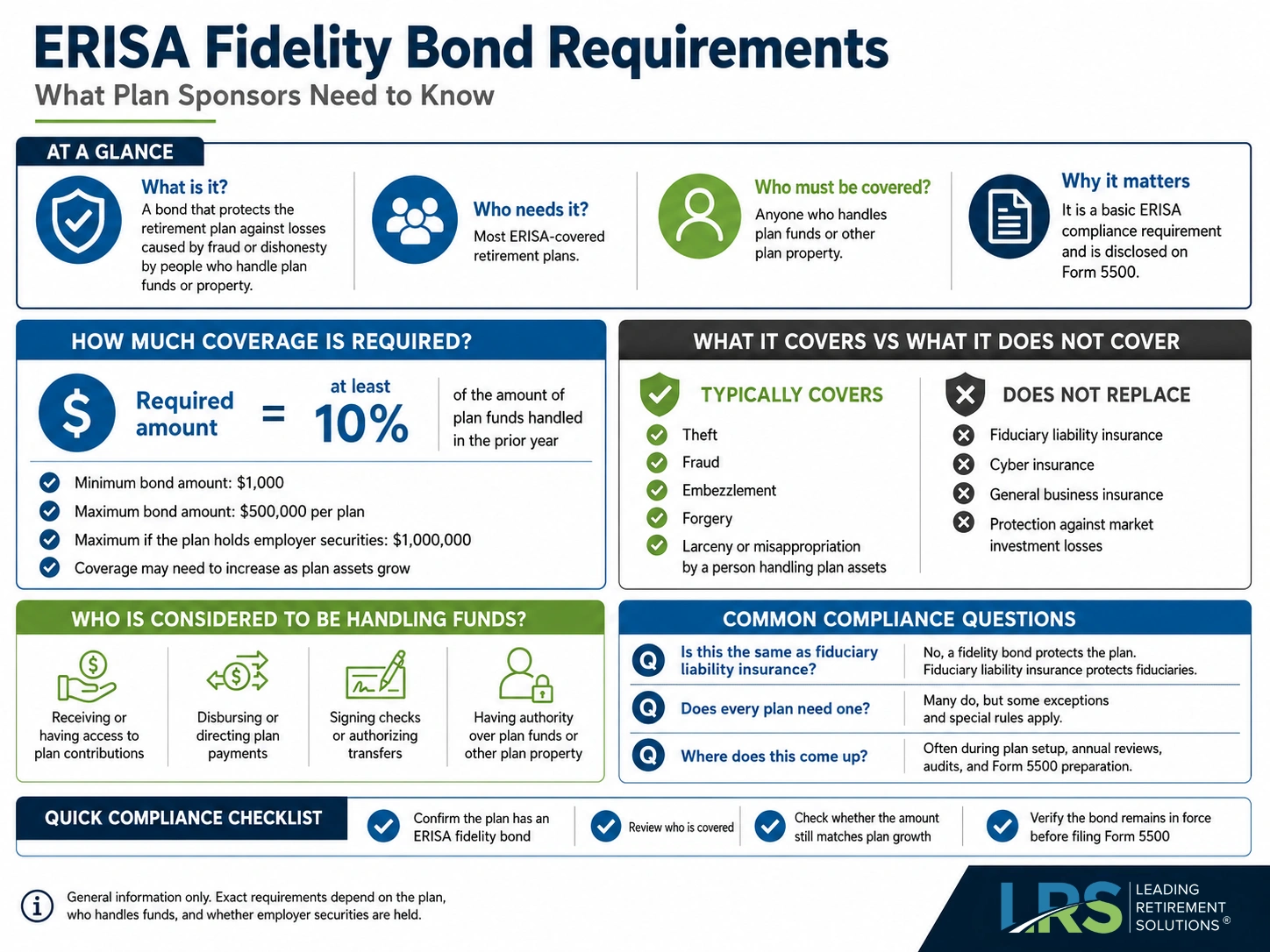
The calculation runs from the amount of funds a person handled, not from the plan’s total assets, and it applies for each plan named on a bond in which that person has handling functions. The regulations governing it are collected in 29 CFR Part 2580, Subpart C.
| Element | What the rules provide |
|---|---|
| Basis of the calculation | At least 10 percent of the amount of funds the person handled in the preceding plan year |
| Minimum | $1,000 per plan for each covered plan official, even where 10 percent is a smaller figure |
| Maximum the Department can require | $500,000 per plan official per plan |
| Maximum where the plan holds employer securities | $1,000,000, for plan years beginning on or after January 1, 2008 |
| Above the maximum | The Secretary of Labor may prescribe a higher amount, not exceeding 10 percent of funds handled, after notice and an opportunity for a hearing |
| When the amount is set | Fixed or estimated at the beginning of the plan’s reporting year, based on the highest amount handled in the preceding plan year |
How the figure is normally arrived at
In practice the bond amount is normally calculated using the total amount of plan assets at the beginning of the plan year, which serves as a working proxy for funds handled rather than the measure the regulations set. The figure the regulations require is measured from the funds the person handled in the preceding plan year, and 29 CFR 2580.412-11 through 2580.412-15 set out how that amount is determined and estimated.
The $1,000,000 figure entered section 412 through section 622 of the Pension Protection Act of 2006. The $500,000 and $1,000,000 amounts are ceilings on what the Department can require rather than caps on coverage. Nothing in section 412 precludes a plan from purchasing a bond in a larger amount, and the Bulletin describes whether to do so as a fiduciary decision subject to ERISA’s prudence standards.
When the amount is fixed, and what happens if funds handled increase
The regulations require that the bond amount be fixed annually with respect to each covered person. It is fixed or estimated at the beginning of the plan’s reporting year, as soon after the date that year begins as the necessary information from the preceding reporting year can practicably be ascertained, and it is based on the highest amount of funds the person handled in the preceding plan year.
The Bulletin addresses the mid-year question directly. Where the amount of funds handled increases during the plan year after the bond is purchased, the bond is not required to be updated during that plan year to reflect the increase.
Where a plan does not have a complete preceding reporting year to measure against, the amount handled must be estimated using the procedures in 29 CFR 2580.412-15. That situation arises for a plan in its first year, which is one of the points at which the calculation comes up when a business establishes a new plan.
Employer securities and the higher maximum
Not every plan whose investments include employer securities is subject to the $1,000,000 maximum. Section 412(a), as amended by section 622 of the Pension Protection Act of 2006, substitutes $1,000,000 for $500,000 in the case of a plan that holds employer securities within the meaning of ERISA section 407(d)(1).
The Bulletin cites the Joint Committee on Taxation’s technical explanation of that provision, which states that a plan would not be considered to hold employer securities where the only securities held by the plan are part of a broadly diversified fund of assets such as a mutual or index fund. On that basis, the Department’s stated view is that a plan is not considered to be holding employer securities for purposes of the increased bonding requirement merely because it invests in a broadly diversified common or pooled investment vehicle that holds employer securities but is independent of the employer and any of its affiliates.
Qualifying employer securities as defined in ERISA section 407(d)(5) are referenced separately in the audit waiver regulation at 29 CFR 2520.104-46, where they appear in the list of qualifying plan assets. That reference concerns the audit waiver’s asset test. Whether the higher section 412 maximum applies turns on whether the plan holds employer securities within the meaning of section 407(d)(1).
Bonds that cover more than one plan
ERISA does not prohibit naming more than one plan as an insured under the same bond. Where that is done, the bond must allow a recovery by each plan in an amount at least equal to what would have been required for that plan under a separate bond. Where a person covered under the bond has handling functions in more than one insured plan, the amount of the bond must be sufficient to cover that person for at least 10 percent of the total amount handled across all the plans insured under the bond, up to the required maximum for each plan.
A claim by one plan cannot reduce the coverage available to other plans insured on the same bond. The bond’s limit of liability must be sufficient to insure each plan as though that plan were bonded separately, and the arrangement must ensure that payment of a loss sustained by one plan does not work to the detriment of any other insured plan with respect to the amount for which that plan is required to be insured. The Bulletin notes this can be achieved through the terms of the bond, through a rider, or through a separate agreement among the parties concerned. It also notes that a bond covering more than one plan may need to exceed $500,000, because the per-plan ceilings apply separately to each plan in which a covered person has handling functions.
The Larger Bond Amount Tied to the Small Plan Audit Waiver
A second bonding figure appears in a different regulation. 29 CFR 2520.104-46 waives the annual examination and report of an independent qualified public accountant for plans with fewer than 100 participants at the beginning of the plan year, subject to conditions. One of those conditions concerns plan assets, and for some plans it produces a required bond amount larger than the section 412 calculation alone would.
For each plan year the waiver is claimed, the regulation requires either that at least 95 percent of plan assets constitute qualifying plan assets, or that any person who handles assets that do not constitute qualifying plan assets be bonded in accordance with section 412 except that the amount of the bond not be less than the value of those assets. Field Assistance Bulletin 2008-04 addresses the interaction, stating that where a bond is intended to meet both section 412 and the audit waiver regulation, it must satisfy the additional requirement under the waiver regulation.
The regulation defines qualifying plan assets, and the categories are:
- qualifying employer securities as defined in ERISA section 407(d)(5)
- any loan meeting the requirements of ERISA section 408(b)(1)
- assets held by a bank or similar financial institution, an insurance company qualified to do business under the laws of a state, an organization registered as a broker-dealer under the Securities Exchange Act of 1934, or any other organization authorized to act as trustee for individual retirement accounts under section 408 of the Internal Revenue Code
- shares issued by an investment company registered under the Investment Company Act of 1940
- investment and annuity contracts issued by an insurance company qualified to do business under the laws of a state
- in an individual account plan, assets in a participant’s or beneficiary’s account over which that person has the opportunity to exercise control and for which that person is furnished, at least annually, a statement from one of the regulated institutions above describing the assets held and the amount of those assets
Qualifying Employer Securities do not fall under this rule. Assets in that category count as qualifying plan assets, so they are not part of the non-qualifying balance the waiver regulation requires a bond to cover.
The regulation’s own example shows how the figure is derived, and it also shows that the bond covers the whole of the non-qualifying assets rather than only the portion above the 5 percent line.
The waiver carries two further conditions beyond the asset test. The summary annual report, or the annual funding notice for plans subject to ERISA section 101(f), must include specified information: the name of each regulated financial institution holding or issuing qualifying plan assets and the amount of those assets as reported by the institution at the end of the plan year, with stated exceptions; the name of the surety company issuing the bond, where the plan has more than 5 percent of assets in non-qualifying plan assets; a notice that participants and beneficiaries may, on request and without charge, examine or receive copies of evidence of the required bond and the institution statements; and a notice identifying the EBSA regional office to contact if they are unable to obtain them. The administrator must also make those statements and evidence of any required bond available for examination, or furnish copies, on request from a participant or beneficiary without charge. The regulation includes model summary annual report language, and the Department has published a set of frequently asked questions on applying the waiver conditions.
Whether a plan meets the asset test, and so whether the waiver is available without a larger bond, is determined plan by plan from that plan’s asset composition. Where the waiver conditions are not met, the annual report includes the independent qualified public accountant’s examination and report described in the regulation. Our pages on large plan audit services and on what the plan audit process involves describe that work.
Bond Terms the Regulations Address
Beyond the amount, the regulations and the Bulletin speak to a number of terms that determine whether a bond satisfies section 412.
The plan as named insured
The plan whose funds are being handled must be specifically named, or otherwise identified on the bond in such a way as to enable the plan’s representatives to make a claim under the bond in the event of a loss due to fraud or dishonesty.
An omnibus clause may be used as an alternative way to identify multiple plans as insureds on one bond rather than naming each plan individually. The Bulletin gives the example of a clause naming as insured all employee benefit plans sponsored by a company, and states that ERISA does not prohibit that approach so long as the clause clearly identifies the insured plans in a way that would enable their representatives to make a claim. Where an omnibus clause is used, the person responsible for obtaining the bond has to ensure the bond terms and limits of liability provide the appropriate amount of required coverage for each insured plan.
No deductible within the required amount
Section 412 requires the bond to insure the plan from the first dollar of loss up to the maximum amount for which the person causing the loss is required to be bonded. On that basis, bonds cannot carry deductibles or similar features whereby a portion of the risk required to be covered is assumed by the plan or transferred to a party that is not an acceptable surety. The Bulletin adds that nothing in ERISA prohibits applying a deductible to coverage in excess of the maximum amount ERISA requires.
The one-year discovery period
ERISA requires that a plan have a one-year period after the termination of a bond in which to discover losses that occurred during the bond’s term. The Bulletin describes how different forms handle this. Bonds written on a loss-sustained basis may contain a clause providing for the discovery period. Bonds written on a discovery basis may not contain such a clause, but may give the plan the right to purchase a one- year discovery period following termination or cancellation.
A bond may provide that the discovery period terminates on the effective date of a replacement bond, but only where the replacement bond provides the statutorily required coverage that would otherwise have been provided under the prior bond’s discovery period. The Bulletin states that where the replacement does not provide that coverage, the bonding arrangement does not meet the requirements of section 412, and that both the terminating bond and the replacement bond warrant examination to confirm the plan is properly insured against losses incurred during the terminating bond’s term but not discovered until after it ended.
Bond forms, and how form affects recovery
The regulations allow substantial flexibility regarding bond forms, so long as the terms meet the substantive requirements of section 412 and the regulations for the persons and plans involved. The Bulletin lists individual bonds, name schedule bonds covering a number of named individuals, position schedule bonds covering the occupants of listed positions, and blanket bonds covering an insured’s officers and employees without a specific list or schedule. A combination of forms may also be used.
Form affects what a plan can recover on a single act, and the Bulletin works through an example on that point.
The Bulletin closes that discussion by stating that it is ultimately the responsibility of the plan fiduciary or plan official procuring the bond to ensure that the type and amount of the bond, together with its terms, limits, and exclusions, are both appropriate for the plan and provide the amount of coverage section 412 requires.
Bonds longer than one year, and inflation guard provisions
Bonds may be written for periods longer than one year, so long as the bond insures the plan for the statutorily required amount. The Bulletin describes what happens at the start of each year: the plan administrator or other appropriate fiduciary assures that the bond continues to insure the plan for at least the required amount, that the surety continues to satisfy the requirements for being an approved surety, and that all plan officials are bonded, obtaining appropriate adjustments or additional protection where necessary for the new plan year.
Nothing in section 412 or the regulations prohibits using an inflation guard provision in a bond to automatically increase the amount of coverage to equal the amount ERISA requires at the time a plan discovers a loss.
Exclusions that do not satisfy section 412
A bond cannot exclude coverage for situations where an employer or plan sponsor knew or should have known that a theft was likely. The Bulletin’s stated reason is that the insured party is the plan, not the employer or plan sponsor.
Many bonds do contain provisions excluding from coverage persons known to have engaged in fraudulent or dishonest acts, and a bond may also cancel coverage for a person whom a plan official knows has engaged in such acts. The Bulletin addresses that situation by stating that in such cases the plan must exclude any such person from handling plan funds or other property where bonding coverage cannot be obtained for that person.
Whether the bond has to state a dollar figure
A bond is not required to state a specific dollar amount of coverage, provided it supplies the required statutory amount per plan of at least 10 percent of funds handled, with minimum coverage of $1,000, for each plan official covered under the bond. The Bulletin gives an example of acceptable wording: a bond stating that a named administrator is covered for the greater of $1,000 or 10 percent of funds handled, up to $500,000.
Where Section 412 Bonds Are Obtained
Bonds must be placed with a surety or reinsurer named on the Treasury Department’s Listing of Approved Sureties, published as Department Circular 570. Under certain conditions bonds may also be placed with the Underwriters at Lloyd’s of London.
One practical note on locating that listing: Field Assistance Bulletin 2008-04 cites it at an fms.treas.gov address that is no longer in service. The listing is now published by the Treasury Department’s Bureau of the Fiscal Service, revised annually with an effective date of August 1, with interim changes posted as they occur.
Section 412(c) and the regulations add a further condition on where a bond comes from. Neither the plan nor a party in interest with respect to the plan may have any control or significant financial interest, whether direct or indirect, in the surety, in the reinsurer, or in an agent or broker through which the bond is obtained. The regulations also address surety failure: where a surety becomes insolvent, is placed in receivership, or has its authority to act as an acceptable surety revoked, the administrator of any plan insured by that surety is responsible, upon learning of those facts, for securing a new bond with an acceptable surety.
Nothing in ERISA prohibits using more than one surety. Persons required to be bonded may be bonded separately or under the same bond, plans may be insured separately or under the same bond, and a bond may be underwritten by a single surety company or by more than one, either separately or on a co-surety basis.
What the rules say about cost
Neither the statute nor the regulations set a price for a section 412 bond. They govern the amount of coverage, who must be covered, the terms the bond must contain, and which companies may issue it. The premium is set by the surety. The only cost observation in the Department’s guidance is comparative rather than numerical: the Bulletin notes that schedule bonds generally cost more than aggregate penalty blanket bonds carrying the same stated limits of liability, because of the potential for a higher recovery under the schedule form.
How the Bond Appears on the Form 5500
The bond is reported on the plan’s annual return. On Schedule H, filed with financial information for large plans, line 4e asks whether the plan was covered by a fidelity bond and provides a field for the amount. Schedule I, used for small plans, asks the same question at line 4e. On the Form 5500-SF, the question appears among the compliance questions at Part V line 10c, and line 10d asks separately whether the plan had a loss, whether or not reimbursed by the plan’s fidelity bond, that was caused by fraud or dishonesty. The current forms and instructions are published on the Department of Labor’s Form 5500 series page.
Because the answer and the amount are reported for each plan year, the filings form a year-over-year record of the coverage a plan reported. Filed Form 5500 and Form 5500-SF returns are available to the public through the Department of Labor’s EFAST2 Form 5500 series search, and the mechanics of requesting and retrieving a filing are covered in our guide to how to get a copy of a retirement plan’s Form 5500.
Where a filing has already been submitted with information that later proves inaccurate, or where a plan receives correspondence from the IRS or the Department of Labor about its filing, the routes available are addressed separately. Our overview of IRS and DOL retirement plan notices covers what those notices typically ask for, what follows an IRS compliance statement covers the step after a correction is accepted, and our plan consulting and correction services page addresses the formal programs.
Questions That Come Up on This Requirement
What is a fidelity bond?
A fidelity bond is a form of insurance that protects against loss caused by acts of fraud or dishonesty. In the retirement plan context, ERISA section 412 requires a specific kind of fidelity bond that protects the plan itself against loss from fraud or dishonesty by the people who handle the plan’s funds or other property. The Department of Labor’s list of covered conduct includes larceny, theft, embezzlement, forgery, misappropriation, wrongful abstraction, wrongful conversion, and willful misapplication, and the Department states that the list is not exhaustive.
Is an ERISA fidelity bond the same as fiduciary liability insurance?
No. Field Assistance Bulletin 2008-04 draws the distinction directly. A section 412 fidelity bond insures the plan against losses due to fraud or dishonesty by persons who handle plan funds or other property. Fiduciary liability insurance generally insures against losses caused by breaches of fiduciary responsibility. Fiduciary liability insurance is neither required by section 412 nor subject to it.
How much fidelity bond coverage does a 401(k) plan need?
Under ERISA section 412, each plan official must be bonded for at least 10 percent of the amount of funds that person handled in the preceding plan year. The amount cannot be less than $1,000, and the Department of Labor cannot require more than $500,000 per plan official per plan, or $1,000,000 where the plan holds employer securities, unless the Secretary of Labor requires a larger bond after a hearing. Because the calculation runs from funds handled rather than from total plan assets, the resulting figure depends on the arrangement and on who performs handling functions.
Who is covered by a fidelity bond?
The persons covered are the plan officials, meaning everyone who handles funds or other property of the plan within the meaning of 29 CFR 2580.412-6, unless an exemption applies. The Department of Labor states that this usually includes the plan administrator and the officers and employees of the plan or plan sponsor whose duties relate to the receipt, safekeeping, and disbursement of plan funds, and that it can extend to service providers whose duties involve access to plan funds or decision-making authority that creates a risk of loss. The plan, rather than those individuals, is the insured party.
Where can a plan obtain a fidelity bond?
Bonds must be placed with a surety or reinsurer named on the Treasury Department’s Listing of Approved Sureties, published as Department Circular 570 by the Bureau of the Fiscal Service. Under certain conditions bonds may also be placed with the Underwriters at Lloyd’s of London. Neither the plan nor a party in interest with respect to the plan may have any control or significant financial interest, direct or indirect, in the surety, the reinsurer, or the agent or broker through which the bond is obtained.
Can an ERISA fidelity bond have a deductible?
Not within the amount the bond is required to cover. Section 412 requires the bond to insure the plan from the first dollar of loss up to the maximum amount for which the person causing the loss is required to be bonded, so deductibles and similar features that shift part of that risk to the plan are prohibited. The Department’s guidance notes that a deductible may apply to coverage in excess of the required maximum.
Does the fidelity bond amount have to be updated when plan assets grow during the year?
The regulations require the amount to be fixed annually rather than adjusted continuously. It is fixed or estimated at the beginning of the plan’s reporting year, based on the highest amount of funds handled in the preceding plan year. Field Assistance Bulletin 2008-04 states that an increase in funds handled during the plan year does not require the bond to be updated during that year. Where a bond runs for more than one year, the plan administrator or other appropriate fiduciary assures at the start of each plan year that the bond still insures the required amount.
Do SEP and SIMPLE IRA plans need a fidelity bond?
Section 412 contains no specific exemption for SEP or SIMPLE IRA plans. Field Assistance Bulletin 2008- 04 states that such plans are generally structured in such a way that if any person does handle their funds or other property, that person falls under one of ERISA’s financial institution exemptions.
Where is the fidelity bond reported?
Schedule H line 4e and Schedule I line 4e ask whether the plan was covered by a fidelity bond and provide a field for the amount. The Form 5500-SF asks the same question at Part V line 10c, and line 10d asks whether the plan had a loss caused by fraud or dishonesty, whether or not the plan’s fidelity bond reimbursed it.
Sources
Every substantive statement above is drawn from the following. Links were verified at the time of writing.
U.S. Department of Labor, Employee Benefits Security Administration
Field Assistance Bulletin 2008-04, Guidance Regarding ERISA Fidelity Bonding Requirements
The 42-question guidance supplying most of the detail above, including handling, exemptions, bond terms, and the amount calculation.
U.S. Department of Labor, Employee Benefits Security Administration
Protect Your Employee Benefit Plan With an ERISA Fidelity Bond
The Department’s plain-language overview of the same requirements for employers and plan sponsors.
Employee Retirement Income Security Act
Section 412, with 29 CFR 2550.412-1 and 29 CFR Part 2580
The statutory bonding requirement and the implementing regulations covering funds handled, bond amount, form, terms, and approved sureties.
Code of Federal Regulations
29 CFR 2510.3-3, employee benefit plan
The regulation addressing when a plan is not treated as covering employees, which bears on whether a plan is subject to Title I of ERISA at all.
Code of Federal Regulations
The audit waiver conditions, the definition of qualifying plan assets, the non-qualifying asset bonding condition, and the model summary annual report language.
U.S. Department of Labor, Employee Benefits Security Administration
Frequently Asked Questions on the Small Pension Plan Audit Waiver Regulation
The Department’s questions and answers on applying the waiver conditions.
U.S. Department of the Treasury, Bureau of the Fiscal Service
The listing of approved sureties with which section 412 bonds must be placed, revised annually effective August 1.
Internal Revenue Service, U.S. Department of Labor, and Pension Benefit Guaranty Corporation
Form 5500, Schedule H, Schedule I, and Form 5500-SF
The annual reporting forms on which the fidelity bond question and amount are reported.
U.S. Department of Labor, Employee Benefits Security Administration
EFAST2 Form 5500 Series Search
The public search through which filed Form 5500 and Form 5500-SF returns, including the reported bond amount, can be retrieved.
U.S. Department of Labor, Employment and Training Administration
The separate no-cost bonding program for employers hiring job seekers who face barriers to employment, included because it is also called a fidelity bond and is frequently confused with the ERISA requirement.
Reviewed by the LRS compliance team in September 2026. Provided for general information only and not legal or tax advice. Bonding outcomes depend on plan terms and facts; confirm your situation with your plan administrator and advisors before acting.