

Last updated
What is a third-party administrator for a retirement plan?
A third-party administrator (TPA) is an outside firm an employer hires to handle the technical administration of a retirement plan such as a 401(k): keeping the plan document current, applying the plan’s eligibility and contribution rules, running the annual compliance tests, and preparing the Form 5500 and participant notices. The Department of Labor notes in Meeting Your Fiduciary Responsibilities that employers often hire outside professionals, sometimes called third-party service providers, to manage some or all of a plan’s day-to-day operations.
What a particular TPA does for a particular plan is set by the plan document and the service agreement, so the same title can describe different arrangements. Some TPAs perform administrative work only, some also act as the plan’s recordkeeper, and some accept a defined fiduciary role in writing. This guide explains each of those pieces, what remains with the employer when a TPA is hired, and what federal guidance suggests employers consider when selecting one.
What a 401(k) TPA typically does
The work below is common to most 401(k) and profit-sharing plans. Which items a given TPA performs, and which sit with the recordkeeper, the payroll provider or the employer, depends on the service agreement. Requirements and service arrangements differ by plan design and provider.
| Area | What the work involves | Where the rule comes from |
|---|---|---|
| Plan document | Drafting or maintaining the written plan, adopting amendments when the law changes, and periodic restatements | IRS 401(k) Plan Fix-It Guide, mistake 1 |
| Eligibility and vesting | Applying the plan’s service and age rules to decide who may participate, and tracking vesting in employer contributions | The plan document |
| Contribution calculations | Calculating matching and profit-sharing allocations using the plan’s definition of compensation, and monitoring the annual limits | IRS Fix-It Guide; current IRS contribution limits |
| Nondiscrimination testing | Running the annual Actual Deferral Percentage and Actual Contribution Percentage tests, and top-heavy testing, and explaining corrective options when a test fails | IRS 401(k) plan overview |
| Annual reporting | Preparing the Form 5500-series return that the plan administrator files each year | DOL, Meeting Your Fiduciary Responsibilities |
| Participant disclosures | Preparing the summary plan description, summary of material modifications, summary annual report and, where the plan auto-enrolls, the automatic enrollment notice | DOL, Meeting Your Fiduciary Responsibilities |
| Distributions and loans | Reviewing requests against the plan’s terms and preparing the related paperwork | The plan document |
| Corrections | Identifying operational errors and helping the employer use the IRS and DOL correction programs | IRS Fix-It Guide; DOL correction programs |
Sources as shown in the right-hand column. Annual dollar limits change each year and are linked rather than printed.
Much of this work is handled through the plan’s administrator, recordkeeper and other service providers, though plan sponsors retain important oversight responsibilities, described below. Our plan administration service covers these tasks for the plans Leading Retirement Solutions administers, and our safe harbor 401(k) guide explains the plan design that removes the annual ADP and ACP tests in exchange for required employer contributions.
TPA, recordkeeper, payroll provider and adviser: how the roles fit together
A 401(k) plan usually draws on several providers at once, and the terms are easy to confuse. The roles are complementary: each one depends on accurate information from the others, and the plan runs well when they coordinate.
| Role | Typical responsibilities | How it connects to the others |
|---|---|---|
| Third-party administrator | Plan document, eligibility and vesting rules, contribution calculations, compliance testing, Form 5500 preparation, notices | Relies on payroll and census data for testing and calculations |
| Recordkeeper | Participant accounts, deferral elections, investment directions, contributions and distributions processing, participant website and statements | Receives contribution data from payroll; supplies account data for testing and reporting |
| Payroll provider | Withholding deferrals from pay and producing the compensation and hours data the plan uses | In many cases the primary source of the data the TPA and recordkeeper work from |
| Investment adviser | Recommending or managing the plan’s investment menu, depending on the engagement | Works from the investment options the recordkeeper makes available |
| Auditor | The independent accountant’s report that larger plans attach to the Form 5500 | Reviews records produced by the administrator and recordkeeper |
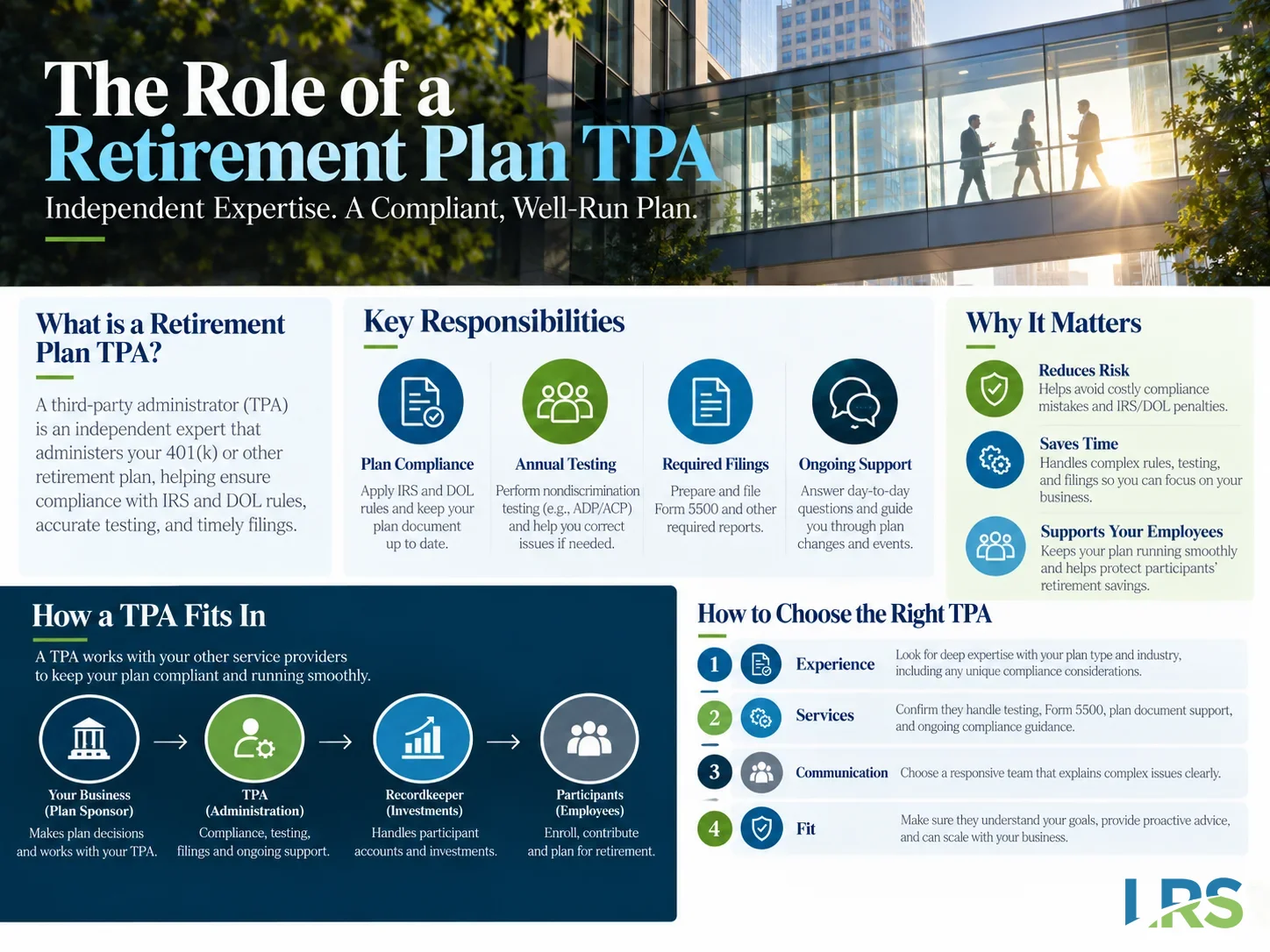
Some providers combine several of these services in one arrangement for a single fee, which the Department of Labor calls “bundled services” in its tips for selecting and monitoring service providers. Others provide each service separately. Both structures are common, and the DOL’s guidance treats either as an option employers may consider. Leading Retirement Solutions provides both plan administration and recordkeeping, and coordinates with the plan’s payroll provider through its enhanced payroll and data integration services.
How contribution data moves between payroll and the recordkeeper, and why the timing matters, is covered in our guide to payroll integration. The payroll partner directory lists the payroll systems LRS currently works with.
A TPA’s year for a calendar-year plan
Much of a TPA’s work follows the plan year. For many calendar-year plans, the dates below are the ones most commonly referenced, and they show where administration, recordkeeping and the employer’s own role meet. Our retirement plan deadlines guide covers each date in more detail.
| Date | What falls due | How administration connects |
|---|---|---|
| January 31 | Form 1099-R furnished to recipients of prior-year distributions | Typically handled by recordkeepers or service providers |
| Early in the year | Year-end census and payroll data for the prior plan year | The starting point for testing, allocations and the Form 5500 |
| March 15 | Corrective distributions after certain ADP or ACP test failures | Generally coordinated by the plan administrator, TPA or recordkeeper |
| July 31 | Form 5500 due, or October 15 with a Form 5558 extension | Prepared for the plan administrator, who files it |
| September 30 | Summary annual report to participants, or December 15 where the filing was extended | Prepared from the Form 5500 information |
| At least 30 days before the next plan year | Annual automatic enrollment notice, where the plan auto-enrolls | Prepared from the plan’s current terms |
Sources: IRS Form 5500 Corner; DOL, Meeting Your Fiduciary Responsibilities. Dates shown for a calendar-year plan.
A plan that fails the ADP or ACP nondiscrimination tests may make corrective distributions to avoid a 10 percent excise tax. For a calendar-year plan, corrective distributions following certain ADP or ACP test failures are commonly completed by March 15 to avoid excise-tax consequences that may apply after the correction period. The applicable deadline depends on the plan year and the nature of the correction.
What a TPA needs from the employer
The TPA’s calculations are only as accurate as the information it receives. Year-end work typically starts from an employee census: dates of hire, birth and termination, hours worked, compensation, and ownership and family relationships, which determine who counts as highly compensated for testing. The IRS Fix-It Guide gives the example of a change to the plan’s definition of compensation, which should be communicated to everyone involved in withholding deferrals, running nondiscrimination tests or allocating employer contributions. Payroll is typically the primary source of this data, which is why the connection between payroll, the recordkeeper and the TPA matters as much as any single provider.
What stays with the employer when a TPA is hired
Hiring a TPA moves work off the employer’s desk, but it does not move every responsibility. The IRS states in its 401(k) Plan Fix-It Guide that the plan sponsor is responsible for keeping the plan in compliance with the tax laws, even though many employees, vendors and tax professionals may service the plan. The Department of Labor makes a similar point from the ERISA side: even when employers hire third-party service providers, certain functions can still make the employer a fiduciary. The DOL’s Meeting Your Fiduciary Responsibilities identifies several of these functions:
- Choosing the provider. The DOL states that hiring a service provider is in and of itself a fiduciary function, and that the decision should be documented.
- Monitoring the provider. The DOL describes a formal review at reasonable intervals: reviewing performance, reading the provider’s reports, checking the fees actually charged and following up on participant complaints.
- Depositing employee contributions on time. Participant deferrals must be deposited as soon as they can reasonably be segregated from the employer’s assets. For plans with fewer than 100 participants, deposits made within seven business days of withholding are treated as timely.
- Following the plan document. The DOL notes that employers will want to be familiar with their plan document, especially when a third-party service provider drew it up, and to review it periodically.
- Paying only reasonable plan expenses. Fees charged to the plan must be reasonable, and the DOL describes cost as one factor among several rather than the deciding one.
When something goes wrong, where responsibility sits depends on the source of the error, the duties each party was assigned and the terms of the service agreements. A deferral withheld at the wrong rate, a missed eligibility date and a late deposit may each trace back to a different party, which is why clear written responsibilities matter at the start of the relationship.
Department of Labor regulations also explain why a TPA’s role is often described as administrative rather than fiduciary. Under 29 CFR 2509.75-8, a person who performs purely ministerial functions, such as applying eligibility rules, preparing government reports or maintaining participant records, within a framework of policies set by others, is not a fiduciary because of that work alone. The same regulation allows a plan fiduciary to rely on information such a person provides, as long as the fiduciary exercised prudence in selecting and retaining them.
3(16), 3(21) and 3(38): what the ERISA section numbers mean
Provider agreements often refer to fiduciary roles by their section numbers in ERISA section 3, which is codified at 29 U.S.C. 1002. The numbers describe roles, not job titles, and a provider holds a fiduciary role only to the extent the plan document and agreement give it that role or it performs the functions the statute describes.
| Section | Role | What the statute says |
|---|---|---|
| 3(16) | Plan administrator | The person designated as administrator in the plan document. If no one is designated, the administrator is the plan sponsor, as the DOL restates in 29 CFR 2510.3-16. |
| 3(21) | Fiduciary | Anyone who exercises discretionary authority or control over plan management or assets, gives investment advice for a fee, or has discretionary authority or responsibility in plan administration, to the extent of that authority. |
| 3(38) | Investment manager | A fiduciary with power to manage, acquire or dispose of plan assets that is a registered investment adviser, a bank or a qualifying insurance company, and that has acknowledged its fiduciary status in writing. |
| 3(44) | Pooled plan provider | The person a pooled employer plan designates as named fiduciary, plan administrator and the party responsible for the administrative duties needed to keep the plan qualified. |
Source: 29 U.S.C. 1002(16), (21), (38) and (44).
The DOL explains that a fiduciary can hire a service provider to handle fiduciary functions and set up the agreement so that the provider assumes liability for the functions selected. The appointing fiduciary still remains responsible for selecting that provider prudently and monitoring it, under the prudence standard in ERISA section 404(a).
The same structure appears in pooled employer plans. The statute requires each employer in a pooled employer plan to retain fiduciary responsibility for selecting and monitoring the pooled plan provider, even though the provider takes on the plan administrator role. Our article on pooled employer plans explains how these arrangements divide responsibilities between employers and providers.
How to evaluate a retirement plan TPA
The Department of Labor’s tips for selecting and monitoring service providers begin with a practical step: give each prospective provider identical and complete information about the plan, so the responses can be compared on the same basis. The DOL adds that fiduciaries are not always required to pick the least costly provider, since cost is only one factor to consider. The questions below draw on that guidance and on the DOL’s fiduciary booklet.
| Question employers often ask | Why it matters | Source |
|---|---|---|
| Which services are included, and which are not? | The DOL suggests asking each provider to be specific about what is covered, so services can be compared like for like. | DOL tips, no. 5 |
| Will the firm act as a fiduciary for any part of the plan, and in what role? | Where it applies, the required service provider disclosure must include a statement that the provider will serve as a fiduciary. A written role helps show who holds which responsibility. | 29 CFR 2550.408b-2(c)(1)(iv)(B) |
| How is the firm compensated, directly and indirectly? | Covered service providers must describe the services and all direct and indirect compensation they expect to receive, which helps the employer assess reasonableness and conflicts of interest. | DOL 408(b)(2) fact sheet |
| What experience does the firm have with plans like ours? | The DOL lists experience with plans of similar size and complexity, and the qualifications of the people who will handle the account. | DOL, Meeting Your Fiduciary Responsibilities |
| How does the firm work with our recordkeeper and payroll provider? | Testing, calculations and deposits all depend on data moving accurately between providers. | IRS Fix-It Guide, mistake 2 |
| Is the firm covered by a fidelity bond if it handles plan assets? | The DOL suggests confirming that a provider handling plan assets has a fidelity bond. | DOL tips, no. 6 |
| How does the firm protect participant data? | The DOL asks fiduciaries to consider a provider’s information security standards, audit results and insurance coverage. | DOL cybersecurity tips |
| How are errors identified and corrected? | Operational errors are a common source of plan problems, and correction programs have their own procedures. | IRS Fix-It Guide |
| What reports will the firm provide, and how often? | The DOL suggests obtaining a commitment to regular information about the services provided, which supports ongoing monitoring. | DOL tips, no. 10 |
Sources: DOL, Tips for Selecting and Monitoring Service Providers for Your Employee Benefit Plan; DOL, Meeting Your Fiduciary Responsibilities (September 2021); DOL, Fact Sheet: Final Regulation Relating to Service Provider Disclosures Under Section 408(b)(2).
The DOL also suggests preparing a written record of the process followed in reviewing potential providers and the reasons for the selection, which may help answer questions about the decision later. Confirming provider capabilities early may help avoid implementation challenges later in the process.
How TPA fees are paid
According to the Department of Labor, plan expenses may be paid by the employer, by the plan, or by both, and expenses paid by the plan may be allocated to participants’ accounts in different ways. The plan document should specify how fees are paid. Depending on provider agreements and plan design, certain administrative expenses may be paid by the employer, from plan assets when permissible, or through investment-related fees, as the DOL’s guide to understanding retirement plan fees and expenses describes.
Changing TPAs or recordkeepers
Employers review their providers for many reasons: a plan that has grown, a new payroll system, a change in plan design or a change in the services the business needs. Because the DOL describes monitoring as an ongoing fiduciary duty, a periodic review of the current arrangement is part of running the plan whether or not a change follows.
When a change does involve moving participant accounts, a blackout period often follows, during which participants cannot direct investments, take loans or request distributions. The DOL’s fiduciary booklet notes that participants must receive at least 30 but not more than 60 days’ advance notice before a 401(k) or profit-sharing plan is closed to participant transactions, and that blackout periods typically occur when plans change recordkeepers or investment options. A transition may also involve updating or restating the plan document and confirming how contribution data will flow from payroll to the new provider. Transition requirements, timelines, and implementation activities may vary based on plan design, service providers, payroll systems, and the condition of existing plan data. Our plan upgrade service describes how Leading Retirement Solutions approaches a move from an existing plan.
Where a TPA fits for state retirement mandates
Many states now require employers that do not offer a retirement plan to facilitate a state-run program, as set out on our state retirement mandate pages and in our guide to which states have retirement plan mandates. Offering a qualifying employer-sponsored plan is the other route, and it is the route that brings plan administration into the picture: the plan needs a document, testing, reporting and the other work described above. Which plans a state accepts in place of its program is covered in our guide to qualifying plans.
Certain employers may qualify for federal retirement plan startup tax credits. Section 45E counts the ordinary and necessary expenses of establishing or administering a new plan as qualified startup costs, according to the Form 8881 instructions, and our article on retirement plan tax credits and deductions explains how the credit works. Tax credits and deductions depend on an employer’s specific facts and tax situation, so businesses should consult their tax advisor regarding eligibility and reporting.
For financial advisors and other partners
Many retirement plans are introduced by a financial advisor, CPA or benefits broker, and the TPA works alongside that professional rather than in place of them. The DOL notes that an adviser who gives specific investment advice to participants is a fiduciary, while the administrative work described in this guide is a separate set of services. Leading Retirement Solutions supports advisors and other partners through its partner solutions and white label services, which provide plan administration behind the partner’s own client relationship.
Questions employers ask about retirement plan TPAs
What is a TPA for a 401(k)?
A third-party administrator is an outside firm that handles a 401(k) plan’s technical administration, typically including the plan document, eligibility and contribution calculations, compliance testing, Form 5500 preparation and participant notices. The exact services depend on the service agreement.
Is a TPA a fiduciary?
It depends on the role. Under 29 CFR 2509.75-8, a firm that performs purely ministerial functions within policies set by others is not a fiduciary because of that work alone. A firm that exercises discretion over plan administration or assets, or that accepts a fiduciary role such as 3(16) administrator in writing, is a fiduciary to that extent.
What is the difference between a TPA and a recordkeeper?
A recordkeeper typically maintains participant accounts, processes contributions and distributions and provides the participant website, while a TPA typically handles plan-level compliance such as testing, calculations and reporting. Some firms provide both services, and the two roles work closely together.
Does a small business need a TPA?
Federal law requires every plan to have a plan administrator, which is the plan sponsor unless the plan document designates someone else, under 29 U.S.C. 1002(16). It does not require that an outside firm fill that role. The DOL notes that many businesses rely on other professionals for their plan duties, and that selecting competent service providers is one of a plan sponsor’s most important responsibilities.
What does a 3(16) administrator do?
A 3(16) administrator is the person designated as plan administrator under ERISA section 3(16). When a provider accepts that role in writing, it takes on the administrative duties the agreement assigns, while the employer generally remains responsible for selecting and monitoring the provider.
Who files the Form 5500?
The DOL states that plan administrators generally are required to file the Form 5500 annual return/report. A TPA commonly prepares the return for the administrator’s review and signature. Our Form 5500 guide covers the filing and how to look up past returns.
How are TPA fees paid?
Plan expenses may be paid by the employer, the plan, or both, according to the DOL, and the plan document should specify how fees are paid. Covered service providers must disclose the services they provide and the direct and indirect compensation they expect to receive.
Can an employer change TPAs?
Generally yes, subject to the terms of the service agreement, and the DOL describes periodic review of service providers as part of a fiduciary’s monitoring duty. Where a change involves moving participant accounts, a blackout notice generally must be provided 30 to 60 days in advance.
Working with Leading Retirement Solutions
Leading Retirement Solutions is a third-party administrator based in Seattle that provides plan administration and recordkeeping for employers nationwide. The plan types it supports include 401(k), 403(b), defined benefit, cash balance, money purchase and church plans, as well as multiple employer plans and pooled employer plans. For certain plans, Leading Retirement Solutions may provide 3(16) administrative fiduciary services. Any fiduciary responsibilities assumed by LRS depend on the services selected and are expressly described in the applicable service agreement. It also works with specialized arrangements such as ROBS plans and cannabis retirement plans, and provides consulting and correction services, large plan audit support and plan termination services.
Employers starting a first plan can learn more about starting a new plan, and those reviewing an existing arrangement can learn more about upgrading a current plan. To talk through a specific plan, contact our team.
Sources
Every rule in this article comes from the Department of Labor, IRS and federal law sources below, each opened and read in September 2026. Annual dollar limits change each year and are linked rather than printed.
U.S. Department of Labor, EBSA
- Meeting Your Fiduciary ResponsibilitiesEmployers often hire third-party service providers; hiring a service provider is a fiduciary function; monitoring steps; deposit timing for participant contributions; the plan document; reasonable fees and bundled services; a fiduciary may hire a provider to handle fiduciary functions and assume liability for them; plan administrators file the Form 5500; participant disclosures; blackout notice timing; investment advisers as fiduciaries.September 2021
- Tips for Selecting and Monitoring Service Providers for Your Employee Benefit PlanThe twelve tips cited by number in the evaluation table, including identical information to each provider, bundled services, cost as one factor, fidelity bonds, a written record of the selection process and regular reporting.No publication date shown
- Fact Sheet: Final Regulation Relating to Service Provider Disclosures Under Section 408(b)(2)Covered service providers, including third party administration where indirect compensation is received; disclosure of services and direct and indirect compensation.February 2012
- Understanding Retirement Plan Fees and ExpensesAdministrative expenses may be paid by the employer, from plan assets or through investment-related fees, depending on arrangements.No publication date shown
- Tips for Hiring a Service Provider with Strong Cybersecurity PracticesInformation security standards, audit results and insurance as considerations when selecting a provider.No publication date shown
Code of Federal Regulations
- 29 CFR 2550.408b-2(c)(1)(iv)(B)The statement of fiduciary status required in a covered service provider’s disclosure, where applicable.Current regulation text, checked September 2026
- 29 CFR 2509.75-8, questions D-2 and FR-11Persons performing purely ministerial functions within policies set by others are not fiduciaries for that reason; a fiduciary may rely on information from such persons if they were prudently selected and retained.Current regulation text
- 29 CFR 2510.3-16Definition of plan administrator: the person designated in the plan instrument or, if none, the plan sponsor.Current regulation text
United States Code (ERISA)
- 29 U.S.C. 1002 (ERISA section 3)Definitions of administrator (16), fiduciary (21), investment manager (38), pooled employer plan (43), including each employer’s retained duty to select and monitor the pooled plan provider, and pooled plan provider (44).Office of the Law Revision Counsel, laws in effect September 13, 2026
- 29 U.S.C. 1104 (ERISA section 404)The prudent person standard of care.Office of the Law Revision Counsel, current code text
Internal Revenue Service
- 401(k) Plan Fix-It GuideCommon plan mistakes, including out-of-date plan documents and operational errors, and the correction routes.Current web page
- Fix-It Guide: You didn’t base the plan operations on the terms of the plan documentThe plan sponsor is responsible for keeping the plan in compliance even when vendors service the plan; communicating compensation definition changes to everyone servicing the plan.Current web page
- 401(k) plan overviewADP and ACP nondiscrimination testing.Page last reviewed or updated August 4, 2026
- Form 5500 CornerThe Form 5500 due date and the Form 5558 extension.Page last reviewed or updated July 20, 2026
- Instructions for Form 8881Qualified startup costs include the expenses of establishing or administering a new plan.Page last reviewed or updated April 30, 2026
Last reviewed