Last updated
Do state retirement mandates apply to cannabis companies?
Generally, yes. State retirement mandates decide coverage by the number of employees a business has in the state and whether it already offers a qualified retirement plan, not by the industry it operates in. California’s program, for example, states that employers with one or more California employees that do not sponsor a qualified plan must register, and lists religious, tribal and government organizations among those exempt, according to the CalSavers frequently asked questions. A licensed dispensary, cultivator or brand with employees in a mandate state is therefore generally in the same position as any other employer there.
That leaves cannabis employers with the same two routes as every other covered business: facilitate the state’s program, or offer a qualified employer-sponsored plan such as a 401(k) and file the state’s exemption. Cannabis businesses can sponsor 401(k) plans, as our cannabis 401(k) employer guide explains. This guide covers how the state programs and a 401(k) compare, what California, Oregon and Washington each require, how payroll deductions work under either route, and what changes for operators with employees in more than one state.
State program rules and federal tax treatment depend on an employer’s specific facts, so businesses should consult their tax advisor and legal counsel regarding eligibility, compliance and reporting.
Two ways to meet a state mandate
The state programs and an employer-sponsored plan both give employees a way to save through payroll, but they are built differently. The table compares them on the points state program materials and federal guidance address.
| Point of comparison | State program (CalSavers, OregonSaves) | Employer-sponsored plan, such as a 401(k) |
|---|---|---|
| Type of account | A Roth IRA for each enrolled employee | An account in the employer’s plan, which may allow pre-tax and Roth deferrals |
| Employer contributions | Not permitted: both programs state that employers cannot contribute to employee accounts | Permitted if the plan document provides for them, such as matching or profit-sharing contributions |
| Contribution limits | IRA limits | 401(k) limits, which are higher; see the current IRS contribution limits |
| Employer’s role | Register, keep the employee roster current and remit payroll deductions | Sponsor the plan, with the fiduciary duties described by the Department of Labor, usually supported by a plan administrator and recordkeeper |
| Fiduciary status | California law states that employers are not fiduciaries of CalSavers | Plan fiduciaries must act prudently and in participants’ interest under ERISA |
| Plan design | Set by the state, including the default contribution rate and investments | Set by the plan document, including eligibility, vesting and employer contributions |
| Federal startup and contribution credits | Not available, because the program is not an employer plan | Section 45E credits may be available to eligible employers, subject to the federal tax treatment discussed below |
Sources: CalSavers, employer help center: registration and contribution; OregonSaves, employers; DOL, Meeting Your Fiduciary Responsibilities; IRS, Instructions for Form 8881.
What enrolled employees see
Under a state program, an enrolled employee has a Roth IRA funded by payroll deductions at the program’s default rate, which the employee can change or opt out of. OregonSaves, for example, describes a default savings rate of 5 percent of gross pay, according to its employer page. Under a 401(k), the employee’s options, including any employer contribution, vesting schedule and investment menu, are set by the plan document, and the employee can generally defer more each year because 401(k) limits are higher than IRA limits.
Neither route is right for every business, and the choice belongs to the employer and its advisors. What the comparison shows is that the two routes involve different responsibilities, and that the plan route is the one where employer contributions and plan design come into play. Our guide to qualifying plans explains which plans each state accepts in place of its program, and our article on retirement plan tax credits and deductions explains the federal credits that attach to the plan route.
California: CalSavers and cannabis employers
According to the CalSavers FAQ, the program assesses each employer’s mandate status every spring using the employee data employers report to the Employment Development Department. Employers that reported one or more employees on the four DE9C filings for the prior year are mandated and have a registration deadline of December 31.
Because the assessment repeats every year, a newly opened dispensary or a business that has just hired its first employee can become covered in a later year even if it was not covered before. Employers that already offer a qualified plan are exempt but are asked to report the exemption on the CalSavers employer portal.
- Who counts. California employees age 18 or older are generally eligible regardless of hours worked. Employers must add eligible new employees to the CalSavers portal within 30 days of hire, and employees then receive a 30-day decision period before payroll deductions begin. Source: CalSavers small business FAQ.
- The employer’s role. California law states that employers are not fiduciaries of the program and are not responsible for its administration beyond registering, remitting payroll deductions and maintaining employee rosters, according to the CalSavers employer help center.
- No employer money. Employers are not allowed to contribute to employee accounts in the program, according to the CalSavers help center.
Current deadlines, thresholds and enforcement details for California are maintained on our California retirement mandate page, which the LRS compliance team reviews as the program changes.
Oregon: OregonSaves and cannabis employers
OregonSaves was the first state auto-IRA program, and it applies to Oregon employers with one or more employees that do not offer a qualified retirement plan. The program states that it applies only to businesses that do not offer a qualified plan, and that employers that already offer one certify their exemption using their access code and EIN, according to OregonSaves. Employers cannot make contributions to employee accounts, which are Roth IRAs.
OregonSaves describes failure to administer the program without a qualified plan as an unlawful practice under ORS 178.205, with enforcement and penalty details set out on its compliance page. Employers offering a qualified plan certify their exemption and renew that certification every three years, as our Oregon retirement mandate page sets out.
Washington: Washington Saves and cannabis employers
Washington’s program, Washington Saves, was enacted in 2024 and is established under chapter 19.05 RCW. It has not launched yet. Washington Saves is scheduled to begin July 1, 2027, although the governing board may phase in implementation. Employer registration timing and any applicable phase-in schedule remain subject to additional guidance, as our Washington retirement mandate page notes.
Once it launches, the program will apply to covered employers. According to the Washington Department of Labor and Industries, those are employers that have been in business in the state for at least two years, do not offer a qualified retirement plan to covered employees with continuous employment of one year or more, and had employees working a combined minimum of 10,400 hours during the previous calendar year. Covered employers will register, provide information about covered employees, distribute program disclosures, automatically enroll covered employees while allowing them to opt out, and withhold and timely remit contributions.
The statute states that Washington Saves is intended to encourage, not replace or compete with, employer-sponsored retirement plans. For Washington cannabis employers, the period before launch leaves time to confirm whether the business will be covered and which route fits it. Leading Retirement Solutions is based in Seattle, and our Washington page is updated as the state publishes program guidance.
Multi-state cannabis operators
Coverage generally follows where employees work, not where an employer is incorporated. An MSO with employees in California, Illinois, and Massachusetts may be subject to three different state retirement-program regimes, each with its own requirements and deadlines. A qualifying 401(k) will generally satisfy the retirement-plan exemption requirements across those states, eliminating the need to participate in multiple state-run programs. For many multi-state operators, that administrative simplicity is one of the strongest arguments for sponsoring a plan instead of managing state-by-state compliance.
Each program keeps its own exemption process, so an operator with a single plan may still have a filing to make in each state: an exemption reported on the CalSavers portal, a certification with OregonSaves renewed every three years, and whatever process Washington adopts. Related businesses add a further question, because federal rules can treat commonly controlled companies as one employer for plan purposes, as the Form 8881 instructions describe for the startup credit. The current position in every state with a program is on our state retirement mandate map, and our guide to which states have retirement plan mandates explains how the programs differ.
An example: one operator, three West Coast states
A hypothetical operator shows how the rules combine. It has run dispensaries in California and Oregon and a processing facility in Washington for several years, with 40 employees in California, 8 in Oregon and 15 full-time employees in Washington, and it does not yet offer a retirement plan.
| State | Position without a plan | Position with a qualifying 401(k) |
|---|---|---|
| California | Mandated, because the employer reports one or more California employees; registers with CalSavers and facilitates payroll deductions | Exempt; reports the exemption on the CalSavers employer portal |
| Oregon | Covered, because it has one or more Oregon employees; registers with OregonSaves | Exempt; certifies the exemption and renews it every three years |
| Washington | Expected to be covered once Washington Saves launches if it meets Washington’s covered-employer requirements: at least two years in business in the state, no qualified plan for covered employees, and at least 10,400 combined employee hours in the prior calendar year | Expected to be exempt, subject to the exemption process the state adopts |
Hypothetical. Applies the program rules described above; each state’s current rules are on its LRS state page.
Without a plan, the operator could be facilitating up to three different state programs through payroll, one of which has not yet published its registration process. A qualifying 401(k) generally allows the employer to administer one retirement plan across its operations while maintaining any required state exemption filings. It can also choose whether to make employer contributions, which none of the state programs allow.
Other states with retirement programs
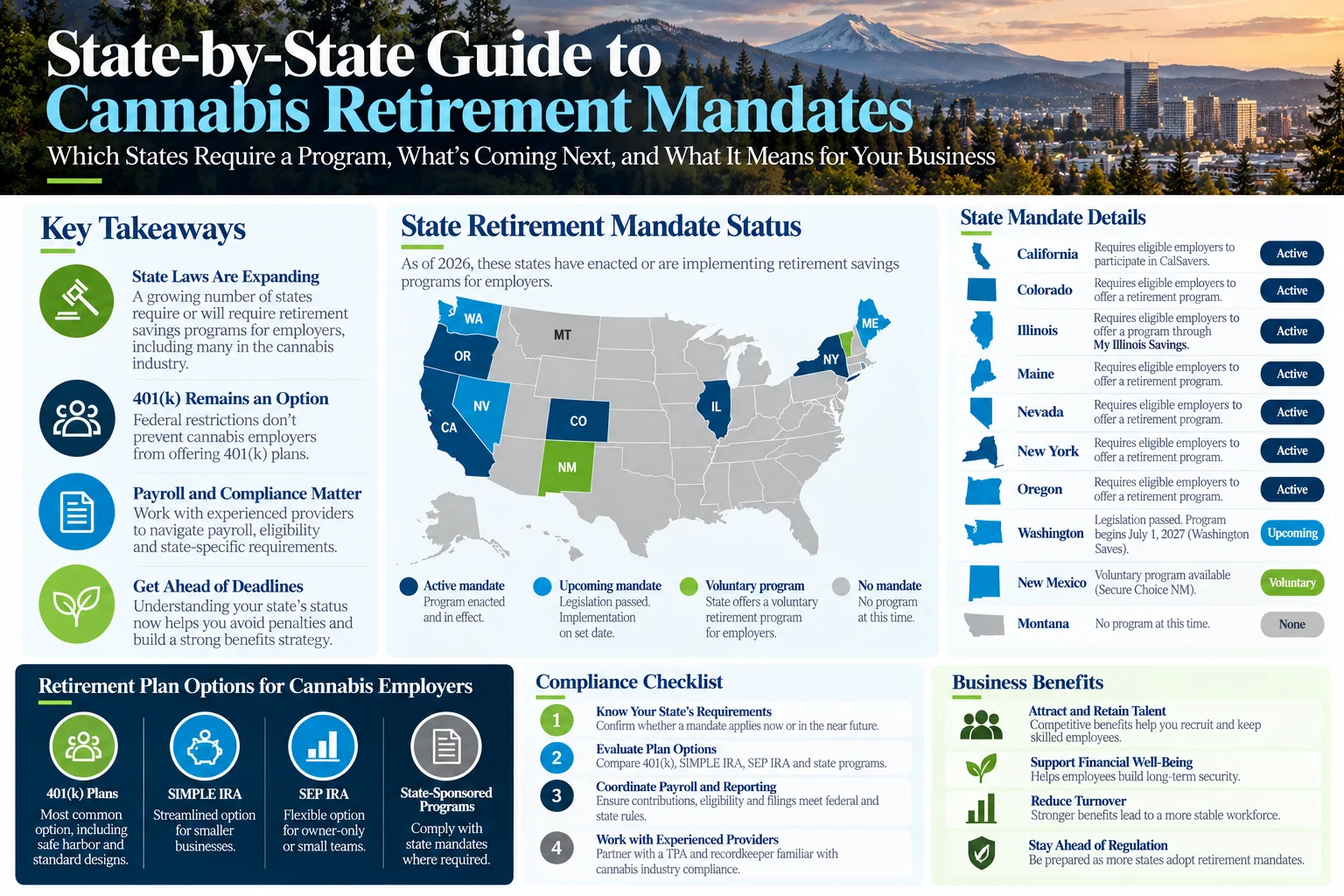
California, Oregon and Washington are three of the 22 states with a program page on our state retirement mandate map. The table lists the others with each program’s current status. Coverage thresholds, deadlines and enforcement change as states amend their programs, so they are kept on each state page rather than repeated here.
| State | Program | Status |
|---|---|---|
| Colorado | Colorado SecureSavings | Active mandate |
| Connecticut | MyCTSavings | Active mandate |
| Delaware | Delaware EARNS | Active mandate |
| Hawaii | Hawaii Retirement Savings Program | Enacted, launching |
| Illinois | My Illinois Savings | Active mandate |
| Maine | MERIT | Active mandate |
| Maryland | MarylandSaves | Active mandate |
| Massachusetts | Massachusetts Defined Contribution CORE Plan | Voluntary program |
| Minnesota | Minnesota Secure Choice | Not currently enforced |
| Mississippi | Mississippi Work and Save | Voluntary program |
| Missouri | Show-Me MyRetirement Plan | Voluntary program |
| Nevada | Nevada Employee Savings Trust | Active mandate |
| New Jersey | RetireReady NJ | Active, deadlines phasing in |
| New Mexico | New Mexico Work & Save | Voluntary program |
| New York | New York State Secure Choice | Active, deadlines phasing in |
| Rhode Island | RISavers | Active, deadlines phasing in |
| Utah | Utah Retirement Plan Exchange | Voluntary program |
| Vermont | VT Saves | Active mandate |
| Virginia | RetirePath Virginia | Active, deadlines phasing in |
Status as shown on each LRS state page, reviewed by the LRS compliance team in July 2026. Voluntary programs do not require employers to participate.
What cannabis employers typically confirm each year
Because state coverage is reassessed and exemptions expire, compliance is an annual cycle rather than a one-time filing. The points below reflect how the programs described above operate.
- Employee counts by state. CalSavers assesses mandate status each spring from the prior year’s EDD filings, and Washington Saves will measure combined hours in the previous calendar year.
- Exemption filings and renewal dates. An exemption reported to one state does not carry over to another, and OregonSaves certifications are renewed every three years.
- New locations and new entities. A new store or a new licensed entity can bring employees into a state’s program, and related entities may be treated together for federal plan purposes.
- Plan coverage. Whether the plan’s eligibility terms reach the employees in each state, which is what the state exemptions generally rely on.
- Payroll data. Whether the payroll system, recordkeeper and plan administrator are working from the same employee and compensation records.
Dispensary payroll deductions under either route
Both routes run through payroll, and in both the employer’s payroll process is where most of the day-to-day work happens.
| Payroll step | State program | 401(k) plan |
|---|---|---|
| Enrollment | Employees are enrolled by the program and may opt out; in California, eligible new employees are added within 30 days of hire, followed by a 30-day decision period before deductions begin | Set by the plan document; many new 401(k) plans must include automatic enrollment under section 414A |
| Withholding | At the program’s default rate unless the employee changes it | At the employee’s deferral election, using the plan’s definition of compensation |
| Remitting | Remitted to the program on the schedule its rules set | Deposited as soon as it can reasonably be segregated from the employer’s assets; for plans with fewer than 100 participants, within seven business days of withholding is treated as timely |
| Employer contributions | None permitted | As the plan provides, calculated from payroll data |
Sources: CalSavers small business FAQ; OregonSaves, employers; Washington L&I; DOL, Meeting Your Fiduciary Responsibilities.
For a 401(k), how the plan treats items such as bonuses, commissions or tips depends on the plan document’s definition of compensation, which payroll, the recordkeeper and the plan administrator all apply. Payroll is typically the primary source of the data the plan relies on, and the payroll provider and recordkeeper work together to move it accurately. Our guide to payroll integration explains how contribution files move between the two, our payroll provider guide covers how individual payroll systems connect, and the payroll partner directory lists the systems LRS currently works with. Automatic enrollment requirements for new plans are covered in our automatic enrollment article.
Who can participate in a cannabis 401(k)
Most W-2 employees who meet the plan’s eligibility requirements can participate in a 401(k). Owners and employees generally participate in the same plan and are subject to the same contribution limits. For plans that require nondiscrimination testing, the contribution levels of highly compensated employees are compared with those of other eligible employees, making broad participation an important consideration for many employers. Automatic enrollment, employer matching contributions, and Safe Harbor plan designs can all help support participation and compliance goals.
The annual testing referred to above is the Actual Deferral Percentage and Actual Contribution Percentage testing described in the IRS 401(k) plan overview. Our safe harbor 401(k) guide explains the design that replaces those tests with required employer contributions.
Federal tax questions for cannabis employers
A cannabis employer’s federal tax position affects how its plan contributions and plan-related credits are treated, and that position depends on the business’s license type and activities. How Section 280E applies to employer contributions and credits, and how the 2026 rescheduling order affects medical-licensed businesses, is covered in our cannabis tax deductions article. Employee deferrals are generally treated under the same plan rules that apply at any other employer. Tax credits and deductions depend on an employer’s specific facts and tax situation, so businesses should consult their tax advisor regarding eligibility and reporting.
Questions cannabis employers ask about benefits and state mandates
Do cannabis companies have to follow state retirement mandates?
Generally, yes. The programs decide coverage by employee counts and whether the employer offers a qualified plan, and industry is not among the exemptions the programs list. Each state’s current rules are on our state mandate pages.
Can a dispensary offer a 401(k) instead of CalSavers?
Yes. CalSavers states that employers that already offer a qualified retirement plan are exempt, and asks them to report the exemption on its employer portal.
Can a cannabis employer contribute to CalSavers or OregonSaves accounts?
No. Both programs state that employers cannot contribute to employee accounts. Employer contributions are available only through an employer-sponsored plan whose document provides for them.
Do part-time budtenders count for CalSavers?
California employees age 18 or older are generally eligible for CalSavers regardless of hours worked. Whether part-time employees are eligible for a 401(k) depends on the plan’s eligibility terms and the federal rules for long-term part-time employees.
Does one 401(k) exempt a multi-state operator from every state program?
A qualifying 401(k) will generally satisfy the retirement-plan exemption requirements across states with programs, though each state has its own exemption process and requirements.
When does Washington Saves start?
Washington Saves is scheduled to begin July 1, 2027, although the governing board may phase in implementation. Employer registration timing and any applicable phase-in schedule remain subject to additional guidance. Our Washington page is updated as the state publishes guidance.
Is CalSavers or a 401(k) better for a dispensary?
Neither is better for every business. CalSavers involves a limited employer role and no employer contributions, while a 401(k) allows employer contributions and plan design choices and carries plan sponsor responsibilities. The choice depends on the employer’s goals and circumstances and is one for the employer and its advisors.
Do hemp and CBD businesses follow the same state mandate rules?
State retirement-program coverage generally depends on factors such as employee location, employee count, hours worked, and whether the employer offers a qualifying retirement plan, rather than solely on the products the business sells. However, coverage rules vary by state. Federal tax treatment, including whether Section 280E applies, depends on the business’s products, licensing, and activities and should be reviewed with qualified tax and legal advisors.
Does facilitating a state program make the employer a fiduciary?
For CalSavers, California law states that employers are not fiduciaries of the program. Sponsoring an ERISA plan such as a 401(k) does involve fiduciary duties, which the Department of Labor describes in its fiduciary responsibilities guidance and which are usually supported by the plan’s administrator and recordkeeper.
How Leading Retirement Solutions works with cannabis employers
Leading Retirement Solutions has administered cannabis 401(k) plans since 2017 and publicly launched The Leading Cannabis 401(k)® in 2019. The Leading Cannabis 401(k)® provides plan design, administration and recordkeeping for cannabis businesses, and our cannabis retirement plan administration guide explains what administration involves. LRS has also published client spotlights with cannabis companies including STIIIZY, Jeeter and Embarc, and the cannabis industry retirement report.
For employers comparing a state program with their own plan, what a third-party administrator does is covered in our guide to retirement plan TPAs. To talk through a specific business and the states it operates in, contact our team.
Sources
Every rule in this article comes from the official state program sites and the state and federal government sources below, each opened and read in September 2026. Thresholds, deadlines and enforcement details are kept on each LRS state page rather than printed.
California: CalSavers Retirement Savings Board
- CalSavers, Frequently Asked QuestionsAnnual spring assessment from DE9C filings; December 31 registration deadline; registration required for employers with one or more California employees and no qualified plan; exemption reporting; religious, tribal and government organizations exempt.No publication date shown
- CalSavers employer help center: RegistrationEmployers are not fiduciaries of the program and are not responsible for administration beyond registering, remitting payroll deductions and maintaining rosters.No publication date shown
- CalSavers employer help center: ContributionEmployers are not allowed to contribute to employee accounts.No publication date shown
- CalSavers, Small Business FAQsEmployee eligibility at age 18 regardless of hours worked; adding new employees within 30 days of hire; the 30-day decision period before deductions begin.No publication date shown
Oregon: Oregon Retirement Savings Board
- OregonSaves, EmployersThe program applies only to businesses without a qualified plan; exemption certification; employers cannot contribute; Roth IRA accounts; 5 percent default savings rate.No publication date shown
- OregonSaves, ComplianceUnlawful practice under ORS 178.205, and enforcement and penalty details for noncompliant employers.No publication date shown
Washington State
- Chapter 19.05 RCW, Washington SavesEstablishment of Washington Saves; covered employer definition; the statement that the program is intended to encourage, not replace or compete with, employer-sponsored plans.Washington State Legislature, current code text
- Washington Saves retirement programCovered employer criteria, including two years in business, no qualified plan for employees with one year of continuous employment and 10,400 combined hours; employer requirements.Washington State Department of Labor and Industries, current web page
Federal: Department of Labor and IRS
- Meeting Your Fiduciary ResponsibilitiesPlan sponsor fiduciary duties; deposit timing for participant contributions, including the seven-business-day rule for plans with fewer than 100 participants.U.S. Department of Labor, EBSA, September 2021
- 401(k) plan overviewADP and ACP nondiscrimination testing.IRS, page last reviewed or updated August 4, 2026
- Instructions for Form 8881 (Rev. December 2025)Section 45E credits attach to employer plans; controlled group members treated as a single employer.IRS, page last reviewed or updated April 30, 2026
Last reviewed