

CANNABIS EMPLOYER GUIDE · REVIEWED AUGUST 2026
Getting a cannabis 401(k) was the hard part for years, and we have covered whether cannabis companies can offer a 401(k) at length: they can, and hundreds do. This guide is about the part that starts the day after setup, because a 401(k) is not a product you buy once. It is a regulated program you operate every payroll, test every year, and report to the federal government annually, and in cannabis it runs on top of cash-heavy payroll, high turnover, and a provider stack that took real work to assemble.
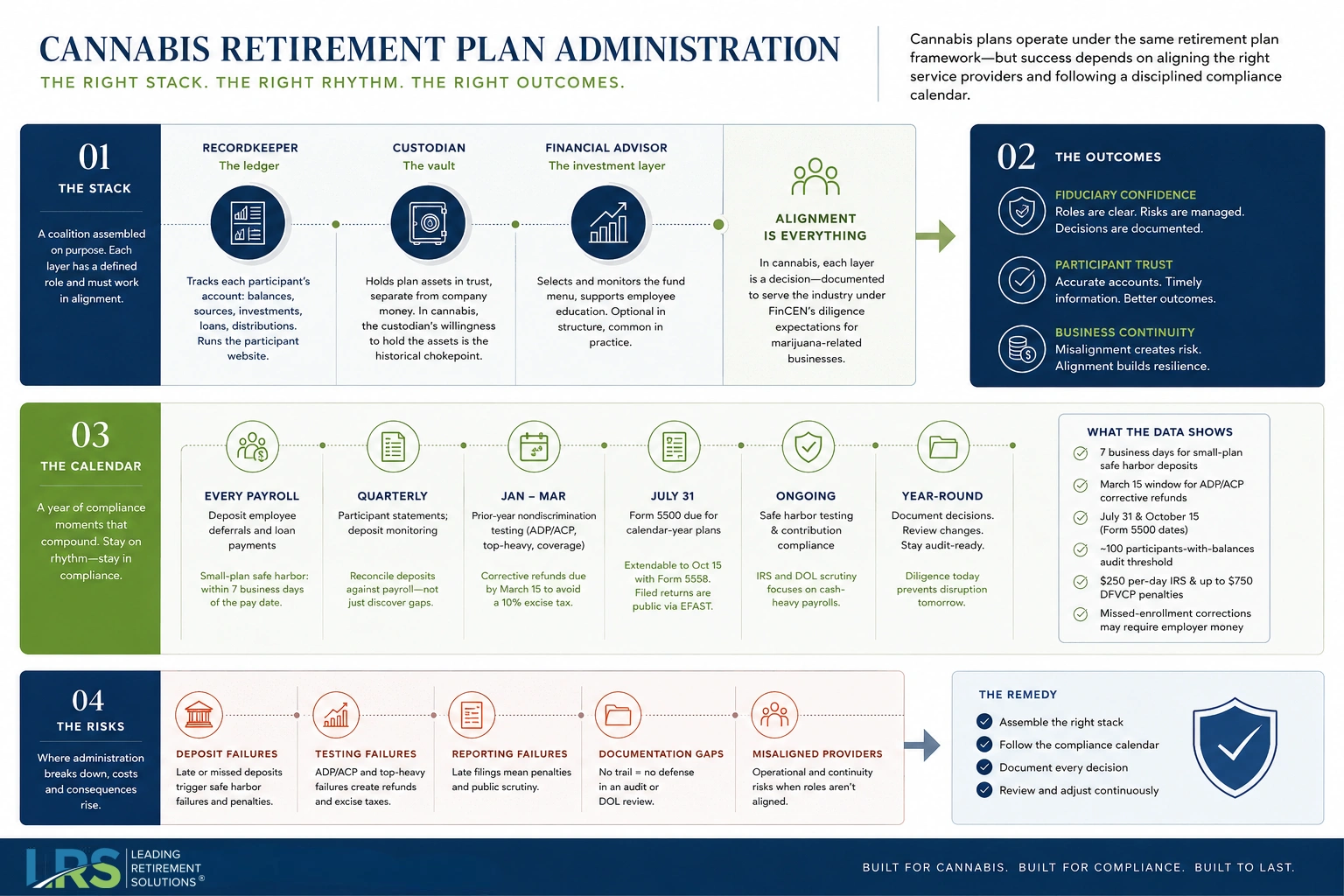
Who does what: administrator, recordkeeper, custodian, advisor
Four roles keep a 401(k) running, and cannabis operators inherit a stack where every one of them had to individually agree to serve the industry. Knowing who owns what is the fastest way to diagnose any problem your plan ever has.
| ROLE | WHAT THEY DO | WHEN YOU CALL THEM |
|---|---|---|
| Third-party administrator (TPA) The compliance engine |
Plan document maintenance, eligibility determinations, nondiscrimination testing, Form 5500 preparation, notices, correction work. This is the role LRS plays. | Testing failures, filing problems, eligibility questions |
| Recordkeeper The ledger |
Tracks each participant’s account: balances, sources, investments, loans, distributions. Runs the participant website. | Statement errors, website access, balance questions |
| Custodian The vault |
Holds plan assets in trust, separate from company money. In cannabis, the custodian’s willingness to hold the assets is the historical chokepoint. | Asset movement, provider-exit risk |
| Financial advisor The investment layer |
Selects and monitors the fund menu, supports employee education. Optional in structure, common in practice. | Fund lineup, fee benchmarking, participant advice |
In mainstream plans these roles are commodities you can swap freely. In cannabis they are a coalition assembled on purpose, each layer having made a documented decision to serve the industry under FinCEN’s diligence expectations for marijuana-related businesses. That is why the first administration question for any cannabis plan is not “what does it cost” but “does every layer of this stack know what I am, in writing.” Misalignment among service providers can create operational and continuity risks for the plan.
The compliance calendar: what has to happen every year
A calendar-year 401(k) runs on a rhythm. Miss a beat and nothing visibly breaks that day, which is exactly why administration problems compound quietly. Here is the year, as your administrator sees it. The Department of Labor’s plan administration and compliance guidance is the underlying framework.
| WHEN | WHAT | WHY IT MATTERS |
|---|---|---|
| Every payroll | Deposit employee deferrals and loan payments | Small-plan safe harbor: within 7 business days of the pay date. The single most-watched item in DOL enforcement, and the one cash-heavy payroll makes hardest. |
| Quarterly | Participant statements; deposit monitoring | Recordkeeper produces statements; the administrator should be reconciling deposits against payroll, not discovering gaps at year-end. |
| January to March | Prior-year nondiscrimination testing (ADP/ACP, top-heavy, coverage) | Corrective refunds for a failed ADP/ACP test are generally due by March 15 for calendar-year plans to avoid a 10% employer excise tax. |
| July 31 | Form 5500 due for calendar-year plans | Extendable to October 15 with Form 5558. Filed returns become publicly searchable through EFAST. |
| September 30 | Summary Annual Report to participants | Later if the 5500 was extended. |
| December 1 | Annual notices for the following year | Safe Harbor, automatic enrollment (QDIA and EACA/QACA), and fee disclosures on their cycles. |
| Year-round | Eligibility tracking, enrollments, terminations, fidelity bond, error correction | In cannabis turnover, eligibility is not an annual event. It is a weekly one. |
becomes a large plan whose Form 5500 requires an independent audit, which is its own annual project; LRS supports large plan audits directly. And the current IRS contribution limits feed the testing math each year, so limit changes are an administration event, not trivia.
The cannabis-specific compliance layer
Everything above applies to every 401(k) in America. Here is what sits on top when the sponsor is a cannabis business, and it is the substance behind the search term “cannabis retirement plan administration company” rather than just “TPA.”
Cash-heavy payroll and the deposit clock
Late deposit of employee contributions is the most common problem the DOL finds in small plans across every industry, and cannabis is structurally exposed to it. Where banking access is thin, payroll runs closer to cash, timing gets manual, and the seven-business-day clock keeps ticking anyway. The fix is process, not heroics: a fixed deposit procedure tied to the payroll calendar, payroll integration wherever the platform allows it, and documentation of every deposit date so a question years later has an answer. LRS integrates with cannabis-compatible payroll platforms for exactly this reason.
Turnover and the eligibility treadmill
Cannabis retail turns over fast, which turns eligibility from an annual chore into a continuous one: new hires crossing entry dates, rehires whose prior service counts, part-timers accumulating hours toward the long-term part-time eligibility rules, and terminated participants with small balances accumulating in the plan. Each missed enrollment is a correction with a cost attached, because the standard fix for excluding an eligible employee involves employer money. Automatic enrollment narrows the error surface considerably, which is one more reason it fits this industry beyond participation.
Compensation definitions, tips, and bonuses
Testing and contributions both run on the plan’s definition of compensation, and dispensary pay is full of edge cases: cash tips, spiffs, bonuses, and multi-entity payroll across license holders. Using a different compensation definition in practice than the plan document states is one of the most common operational failures in the IRS’s own 401(k) Fix-It Guide, and it is quietly rampant in cannabis because payroll is complicated. Reconciling payroll compensation codes against the plan document, and re-checking when payroll changes, keeps the two aligned.
Entity changes, license moves, and M&A
Cannabis reorganizes constantly: licenses move between entities, MSOs acquire and divest, ownership shifts for regulatory reasons. Every one of those events is a plan event, touching who the sponsoring employer is, whose employees are covered, and whether related entities form a controlled group that testing must treat as one employer. The expensive version is discovering this in diligence; the better version is telling your administrator before the deal papers are signed. Your Form 5500 history is public through EFAST, and acquirers read it; here is how those filings are searched.
The five administration failures we actually see in cannabis plans
Every one of these is drawn from cleanup work, every one is correctable, and every one is easier to resolve the earlier it is caught. The IRS and DOL both run voluntary correction programs, and moving before an agency letter arrives is the whole game; if one already has, start with what an IRS or DOL notice means and how to respond.
1. Late or irregular contribution deposits
The cash-payroll problem above. Correction means depositing the contributions plus lost earnings, and the DOL’s voluntary fiduciary correction process exists for exactly this. The pattern matters more than any single deposit: examiners look at consistency.
2. Eligible employees never enrolled
Turnover plus manual tracking. The standard correction requires an employer contribution to make the missed employee whole, which is why preventing the error through automatic enrollment is preferable to correcting it.
3. Compensation used in practice does not match the plan document
Tips and bonuses included in payroll but excluded in the document, or vice versa. Fix the definition or fix the practice; running both is the failure.
4. Testing done late, or on bad data
A test run in September on a March deadline is not a test, it is a postmortem. Refund windows and excise tax run on the calendar whether the data was ready or not.
5. The Form 5500 that quietly never got filed
Usually after a provider change or an internal handoff. Penalty exposure runs per day under both the IRS and DOL, and the DOL’s Delinquent Filer program caps a small plan’s cost at $750 per return, but only before a notice arrives.
When correction is needed, consulting and correction services is the LRS practice built for it, and our compliance overview in Navigating Cannabis 401(k) Plan Compliance covers the prevention side.
Nondiscrimination testing, and the design that makes it boring
Annual testing compares what owners and highly compensated employees get from the plan against everyone else: ADP and ACP tests on deferrals and match, top-heavy testing on whether key employees hold more than 60 percent of plan assets, and coverage testing on who benefits at all. Cannabis ownership groups tend to be small and highly involved, and rank-and-file participation fluctuates with turnover, which is a recipe for tests that pass one year and fail the next.
Two design moves make testing predictable. Automatic enrollment lifts rank-and-file participation and deferral rates, improving the employee data that drives most nondiscrimination testing results. And a Safe Harbor design generally eliminates ADP and ACP testing and often eliminates top-heavy testing, in exchange for a required employer contribution, which is why it is the most common recommendation we make to dispensary ownership groups who want to contribute meaningfully themselves.
What cannabis plan administration costs, and what it prevents
Cannabis plan administration is typically priced as a combination of annual administration fees and per-participant charges, with a premium over comparable mainstream plans that has narrowed as the provider field has grown. The honest comparison is not against a mainstream TPA that will not take the business anyway. It is against the cost of administration done badly: a missed-enrollment correction funded with employer money, a failed test refunded under excise-tax deadlines, a late Form 5500 accruing per-day penalty exposure, or a cleanup project priced in months of professional time. Administration failures can result in corrective costs, professional fees, and potential penalties that may exceed routine administration expenses.
The tax side belongs in the same conversation: whether administration fees and employer contributions are deductible runs through Section 280E and, since April 2026, through which side of the medical and adult-use line each license sits on. That analysis lives in our guide to cannabis company tax deductions and 280E, and it belongs with your CPA.
Choosing a cannabis retirement plan administration company
The general playbook for choosing a TPA applies here, with an industry overlay. Six questions, answers in writing:
Does your written policy permit plant-touching clients, and do your recordkeeper and custodian each know and agree? Every layer, knowingly, or the stack has a hidden exit.
How many cannabis plans do you administer, and since when? Tenure means the provider has already survived its own risk reviews.
Which cannabis payroll platforms do you integrate with, and is the integration 180 or 360? Manual payroll handling is where deposit and contribution errors are born.
Who monitors deposit timeliness, and how would you know if we slipped? The right answer describes reconciliation, not trust.
What is your correction experience? Ask for the last cannabis plan problem they fixed and how. Administrators who have never corrected anything have never looked closely.
What happens to us if your policy changes? The transition commitment matters more than the reassurance.
Operators like Jeeter and Embarc have talked publicly about what this looks like in practice, and the Cannabis Industry Retirement Report benchmarks what employers across the industry are offering and administering today.
What to do next
- 01
If your plan is running and you are not sure how well
Ask your administrator for three things this week: the last deposit-timeliness reconciliation, the latest testing results, and confirmation the last Form 5500 was filed. The answers, and how fast they arrive, are the health check.
- 02
If you already know something is off
Move before an agency does. Voluntary correction programs exist for this, and the best of them close once a notice arrives. Consulting and correction services.
- 03
If you are unhappy with your current administrator
Mid-year transfers are routine. Bring your plan document, latest testing, and most recent Form 5500, and LRS can scope the move against what you have now.
- 04
If you are still at the setup stage
Start with the eligibility question, which we cover in the complete cannabis 401(k) employer guide, then come back here for what running it takes.
Frequently asked questions
What does a cannabis retirement plan administrator actually do?
The administrator, usually a third-party administrator or TPA, runs the compliance machinery of the plan: tracking eligibility as people are hired and leave, running the annual nondiscrimination tests, preparing the Form 5500, producing participant notices, monitoring contribution deposits, coordinating the recordkeeper and custodian, and correcting problems when they surface. In a cannabis plan the administrator also needs to be part of a service stack that has knowingly agreed to serve the industry, which is what separates a cannabis administrator from a generalist with one cannabis client.
Do cannabis companies really need cannabis-specific administration?
The plan rules are similar to those for any other 401(k). What is different is everything around them: a provider stack that must knowingly accept cannabis money, cash-heavy payroll that raises deposit-timing risk, turnover that stresses eligibility tracking, and license structures that complicate compensation and entity questions. A generalist administrator can run the forms. An administrator who works in the industry knows where cannabis plans actually break, which is better than finding out on your own plan.
How fast do employee 401(k) contributions have to be deposited?
For plans with fewer than 100 participants, the Department of Labor provides a safe harbor: deposits made within seven business days of the payroll date are considered timely. Larger plans must deposit as soon as the money can reasonably be segregated from company assets, which in practice is usually within days. Late deposits are the most common issue the DOL finds in small plans generally, and cash-heavy cannabis payroll makes the discipline harder and the documentation more important.
What annual testing applies to a cannabis 401(k)?
The same tests as any 401(k): ADP and ACP testing comparing what highly compensated employees defer and receive in match against everyone else, top-heavy testing measuring whether key employees hold more than 60 percent of plan assets, and coverage testing confirming enough rank-and-file employees benefit. A Safe Harbor design removes most ADP, ACP, and top-heavy exposure in exchange for a required employer contribution, which is why many dispensaries choose it.
Is our Form 5500 public? Can people see our plan details?
Yes. Most 401(k) plans file the Form 5500, and filed returns are publicly searchable through the Department of Labor’s EFAST system, including plan assets, participant counts, and service providers. Competitors, journalists, and acquirers all look. That is one more reason the filing should be accurate and on time, and it is worth knowing before an M&A process, not during one.
What happens if our plan fails nondiscrimination testing?
It is fixable, on a deadline. The usual corrections are refunding excess contributions to highly compensated employees or making an additional employer contribution for everyone else, generally within prescribed windows after the plan year ends to avoid excise tax. A plan that fails repeatedly is telling you something about its design, and the durable fix is usually a Safe Harbor conversion or automatic enrollment rather than another year of refunds.
We missed a Form 5500 filing. How bad is it?
Left alone, expensive: the IRS can assess up to $250 per day capped at $150,000 per plan year, and the DOL assesses its own per-day penalty with no cap. Addressed voluntarily, manageable: the DOL’s Delinquent Filer program caps the cost at $750 per late return for a small plan, but only if you file before the DOL sends a notice. If you have missed a year, the correct move is to move first.
What does cannabis 401(k) administration cost?
Typically a flat annual administration fee plus a per-participant charge, with a modest industry premium that reflects the smaller provider field and the additional diligence work. Weigh it against what administration failures can involve: late-deposit corrections, testing refunds, penalty exposure on a missed filing, and cleanup projects, each carrying corrective costs, professional fees, and potential penalties. Effective administration may help reduce the likelihood of costly correction projects and compliance issues.
Can we keep our current payroll provider?
Usually, if it serves cannabis businesses. The practical question is integration: whether payroll data flows to the plan automatically each pay period or gets keyed by hand. Manual processing is where deposit delays and contribution errors come from, so if your payroll platform cannot integrate, that is worth solving at setup rather than absorbing forever.
Can we switch plan administrators mid-year?
Yes. Administration transfers happen on a defined timeline with a records handoff, and mid-year moves are routine when service has broken down or a provider has exited the industry. The transition work is real, so the practical standard is: switch when the current arrangement is costing you compliance, not merely convenience. Bring your plan document, latest testing, and most recent Form 5500 to the first conversation and a competent administrator can scope the move quickly.
Sources
- U.S. Department of Labor
Plan Administration and Compliance
The employer-facing framework for operating a retirement plan.
- Internal Revenue Service
The IRS’s own catalog of common operational failures and how to correct each one.
- U.S. Department of Labor
Delinquent Filer Voluntary Compliance Program
Eligibility, penalty caps, and process for late Form 5500 filings.
- Internal Revenue Service
Filing requirements, deadlines, and form selection.
- U.S. Department of Labor
Where Form 5500 returns are filed and become publicly searchable.
- Financial Crimes Enforcement Network
BSA Expectations Regarding Marijuana-Related Businesses
The diligence framework behind every provider’s decision to serve, or refuse, cannabis.
- Internal Revenue Service
Marijuana Industry Tax Guidance
Income reporting, Section 280E, and cash payment rules for cannabis businesses.