Plan Sponsor Guide · Updated October 2026
Which Form 5500 obligations apply to a plan starts with whether the plan is covered by Title I of ERISA, how many participants it has, and what it holds. Those questions, together with plan type, filing history, and the plan’s own documents, shape which schedules attach to the filing and whether an independent qualified public accountant’s report is required.
This article covers the parts of the annual report that sit underneath the form itself. For what Form 5500 is, when it is due, what the penalties are, and how to look up a filing that has already been submitted, see our guide to searching Form 5500 filings by company name.
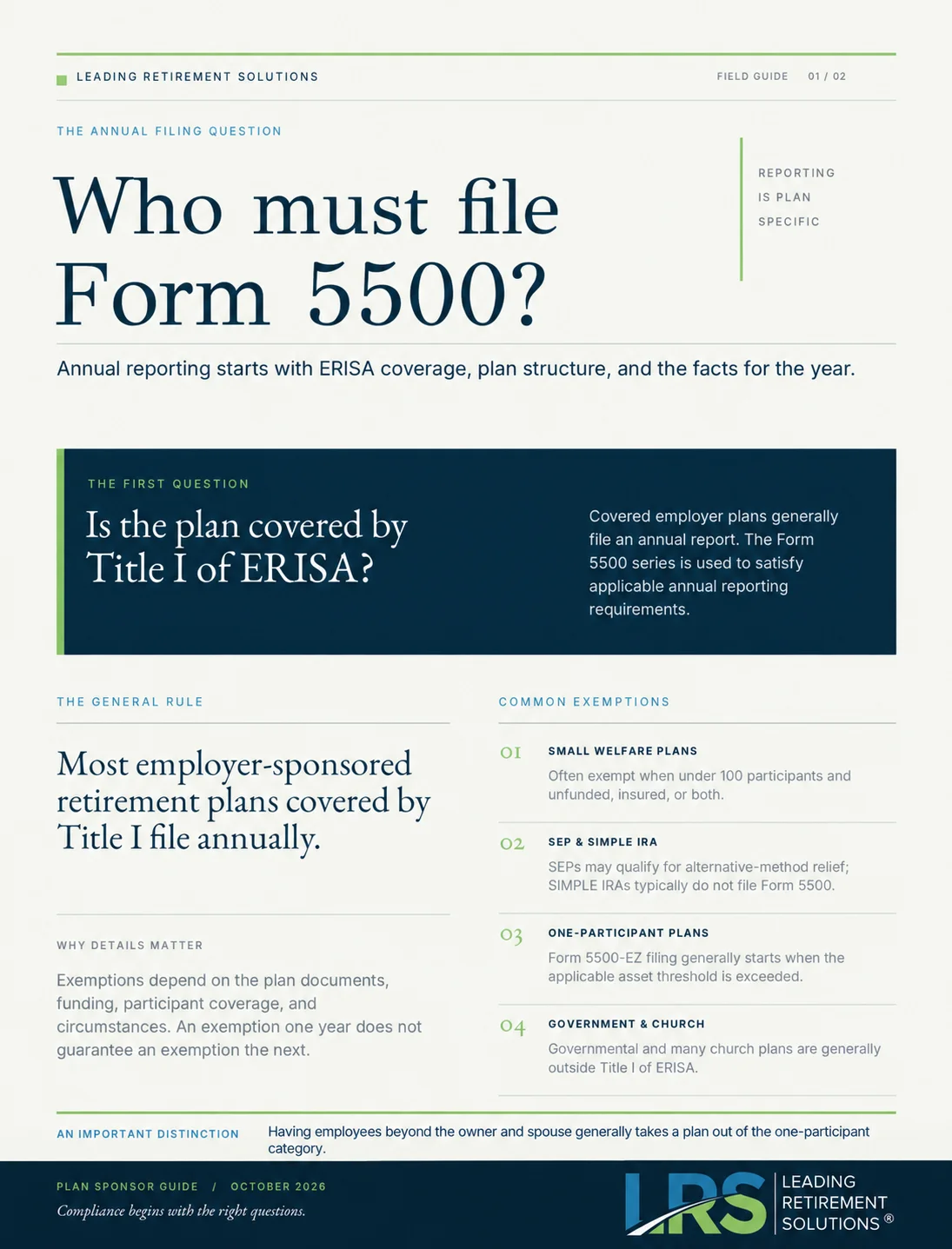
- A plan covered by Title I of ERISA usually files an annual report. The common exemptions are small unfunded or insured welfare plans, SEP and SIMPLE IRA arrangements, and one-participant plans under the asset threshold.
- Much of the detail sits in the schedules. Which ones attach depends on plan size, plan type, and what the plan invests in, as set out in the Form 5500 instructions for the year.
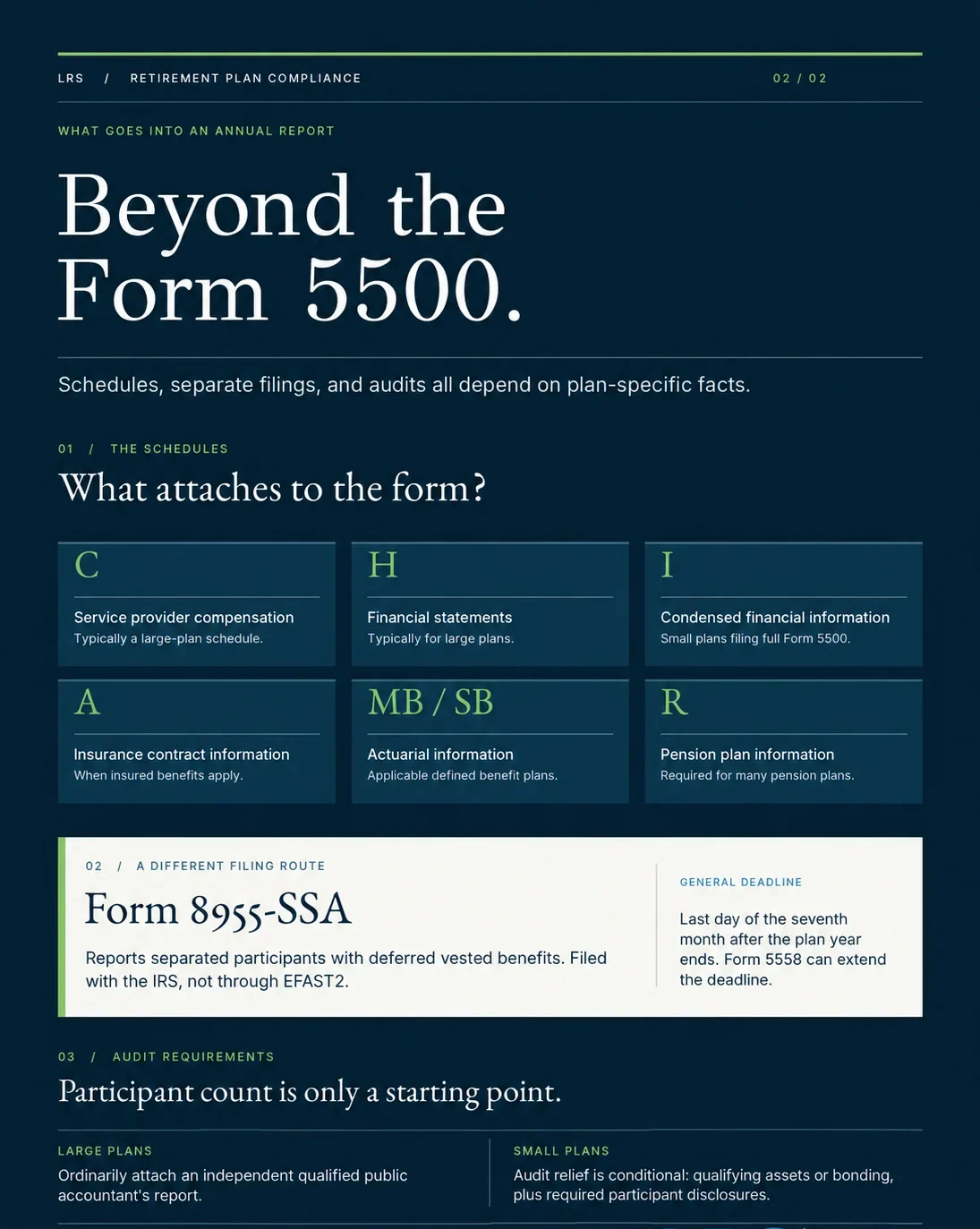
- Schedule C reports service provider compensation and is typically a large-plan schedule. Schedules H and I are the financial statements, split large and small.
- Form 8955-SSA reports separated participants with deferred vested benefits. It is filed with the IRS rather than through EFAST2, so it can be overlooked because it travels separately from the Form 5500.
- Whether a plan needs an independent qualified public accountant’s report depends on its filing classification, participant count, asset characteristics, and satisfaction of applicable waiver conditions. A plan that does not meet the waiver conditions may need an audit.
Who Must File, and Who Is Exempt
Two separate statutes create the obligation. Section 103 of ERISA requires the administrator of a covered plan to file an annual report, and section 104 governs how that report is filed and made available.1,2 Separately, section 6058 of the Internal Revenue Code requires an employer maintaining a plan qualified under the Code to file an annual return of information.3 The Form 5500 series satisfies both at once, which is why one filing reaches three agencies.
Most employer-sponsored retirement plans are in scope. The exemptions worth knowing are these.
| Arrangement | General treatment | Where the rule sits |
|---|---|---|
| Small welfare plans | Usually exempt if the plan covers fewer than 100 participants at the beginning of the plan year and is unfunded, fully insured, or a combination of the two | 29 CFR §2520.104-20 |
| SEP arrangements | A simplified employee pension that meets the conditions of the alternative method is relieved of the annual report | 29 CFR §2520.104-48 and §2520.104-49 |
| SIMPLE IRA plans | Typically no Form 5500, because the assets sit in individual retirement accounts rather than a plan trust | Form 5500 instructions |
| One-participant plans | In most cases, no filing until total plan assets exceed the threshold at the end of the plan year, then Form 5500-EZ | IRS, one-participant 401(k) plans |
| Governmental and church plans | Governmental plans and many church plans are generally excluded from Title I of ERISA, and so do not typically file Form 5500 | ERISA §4(b) |
Whether an exemption reaches a particular plan depends on that plan’s documents, how it is funded, and the facts for the year. A plan can be exempt one year and a filer the next.
A plan that covers a common-law employee other than the owner and spouse is not treated as a one-participant plan. That usually moves the arrangement from the Form 5500-EZ track onto the Form 5500 or 5500-SF track, with the schedules and the possible audit that can come with it.12
The Schedules That Attach to the Form
Much of the detail in a Form 5500 filing sits in its schedules. Which ones attach depends on the plan’s facts and on the Form 5500 instructions for the year being reported.4
| Schedule | Reports | Typically applies to |
|---|---|---|
| Schedule A | Insurance contract information, including premiums and commissions | Any plan where a benefit is provided by an insurer |
| Schedule C | Service provider compensation and any accountant or actuary who was terminated | Large plans |
| Schedule D | Participation in pooled arrangements such as common or collective trusts and master trusts | Plans holding an interest in those arrangements |
| Schedule G | Loans or leases in default or classified as uncollectible, and non-exempt transactions | Required where applicable under the Form 5500 instructions |
| Schedule H | Financial statements, including assets, income, expenses, and the accountant’s report | Large plans |
| Schedule I | Financial information in condensed form | Small plans filing the full Form 5500 |
| Schedule MB | Actuarial information | Multiemployer defined benefit plans and certain money purchase plans |
| Schedule SB | Actuarial information | Single-employer defined benefit plans |
| Schedule R | Retirement plan information, including distributions and funding | Most pension plans |
Summary only. The instructions to Form 5500 set out which schedules a given plan is required to attach for the year being reported.
A plan filing Form 5500-SF reports its financial information on the form itself rather than on Schedule H or I, which is most of what makes the short form shorter.4
Schedule C and service provider compensation
Schedule C often generates questions, because it can reach compensation a plan sponsor may never see on an invoice. It covers direct compensation paid from plan assets and, for service providers meeting the reporting threshold, indirect compensation received in connection with the plan.4 Revenue sharing, float, and finder’s fees are common examples of indirect compensation.
Gathering what Schedule C needs usually means requesting disclosures from each provider rather than reading them off the plan’s own records, which is why it can be the schedule that takes longest to complete.
Form 8955-SSA, the Return That Travels Separately
Form 8955-SSA reports participants who separated from service with a deferred vested benefit, so that the Social Security Administration can tell them about it when they later claim benefits.5,13
It is due by the last day of the seventh month after the plan year ends, and an extension can be requested on Form 5558, as the IRS describes.14 Whether a particular plan has participants to report depends on its plan type, vesting provisions, and who has separated from service.
It is easy to miss for a structural reason: it is filed with the IRS rather than through EFAST2, so it does not move through the same system as the rest of the annual report. Electronic filing is required in certain circumstances.6 A plan that has had turnover and has not been reporting separated vested participants may have earlier years to address, and how that is handled depends on the plan’s facts.
When a Plan Needs an Independent Audit
Audit requirements depend on the plan’s filing classification, participant count, asset characteristics, and satisfaction of applicable waiver conditions. Participant count is often the starting point for determining whether a plan files as a large or small plan, but it does not settle the question on its own. Filing history, the 80-120 participant rule, plan type, and the assets the plan holds may also affect whether an accountant’s report is required.4,7
A plan filing as a large plan is ordinarily required to attach the report of an independent qualified public accountant covering the plan’s financial statements.4,15 A plan filing as a small plan may be relieved of that requirement if it meets the waiver conditions, which depend in part on how its assets are held, so the relief is conditional rather than automatic.7
For a defined contribution plan, the count is based on participants with account balances at the beginning of the plan year. That changed for plan years beginning on or after January 1, 2023, and we cover the change in our guide to searching Form 5500 filings.
What the small plan audit waiver asks for
The Department of Labor’s audit waiver regulation generally requires a small plan to satisfy qualifying asset or bonding requirements, together with specified participant disclosure requirements.7
- Qualifying plan assets. Generally, at least 95 percent of the plan’s assets must be qualifying plan assets as the regulation defines them.
- The bonding alternative. If that condition is not met, the regulation provides an alternative involving bonding for persons who handle nonqualifying assets.
- Participant disclosures. Under either path, the plan has to provide specified disclosures to participants, including in the summary annual report.
A small plan that holds assets outside the qualifying categories, such as real estate or a privately held interest, may not meet these conditions, and may need an audit even though its participant count is below the large plan threshold.
The 80-120 participant rule
A plan whose participant count moves back and forth around the large plan threshold could otherwise change filing categories from year to year. The Form 5500 instructions address that. Plans with between 80 and 120 participants at the beginning of a plan year may generally continue to file in the same category used for the prior year, subject to the Form 5500 instructions then in effect.4
A plan that continues to file as a small plan under this rule still has to meet the audit waiver conditions described above to be relieved of the accountant’s report.7
Whether a plan needs an audit for a given year depends on the plan’s filing classification, participant count, asset characteristics, and satisfaction of applicable waiver conditions, together with the plan’s governing documents and facts for the year. It is not determined by a rule of thumb about headcount alone.
Relief for a One-Participant Plan That Filed Late
The Department of Labor’s voluntary program for delinquent filers is available to plans subject to Title I of ERISA. A one-participant plan is generally not subject to Title I, so that program does not typically apply to it.
The IRS operates a separate relief program for late Form 5500-EZ filers, with its own eligibility conditions and its own submission requirements.8 Relief under either program is usually available only before the agency has issued a notice about the delinquent filing.
Frequently Asked Questions
Who is exempt from filing Form 5500?
Common exemptions include small welfare plans that are unfunded or fully insured and cover fewer than 100 participants, SEP arrangements meeting the alternative method conditions, SIMPLE IRA plans, and one-participant plans below the asset threshold. Governmental plans and many church plans are generally excluded from Title I of ERISA. Whether an exemption applies to a particular plan depends on its documents and facts.
Which schedules does a plan have to file?
It depends on the plan’s size, type, and holdings, as set out in the Form 5500 instructions for the year. Large plans typically attach Schedules C and H, and Schedule G where applicable. Small plans filing the full form typically attach Schedule I. Plans with insured benefits attach Schedule A where applicable, defined benefit plans attach Schedule MB or SB, and many pension plans attach Schedule R.
What is Schedule C on Form 5500?
Schedule C reports compensation paid to the plan’s service providers, including direct compensation from plan assets and, above a reporting threshold, indirect compensation such as revenue sharing. It is typically a large plan schedule, and it also reports an accountant or actuary who was terminated during the year.
What is Form 8955-SSA used for?
It reports participants who separated from service with a deferred vested benefit, so the Social Security Administration can notify them when they later claim benefits. It is filed with the IRS rather than through EFAST2, which is one reason it can be overlooked.
Do I need to file Form 8955-SSA?
Whether a plan has a Form 8955-SSA filing obligation for a particular year depends on the plan’s facts, participant status, and applicable reporting requirements.
When does a 401(k) plan need an audit?
Audit requirements depend on the plan’s filing classification, participant count, asset characteristics, and satisfaction of applicable waiver conditions. For a defined contribution plan, the participant count is based on participants with account balances at the beginning of the plan year, and filing history and the 80-120 participant rule can also affect the filing category. A plan filing as a small plan may be relieved of the audit if it meets the Department of Labor’s waiver conditions.
Can a plan file Form 5500 without an audit report?
A plan filing as a small plan may be relieved of the accountant’s report if it meets the audit waiver conditions, which involve qualifying plan assets or a bonding alternative, together with specified participant disclosures. Whether the report is required depends on the plan’s filing classification, participant count, asset characteristics, and satisfaction of applicable waiver conditions, subject to the Form 5500 instructions.
What is the 80-120 participant rule?
Plans with between 80 and 120 participants at the beginning of a plan year may generally continue to file in the same category used for the prior year, subject to the Form 5500 instructions then in effect. It helps keep a plan near the threshold from switching categories back and forth.
Is there relief for a solo 401(k) that never filed?
The Department of Labor’s delinquent filer program does not typically apply to one-participant plans, because they are generally not subject to Title I of ERISA. The IRS runs a separate relief program for late Form 5500-EZ filers, usually available before the IRS has issued a notice about the filing.
Related Reading
- How to search Form 5500 filings by company name, which covers what the form is, the deadlines, the penalties, and how to retrieve a filing.
- Safe harbor plans for small businesses, on the designs that are exempt from annual nondiscrimination testing.
- State-approved qualifying retirement plans, on which arrangements satisfy the state mandates.
- How to exit a ROBS plan, including the reporting that continues until a plan is formally terminated.
Sources
Every substantive statement above is drawn from the following primary sources. Numbers in the text refer to this list. Links were verified at the time of writing.
- U.S. Code29 U.S.C. §1023, Annual reports (ERISA §103)
- U.S. Code29 U.S.C. §1024, Filing with Secretary and furnishing information to participants (ERISA §104)
- U.S. Code26 U.S.C. §6058, Information required in connection with certain plans of deferred compensation
- U.S. Department of LaborInstructions for Form 5500, Annual Return/Report of Employee Benefit PlanCited for the schedule requirements, Schedule C, the 80-120 participant election, and Form 5500-SF financial reporting.
- Internal Revenue ServiceAbout Form 8955-SSA, Annual Registration Statement Identifying Separated Participants With Deferred Vested Benefits
- Internal Revenue ServiceMandatory electronic filing for certain Form 8955-SSA and 5500-EZ returns
- Code of Federal Regulations29 CFR §2520.104-46, Waiver of examination and report of an independent qualified public accountant for employee benefit plans with fewer than 100 participants
- Internal Revenue ServicePenalty relief program for Form 5500-EZ late filers
- Code of Federal Regulations29 CFR §2520.104-20, Limited exemption for certain small welfare plans
- Code of Federal Regulations29 CFR §2520.104-48 and §2520.104-49, alternative methods of compliance for simplified employee pensions
- U.S. Code29 U.S.C. §1003(b), coverage exclusions under ERISA §4(b)Cited for governmental and church plans.
- Internal Revenue ServiceOne-participant 401(k) plans
- U.S. Code26 U.S.C. §6057, Annual registration, etc., the statutory basis for Form 8955-SSA
- Internal Revenue ServiceFAQs regarding Form 8955-SSACited for the due date and the Form 5558 extension.
- Internal Revenue Service401(k) resource guide, plan sponsors, filing requirements
About Leading Retirement Solutions. Leading Retirement Solutions is a Seattle-based third-party administrator that has designed, administered, and corrected retirement plans for employers across the country since 2017, including the Leading Cannabis 401(k)®. Form 5500 preparation, large plan audit support, and delinquent filing correction are part of the administration work we do.
Provided for general information only and not legal, tax, or investment advice. Whether a reporting requirement, exemption, schedule, or audit obligation applies to a particular plan depends on that plan’s documents and circumstances.