

CANNABIS EMPLOYER GUIDE · REVIEWED SEPTEMBER 2026
If you run a cannabis business and you have asked a bank, a payroll company, or a national 401(k) provider about retirement benefits, you have probably read some version of the same sentence: “We do not knowingly accept business from entities engaged in the cultivation, possession, or sale of marijuana.” It arrives politely, it cites policy rather than law, and it leaves the impression that a 401(k) is simply not available to you.
In many cases, cannabis businesses may have more retirement plan options available than they initially realize.
This guide covers what the law actually says, what changed in April 2026 and what did not, how to set a plan up, what it costs, how Section 280E interacts with it, why state retirement mandates apply to you whether or not you offer benefits, and how to pick a provider that will not disappear when their risk committee meets. It is written for owners and operators, and where a point depends on your license type or your CPA, it says so.
Yes, cannabis companies can offer a 401(k). Here is why.
What federal law actually says
A 401(k) is created under the Internal Revenue Code and governed by ERISA, and neither law contains an industry test. The IRS rules for 401(k) plans ask whether the plan document is qualified, whether contributions stay within limits, whether the plan covers employees fairly, and whether it is administered and reported correctly. They do not ask what the sponsoring business sells.
The IRS itself is explicit that cannabis businesses are taxpayers like any other. Its Marijuana Industry guidance confirms that cannabis income is taxable, that cannabis businesses file returns, make estimated payments, and face the same audits and penalties as everyone else. The IRS generally treats cannabis businesses as taxpayers, and federal retirement-plan rules do not expressly exclude them from sponsoring qualified plans. Employees of cannabis companies earn W-2 wages, and W-2 wages are exactly what a 401(k) is built on.
So why did every provider turn you down?
Because the risk was never yours, it was theirs. Banks and financial firms that touch cannabis money take on Bank Secrecy Act and anti-money-laundering obligations under FinCEN’s 2014 guidance on marijuana-related businesses, which requires enhanced due diligence and ongoing suspicious-activity reporting. Most national recordkeepers, custodians, and payroll platforms looked at that workload, weighed it against reputational caution, and wrote the policy you received a copy of.
That decision was a business choice, not a legal conclusion, and it is why the refusal letters cite internal policy rather than any statute. We have written separately about the effect of restricted banking access on the industry, in restricting cannabis access to banking is discriminatory.
The answer to a provider-access problem is providers. In 2017, LRS partnered with financial, legal, and retirement industry veterans to build a 401(k) service stack specifically for cannabis: an administrator, recordkeeper, custodian, and payroll connections that each made a deliberate, documented decision to serve the industry and do the compliance work that decision requires. That program was publicly launched as The Leading Cannabis 401(k)® in 2019. That coalition has since expanded, and hundreds of cannabis companies now run plans on it. The history of that access problem, and the 89% growth in cannabis companies offering plans across a recent two-year span, is covered in our piece on retirement plan access for the cannabis industry.
The Schedule III split: where federal law stands in July 2026
If you have seen headlines saying marijuana was rescheduled and others saying it was not, the difference largely reflects which category of marijuana the writer was discussing. Here is the state of play, precisely.
What changed on April 28, 2026
A Department of Justice final order, effective April 28, 2026, moved two categories of cannabis from Schedule I to Schedule III of the Controlled Substances Act: FDA-approved drug products containing marijuana, and marijuana operating under a qualifying state-issued medical license. Adult-use cannabis and other marijuana activity not covered by the April 2026 order remained subject to Schedule I treatment.
That split runs straight through the middle of many operators. A vertically integrated operator holding both medical and adult-use licenses may need to evaluate the tax, accounting, operational, and compliance implications of the distinction with qualified legal and tax advisors.
What the June hearing was about, and where it stands
The broader question, whether all marijuana moves to Schedule III, went to a formal DEA administrative hearing that began June 29, 2026 and was scheduled to conclude by July 15 under the notice published in the Federal Register. As of this writing the hearing has concluded, the administrative law judge’s recommendation and any final rule are still ahead, and legal challenges to the April order are already moving in the courts. Ohio State’s Drug Enforcement and Policy Center maintains a careful timeline of the federal rescheduling process if you want to follow it closely; we also keep our own analysis current in The Impact of Schedule III on Cannabis 401(k)s: Reality vs. Expectation.
What none of this changes about your 401(k)
Marijuana’s scheduling status does not, by itself, determine whether a cannabis business can sponsor a qualified retirement plan. Cannabis employers sponsored retirement plans before the April 2026 order and continue to do so today. While scheduling may affect tax treatment and influence provider participation in the industry, it is separate from an employer’s decision to establish a plan. For that reason, waiting for broader rescheduling may mean delaying a benefit that many employers can already offer. We discussed this distinction before the April order in What Rescheduling Should, but Likely Will Not, Mean for Retirement Plans. The developments since then have reinforced an important point: retirement-plan sponsorship and cannabis scheduling are related to different regulatory questions.
How to set up a cannabis 401(k), step by step
From first call to first payroll deferral typically runs four to eight weeks. Here is the sequence and where cannabis differs from a mainstream setup.
Step 1: Start with the provider, not the plan document
In most industries you design a plan and then shop providers. In cannabis it runs the other way: the binding constraint is which recordkeeper and custodian will knowingly hold your plan’s assets, so confirm the full service stack first. Ask every provider the question in the checklist further down, and get the answer in writing. Confirming provider capabilities early may help avoid implementation challenges later in the process.
Step 2: Design the plan around your workforce, not a template
Cannabis workforces skew young, hourly, and mobile, which argues for immediate or short eligibility, automatic enrollment, and a match employees can see in every paycheck. If owner and manager participation matters, weigh a Safe Harbor design, which trades a required employer contribution for relief from most nondiscrimination testing. Current IRS contribution limits apply to your plan exactly as they do to any other.
Step 3: Connect payroll properly
This is the step that quietly determines whether the plan runs itself or becomes a monthly chore. Payroll integration moves deferrals from paycheck to plan automatically, and LRS connects with cannabis-compatible payroll and HRIS platforms, including 180 and 360 integrations. If your payroll provider is cannabis-friendly but not integrated, that is solvable; say so up front.
Step 4: Enroll employees like you mean it
A retirement plan only works if employees participate. Announce the plan clearly, offer enrollment meetings at times employees can attend, and use automatic enrollment where appropriate to help increase participation. Participation can also affect certain plan testing outcomes, making broad employee engagement an important consideration for employers and owners alike.
Step 5: Run it: administration, testing, and the Form 5500
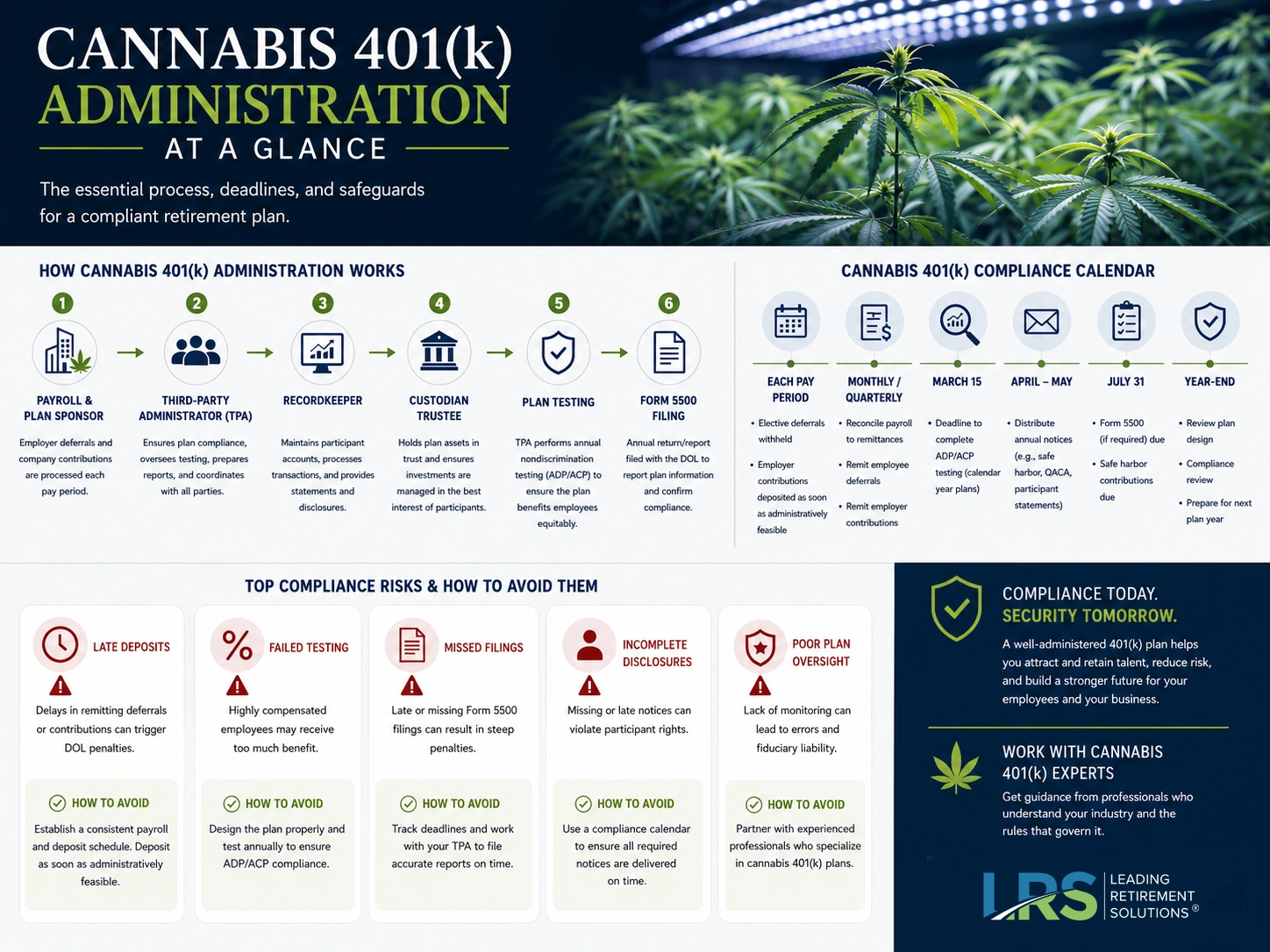
A 401(k) is an ongoing responsibility, including annual testing and compliance requirements, participant notices, a fidelity bond, and typically an annual Form 5500 filing. Much of this work is handled through your plan administrator, recordkeeper, and other service providers, though plan sponsors retain important oversight responsibilities. Cannabis plans generally follow the same retirement-plan rules and filing requirements as other employers. The difference is having service providers who understand the industry’s unique operating environment.
What a cannabis 401(k) costs, and how Section 280E fits in
The cost of the plan itself
Expect setup in the low four figures and ongoing administration billed annually plus per participant, with a modest cannabis premium over mainstream pricing that reflects a smaller provider field and genuine compliance work. That premium has narrowed every year since 2017 as the coalition serving the industry has grown. Judged against recruiting reality, where a competitor can hire away a trained budtender or cultivation lead with a dollar an hour and a benefits package, a funded match is one of the cheapest retention tools available. Our cannabis workforce and benefits trends research and the Cannabis Industry Retirement Report both put numbers on that.
280E and your plan, precisely
Section 280E disallows federal deductions and credits for a business trafficking in Schedule I or II substances, allowing only cost of goods sold. It is the single most expensive sentence in cannabis taxation, and it touches your 401(k) in exactly one place. Three pieces, kept separate:
Employee contributions: always unaffected
Deferrals come out of the employee’s own wages and reduce the employee’s own taxable income. 280E is an employer-deduction statute; it has nothing to say about an employee’s paycheck. Every employee of every cannabis company gets the full normal tax benefit of contributing. This is an often misunderstood point in cannabis retirement benefits and it deserves to be stated plainly.
Employer contributions: the deduction question
Matching and profit-sharing contributions are compensation expense, and whether a plant-touching business can deduct them runs through 280E. Since April 28, 2026 that answer splits by license: activity under a qualifying state medical license is Schedule III, outside 280E, and ordinary deduction rules apply; adult-use activity remains Schedule I, inside 280E, where non-COGS deductions are generally disallowed. Ancillary businesses that never touch the plant were never inside 280E at all. Where labor is genuinely part of production, some contribution cost can land in COGS, which is precisely the kind of allocation that belongs with a cannabis-experienced CPA and not a blog post. The full picture is in our guide to cannabis company tax deductions and 280E.
Startup tax credits: read the fine print, then read your license
SECURE 2.0 offers small employers up to $5,000 a year for three years in plan startup credits, plus $500 a year for automatic enrollment; the mechanics are in our small business tax credit guide. But 280E disallows credits as well as deductions, so an adult-use plant-touching business generally cannot claim them today, while medical-licensed activity moved outside 280E in April and ancillary businesses were always eligible. Any provider who quotes you the credits without asking what your license says is selling past the question. Employers may wish to consult qualified tax professionals regarding their specific circumstances.
State retirement mandates apply to cannabis companies too
Here is the part that surprises operators: while providers were telling you a 401(k) was unavailable, ten states quietly required employers to offer access to a retirement savings program, and cannabis companies get no exemption. If you employ people in California, Oregon, Illinois, Colorado, Connecticut, Maryland, Maine, Delaware, Vermont, or Nevada, you may be required to either register with the state program or sponsor a qualifying plan and certify the exemption. Those ten are the programs open and enforcing today. Additional states have enacted programs with registration deadlines and penalties phasing in, several more are scheduled to launch, and others are expected to follow over the next few years, so a state that does not reach you this year may reach you before your next plan year. Several of the active states are also the country’s largest cannabis markets, which is not a coincidence you can plan around.
What the mandates require, in one paragraph
Each state sets a covered-employer threshold, commonly one to five employees, a registration deadline, and a per-employee penalty for ignoring both. California’s CalSavers reaches employers with a single eligible employee and its penalties reach $750 per employee for sustained non-compliance; we covered the CalSavers deadline for cannabis companies specifically. The state programs are payroll-deduction Roth IRAs: no employer match allowed, IRA-level contribution limits, and state-chosen investments. A qualified 401(k) plan generally satisfies state retirement-program exemption requirements, subject to each state’s rules, and it does so at several times the contribution capacity, with a match if you want one. The full 50-state picture, including thresholds, deadlines, and penalties, is in our state retirement mandates guide and the interactive 50-state mandate map.
The multi-state operator problem
Coverage generally follows where employees work, not where an employer is incorporated. An MSO with employees in California, Illinois, and Massachusetts may be subject to three different state retirement-program regimes, each with its own requirements and deadlines. A qualifying 401(k) will generally satisfy the retirement-plan exemption requirements across those states, eliminating the need to participate in multiple state-run programs. For many multi-state operators, that administrative simplicity is one of the strongest arguments for sponsoring a plan instead of managing state-by-state compliance.
Owners, budtenders, and everyone in between: who can participate
Most W-2 employees who meet the plan’s eligibility requirements can participate in a 401(k). Owners and employees generally participate in the same plan and are subject to the same contribution limits. For plans that require nondiscrimination testing, the contribution levels of highly compensated employees are compared with those of other eligible employees, making broad participation an important consideration for many employers. Automatic enrollment, employer matching contributions, and Safe Harbor plan designs can all help support participation and compliance goals.
Two related points are worth noting. Independent contractors generally cannot participate in an employer’s 401(k) plan because they are not employees. Employers should ensure worker classifications are accurate and consistent with applicable law. Founders who want to fund a business with retirement assets are addressing a different issue altogether: a ROBS (Rollovers as Business Startups) structure, which has its own rules and considerations and is discussed separately in our article on ROBS financing for cannabis businesses.
Why cannabis operators actually offer a 401(k)
Not because of the tax credit, and not because of the state mandate, though both can help. The real driver is people. In a competitive labor market, employees are looking for benefits that support long-term financial security. A 401(k) helps demonstrate that a company is investing in its workforce, and it is often a benefit candidates expect when comparing opportunities across industries. For many cannabis operators, that makes a retirement plan as much a talent strategy as a financial one.
You do not have to take our word for the operator experience. Jeeter, STIIIZY, and Embarc have each talked publicly about running retirement benefits with us, from multi-state brands to California retail. The pattern across all of them: the plan mattered most in hiring conversations they were previously losing.
How to choose a cannabis-friendly 401(k) provider
“Cannabis-friendly” gets claimed loosely, and the cost of a provider who wobbles is real: frozen plans, forced provider changes, and employees asking why their retirement account moved. Six questions separate the committed from the curious. Get the answers in writing.
Does your written policy permit plant-touching clients? Not “we have cannabis clients,” but a documented policy, because undocumented tolerance is what gets reversed by a new risk officer.
Who are the recordkeeper and custodian, and do they know? Every layer of the stack has to have made the decision knowingly. A friendly administrator on top of an unwitting custodian is a plan waiting for a termination letter.
How many cannabis plans do you administer, and since when? Tenure matters because the providers still standing have already survived their own risk reviews.
Which payroll platforms do you integrate with? Cannabis payroll is its own ecosystem; an administrator who cannot connect to it hands the work back to you.
What happens to us if your policy changes? The answer reveals whether they have thought about you or about themselves.
Who owns fiduciary responsibilities, and in what form? The Department of Labor’s fiduciary guidance applies to your plan like any other; know which duties the provider takes and which stay with you.
More on the compliance side of running these plans is in Navigating Cannabis 401(k) Plan Compliance, and everything we publish on the industry lives in the cannabis retirement plans library.
What to do next
- 01
If you have no plan and mandate-state employees
Check your states against the mandate map first, because a deadline may already apply. Then decide between the state program and a 401(k) with the real numbers in front of you.
- 02
If you have no plan and no mandate pressure
Price a plan against your actual turnover cost. Start with the Cannabis Industry Retirement Report to see what competitors in your segment offer, then scope a new plan.
- 03
If you were declined before
That was a provider policy decision, not necessarily a question of eligibility. The providers willing to serve cannabis businesses have been in the market for years. The Leading Cannabis 401(k)®.
- 04
If you hold both medical and adult-use licenses
Businesses operating under both medical and adult-use licenses may face additional tax and accounting considerations following the April 2026 changes. A conversation with your CPA and plan administrator before year-end can help ensure those issues are addressed thoughtfully and consistently.
Frequently asked questions
Can a cannabis company legally offer a 401(k) to employees?
Yes. Nothing in ERISA or the Internal Revenue Code excludes cannabis businesses from sponsoring a qualified retirement plan, and that has been true the entire time cannabis has sat in Schedule I. A cannabis 401(k) is a standard 401(k). What made these plans hard to get was never the law, it was providers: most recordkeepers, custodians, and payroll platforms refuse cannabis money as a matter of their own risk policy. The fix is working with providers built to serve the industry, not a different kind of plan.
Is a cannabis 401(k) different from a regular 401(k)?
The plan itself is identical: same contribution limits, same vesting and matching options, same investments, same IRS and Department of Labor rules. What differs is the service stack behind it. A cannabis 401(k) runs on a recordkeeper, custodian, and administrator that have each made a deliberate, documented decision to serve cannabis businesses, with the banking-compliance work that decision requires. Employees see a normal 401(k). The diligence lives underneath.
Did the April 2026 rescheduling order legalize cannabis 401(k) plans?
No, because they were already legal. The April 28, 2026 order moved FDA-approved marijuana products and cannabis operating under qualifying state medical licenses to Schedule III, while adult-use cannabis stayed in Schedule I. That changes tax treatment under Section 280E for medical-licensed activity. It changes nothing about whether you can sponsor a 401(k), which was never a scheduling question.
Does Section 280E affect our 401(k)?
It affects the employer’s tax deduction, not the plan and never the employees. Employee contributions come out of wages and reduce the employee’s own taxable income regardless of 280E. Employer contributions are a business expense, and whether a plant-touching business can deduct them runs through 280E, which since April 28, 2026 depends on whether the activity operates under a qualifying state medical license (Schedule III, 280E no longer applies) or an adult-use license (Schedule I, 280E still applies). Employers should consult a cannabis-experienced CPA about their own circumstances before relying on any deduction.
Can cannabis companies claim the SECURE 2.0 startup tax credits?
It depends on what touches the plant and under which license. The credits themselves, up to $5,000 a year for three years in startup costs plus $500 a year for automatic enrollment, exist for any eligible small employer. Section 280E disallows deductions and credits for trafficking in Schedule I or II substances, so an adult-use plant-touching business generally cannot claim them today, while ancillary businesses always could and medical-licensed activity moved outside 280E in April 2026. This is a fact-specific call for your CPA, and it is one of the strongest reasons the rescheduling process matters to retirement benefits.
Can owners participate in the same 401(k) as employees?
Yes. Owners, executives, and staff participate in the same plan, subject to the same limits. For plans that require nondiscrimination testing, the contributions of highly compensated employees are compared with those of other eligible employees. If testing is a concern, a Safe Harbor design removes most of it in exchange for a required employer contribution, which is the route many dispensaries take.
Do state retirement mandates apply to cannabis companies?
Yes. CalSavers, OregonSaves, and the other state programs apply to cannabis employers as they do to other employers, and several of those states are also major cannabis markets. A covered cannabis employer either registers with the state program or sponsors a qualifying plan of its own and certifies the exemption. A qualified 401(k) plan generally satisfies state retirement-program exemption requirements, subject to each state’s rules.
What does a cannabis 401(k) cost?
Setup typically runs in the low four figures, with ongoing administration billed annually and per participant. Cannabis plans carry a modest premium over mainstream plans because the provider stack is smaller and the compliance work is real, but the difference has narrowed every year as more providers enter. Price it against what it does: in an industry where experienced staff get recruited constantly, a funded match is one of the few benefits candidates actually compare.
What happens to our 401(k) if we get bought, or if we sell?
The plan is an asset and an obligation that has to be dealt with in the transaction, usually by merging it into the buyer’s plan or terminating it with proper notices and distributions. Handled early, it is routine. Handled the week of closing, it creates exactly the kind of compliance loose end cannabis acquirers are trained to find in diligence. Tell your plan administrator the moment a deal is realistic.
We were turned down by a big-name provider before. Has anything changed?
The big names mostly still decline plant-touching businesses, and their letters read the same as they did in 2017. What changed is that a real service stack now exists specifically for the industry: cannabis-experienced administrators, recordkeepers, custodians, and payroll integrations that work together. LRS has been administering cannabis 401(k) plans since 2017 and helped build that coalition. Being declined by a mainstream provider says nothing about your eligibility.
If cannabis moves fully to Schedule III, should we wait to start a plan?
Waiting costs more than it saves. The plan is legal now, your hiring competition is now, and state mandate deadlines run on their own calendar. Full rescheduling would mainly improve the employer tax math, and a plan you start today captures that improvement automatically the day it lands.
Sources
- U.S. Department of Justice
Order Placing FDA-Approved and State Medical-Licensed Marijuana in Schedule III
The April 2026 action that created the current medical and adult-use split.
- U.S. Drug Enforcement Administration
Hearing on Proposed Marijuana Rescheduling, June 29, 2026
The proceeding that will determine whether all marijuana moves to Schedule III.
- Federal Register
Schedules of Controlled Substances: Rescheduling of Marijuana
The formal notice governing the 2026 hearing process.
- The Ohio State University, Moritz College of Law
Federal Marijuana Rescheduling Tracker
The Drug Enforcement and Policy Center’s running timeline of the rescheduling process.
- Internal Revenue Service
Marijuana Industry Tax Guidance
Income reporting, Section 280E, cost of goods sold, and cash payment rules for cannabis businesses.
- Internal Revenue Service
Plan qualification, contribution, and coverage rules that apply to every sponsor.
- Financial Crimes Enforcement Network
BSA Expectations Regarding Marijuana-Related Businesses
The 2014 guidance that defines financial institutions’ diligence obligations, and explains the provider-access problem.
- U.S. Department of Labor
Meeting Your Fiduciary Responsibilities
The fiduciary duties that come with sponsoring any 401(k).