

A ROBS 401(k) is subject to the same required minimum distribution rules as any other qualified plan. What makes it different is the asset. The plan’s main holding is stock in a private company with no public market, so there is nothing to redeem and no share price to sell into. The distribution still has to happen, and it has to happen in a fixed amount by a fixed date.
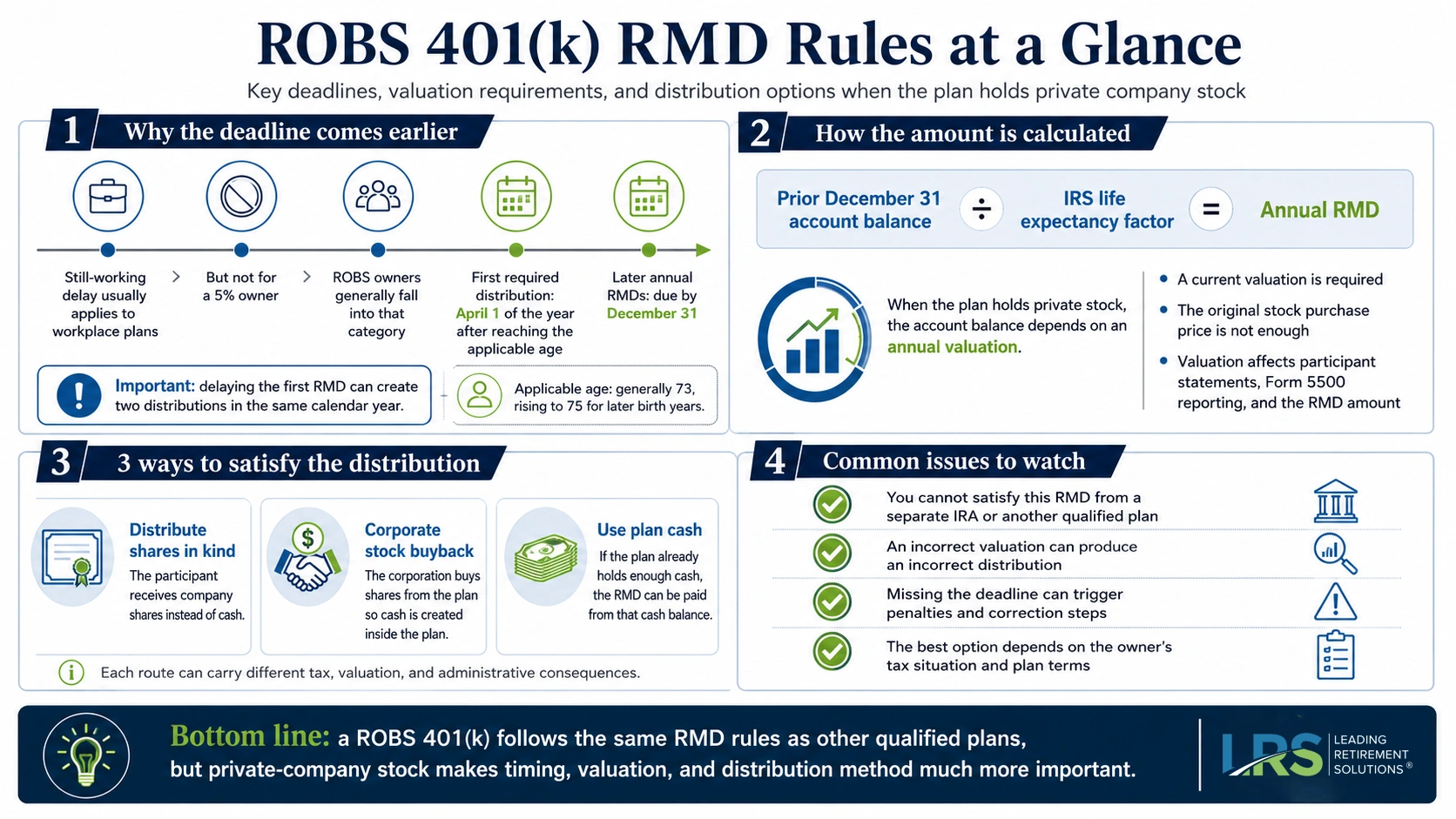
There are three ways a plan can satisfy the requirement in that situation: distribute shares in kind, have the corporation buy shares back from the plan to create cash inside it, or fund the distribution from cash the plan already holds. Each carries different tax and valuation consequences, and the choice among them turns on the owner’s own tax circumstances, which makes it a question for the owner’s tax professional rather than one with a single correct answer.
What follows sets out what the Internal Revenue Code, the IRS, and ERISA provide on each of those points. It also covers the timing rule that catches ROBS owners most often, which is that the delay available to other still-working participants is not available to them. It is general information rather than a determination about any particular plan, owner, or distribution.
Why the Deadline Arrives Earlier for a ROBS Owner
Most participants who are still working past the required minimum distribution age can delay distributions from their current employer’s plan until they retire. The IRS states the rule and its limit plainly in its required minimum distribution FAQs: participants in a workplace plan can delay taking their distributions until the year they retire, unless they are a 5 percent owner of the business sponsoring the plan.
That exclusion is the point that matters here. Code section 401(a)(9)(C)(ii) withholds the still-working delay from a 5 percent owner, and section 416(i) supplies the definition, which reaches ownership held directly and ownership attributed under the constructive ownership rules. A ROBS arrangement exists so that the owner’s plan account holds the company’s stock and the owner works in the business, which is the combination the exclusion is written for.
A ROBS owner who is still running the business does not get to wait until retirement. Distributions begin by the required beginning date, which is April 1 of the year following the year the participant reaches the applicable age, and each later year’s distribution is due by December 31. Whether a particular owner is a 5 percent owner for the plan year in question is a determination made on that plan’s facts and the attribution rules, and the plan document also governs what the plan itself permits.
The applicable age is 73 under the change SECURE 2.0 made, rising to 75 for later birth years. The IRS sets out the required beginning date and the calculation rules on its required minimum distributions pages, and our note on the April 1 deadline covers the first-year timing that applies to any plan.
The first year can produce two distributions in one calendar year
The first required distribution may be deferred to April 1 of the year following the year the participant reaches the applicable age. The second is due by December 31 of that same following year. Where the first is deferred to the April 1 date, both fall in the same calendar year, which means two taxable distributions land in one tax year. For a plan whose only asset is company stock that also means two valuations are in play, because each distribution is measured against a different preceding December 31 balance.
Distributions cannot be taken from another account instead
Someone with several individual retirement accounts may total the required amounts and take the whole figure from one of them. That aggregation is not available across qualified plans. Each plan’s required amount is calculated separately and has to come out of that plan. For a ROBS owner this closes an option that might otherwise have solved the problem, because the distribution cannot be satisfied by drawing on a separate IRA that holds liquid assets. The requirement has to be met from the plan that holds the stock.
How the Amount Is Calculated When the Plan Holds Private Stock
The calculation itself is the same one that applies to any defined contribution plan: the account balance as of December 31 of the preceding year, divided by the life expectancy factor for the participant’s age. The general mechanics are covered in our overview of how defined contribution plans work.
The difficulty is the first input. In a plan invested in mutual funds the December 31 balance is a matter of record. In a ROBS plan the balance depends on what the company stock is worth, which means a valuation. That valuation is not optional and it is not a one-time exercise at formation. It drives the participant statements, the asset figures reported on the annual return, and now the size of a distribution that carries a tax consequence and a deadline.
A figure carried forward unchanged from the original stock purchase is not a valuation of the current year’s balance. Where the company has grown, an understated balance produces an understated distribution, and the shortfall is measured against what the correct balance would have produced. Where the company has declined, the same logic runs the other way. The annual valuation and reporting work is part of ongoing plan administration, and the reported asset figures appear on the plan’s Form 5500.
Take a plan account valued at $900,000 as of December 31, holding 90,000 shares, and a life expectancy factor of 26.5. The required amount is $900,000 divided by 26.5, or $33,962. At a per-share value of $10, that is 3,397 shares if the distribution is made in kind, or $33,962 in cash if the corporation redeems shares or the plan holds cash. The figures are arithmetic for illustration rather than a determination for any plan. The per-share value, the factor, and the resulting number of shares are all specific to a plan and a participant.
Option One: Distributing Shares In Kind
The plan distributes actual shares of the company to the owner rather than cash. The owner then holds those shares personally, outside the plan, and the plan’s holding is reduced by the shares distributed. This is the route most often asked about, and it is the one that requires the most attention to detail.
How the amount is matched to the requirement
The distribution has to satisfy a dollar figure, and shares come in units. The value of the shares distributed is measured by the same valuation that produced the account balance, so the number of shares needed follows from that per-share value. Where the arithmetic does not divide evenly, the plan distributes at least enough to satisfy the required amount rather than less, since a shortfall is what carries the excise tax. Whether the plan can distribute fractional shares is a function of the plan document and the corporation’s own governing documents.
How the distribution is taxed
An in-kind distribution is a distribution. The owner includes the value of what was distributed in income for the year, at ordinary income rates, in the same way as if cash of that amount had been paid. The plan reports it on a Form 1099-R. Receiving stock instead of cash does not defer the tax, which is the point most often misunderstood about this route: it moves the asset without moving the tax.
Code section 402(e)(4) allows favorable treatment of net unrealized appreciation in employer securities, under which appreciation is not taxed at distribution and is instead treated as capital gain when the shares are later sold. The full exclusion is conditioned on the distribution being a lump-sum distribution as the statute defines it, which requires the balance to the credit of the employee to be distributed within one taxable year on account of a qualifying event. An annual partial distribution taken to satisfy a required minimum distribution does not meet that definition on its own. The IRS guidance on the treatment is in Notice 98-24. Whether net unrealized appreciation is available in any particular distribution or exit is a question for the owner’s tax professional.
What it does to the ownership picture
After an in-kind distribution the shares are held by the owner personally rather than by the plan. Repeated annually, that shifts the split between plan-held and personally held stock over time. That shift reaches several other things: the plan’s asset composition and therefore its audit and bonding position, the availability of net unrealized appreciation on a later exit, and how a future sale of the business is structured, because the plan and the individual are separate holders with different tax treatment. Our walkthrough of how to exit a ROBS plan covers the sale side of that.
The company also remains a C corporation for as long as the plan holds shares, so an in-kind distribution does not by itself change the entity requirement unless and until the plan’s holding is fully unwound.
Option Two: The Corporation Redeems Shares From the Plan
The corporation buys some of its own stock back from the plan. The plan receives cash, and the distribution to the owner is then made in cash out of the plan in the ordinary way. The plan’s share count falls and the corporation’s treasury holding rises.
The prohibited transaction analysis
A sale or exchange of property between a plan and a disqualified person is a prohibited transaction under Code section 4975(c)(1)(A), and the employer whose employees are covered by the plan is a disqualified person and a party in interest. A redemption is a sale of property between the plan and the employer, so on its face it falls inside that prohibition.
It is permitted by an exemption rather than by falling outside the rule. ERISA section 408(e) and Code section 4975(d)(13) permit the acquisition or sale of qualifying employer securities by an eligible individual account plan where the transaction is for adequate consideration, no commission is charged, and the plan is an eligible individual account plan. This is the same exemption the original stock purchase relied on, applied in the opposite direction.
Adequate consideration, and why the price is the whole question
Because the exemption is conditioned on adequate consideration, the redemption price is the condition on which the transaction’s permissibility rests. ERISA section 3(18)(B) defines adequate consideration, for an asset other than a security with a generally recognized market, as the fair market value determined in good faith by the trustee or named fiduciary in accordance with the plan’s terms and the applicable regulations. A price set for convenience, or carried over from an earlier year, is not a determination of fair market value for the year of the transaction.
The fiduciary acting for the plan in the redemption is generally the same person who controls the corporation on the other side, which is a structural feature of ROBS rather than a defect, and it is why the valuation supporting the price matters more here than it would between unrelated parties. The Department of Labor’s overview of the underlying duties is Meeting Your Fiduciary Responsibilities.
The corporation has to have the cash
A redemption moves cash out of the operating business and into the plan. The amount required is set by the distribution, not by what the business can comfortably release, and it recurs annually once distributions have begun. Whether a redemption is available in a given year is a function of the corporation’s own cash position and its other obligations.
Option Three: Funding the Distribution From Cash Already in the Plan
Where the plan holds cash or other liquid assets alongside the stock, the distribution can be made from those assets and the shares left untouched. Nothing is redeemed, nothing is distributed in kind, and the ownership split does not move.
Whether that cash exists is determined years earlier. A plan that invested its entire balance in employer stock at formation has no liquid assets to draw on, while one that retained a cash allocation, or that receives ongoing contributions because the business runs payroll and the plan continues to operate, may. Ongoing contributions are also subject to the annual additions limit and to the plan’s own allocation formula, so they are not a mechanism that can be sized to a distribution.
The Three Routes Compared
| In-kind distribution of shares | Corporate redemption | Cash already in the plan | |
|---|---|---|---|
| What moves | Shares move from the plan to the owner personally | Shares move from the plan to the corporation, and cash moves into the plan | Cash moves from the plan to the owner |
| Cash required from the business | None | The full distribution amount, paid by the corporation | None |
| Taxation to the owner | Ordinary income on the value distributed, reported on Form 1099-R | Ordinary income on the cash distributed | Ordinary income on the cash distributed |
| Valuation required | Yes, for the account balance and the per-share value | Yes, for the account balance and for adequate consideration on the redemption price | Yes, for the account balance |
| Prohibited transaction analysis | Not a sale between the plan and the employer | A sale between the plan and the employer, permitted under the ERISA section 408(e) exemption where its conditions are met | Not a sale between the plan and the employer |
| Effect on the ownership split | Plan-held stock falls, personally held stock rises | Plan-held stock falls, corporate treasury stock rises | No change |
| Depends on planning done earlier | No | On the corporation holding cash in the year required | On the plan holding liquid assets |
All three are workable. Which one suits a particular owner depends on that owner’s overall tax picture, the corporation’s cash position, and what the plan document permits, and that decision generally belongs with the owner’s tax professional. LRS administers whichever route is chosen, as part of ROBS and qualified employer securities plan services.
The Sequence in a Year Once Distributions Have Begun
The steps repeat annually for as long as the plan holds the stock and the participant has a balance. They are set out here as a sequence because the order determines whether the December 31 deadline is workable, and several of the steps have lead times.
- The company stock is valued as of the plan year end, which establishes the December 31 account balance the calculation runs on.
- The required amount is calculated from that balance and the applicable life expectancy factor for the participant’s age in the distribution year.
- The route is selected, which is where the owner’s tax professional and, for a redemption, the corporation’s cash position come in.
- For an in-kind distribution, the number of shares is derived from the per-share value, and the transfer is recorded on the corporation’s stock ledger as well as in the plan’s records.
- For a redemption, the price is supported by the valuation as adequate consideration, the corporation pays cash to the plan, and the plan then distributes cash.
- The distribution is reported on a Form 1099-R for the year, and the plan’s asset figures for the year reflect the reduced holding.
The valuation sits at the front of that sequence, which is why a plan without a current valuation is not in a position to calculate the amount, let alone distribute it. Where a valuation is commissioned late in the year the remaining steps compress against the December 31 date.
How the distribution is reported
The plan issues a Form 1099-R reporting the distribution, whether it was paid in cash or in shares, with the value of any shares distributed reported as the gross distribution. The IRS ROBS compliance project records that failure to issue a Form 1099-R was among the reporting items its contact letters asked about. On the annual return, the plan’s asset figures for the year reflect both the revised valuation and the reduced holding, and those figures are what a reader of the filing sees.
What Happens If the Distribution Is Missed
Two separate exposures follow a missed required minimum distribution, and they run to different parties.
The excise tax on the participant
Code section 4974 imposes an excise tax on the payee where the amount distributed for a year is less than the required amount. Section 302 of SECURE 2.0 reduced that tax to 25 percent of the shortfall for taxable years beginning after December 29, 2022, and the IRS confirms the figure and the reduction in Notice 2024-35. The IRS states in its FAQs that the 25 percent falls to 10 percent where the shortfall is corrected within two years, and that the tax may be waived where the account owner establishes that the shortfall was due to reasonable error and that reasonable steps are being taken to remedy it. The tax is reported on Form 5329 with the participant’s return.
The plan qualification exposure on the employer
The required minimum distribution rules are qualification requirements, which means they have to be written into the plan and followed as written. The IRS states on its page covering failure to timely start minimum distributions that failure to follow the minimum payment rules as written in the plan document can lead to loss of the plan’s tax-qualified status. That exposure sits with the plan rather than with the participant, and it is separate from the excise tax.
Correction programs exist for operational failures of this kind, and the IRS describes them on its correcting plan errors pages. Our overview of consulting and correction services covers the formal routes, and where correspondence has already arrived, our note on what an IRS or DOL notice means covers what those letters ask for. The compliance history the IRS published in its ROBS compliance project records that the arrangements it examined were selected in part on reporting failures, which is context for why the reporting and distribution mechanics on these plans receive attention.
Related Points That Come Up
Designated Roth accounts
Amounts in a designated Roth account within a plan are no longer subject to lifetime required minimum distributions. Where a ROBS plan holds both pre-tax and designated Roth amounts, that distinction affects which portion of the balance the calculation runs on. Whether a plan has a Roth feature at all is determined by its plan document.
Other participants in the plan
A ROBS plan that has grown beyond the owner has other participants, and the required minimum distribution rules apply to each of them on their own facts. A participant who is not a 5 percent owner and is still employed can use the still-working delay where the plan permits it, which is the opposite result from the owner’s. Employer stock also has to remain available to eligible participants on the same terms, a point the IRS has identified as a compliance concern and one covered in our article on the ROBS mistakes seen most often.
How this interacts with exiting the structure
An owner approaching the required beginning date is often also approaching a decision about the business. The two interact, because the sequencing of a sale, a wind-down, or a buyback determines how the plan’s shares are treated and whether the deferral survives. Our walkthrough of the routes out of a ROBS structure covers each of them, and the four compliance issues we see most often are set out in our piece on ROBS compliance issues. The ongoing cost of running the plan through that period, including the annual valuation, is covered in what a ROBS plan costs.
The arithmetic of a required minimum distribution is not the hard part. The hard part is that the amount is fixed by a balance and a deadline, while the asset that has to produce it has no market. That is a planning question with a lead time rather than a filing question, and it is one of the recurring obligations described in our guide to how the ROBS transaction works. Plans holding assets without a public market carry the same issue in other forms, which is covered on our page on non-traditional plan investments.
Questions That Come Up on This Requirement
Do required minimum distributions apply to a ROBS 401(k)?
Yes. A ROBS 401(k) is a qualified plan and the required minimum distribution rules under Code section 401(a)(9) apply to it in the same way they apply to any other defined contribution plan. What differs is that the plan’s main asset is private company stock with no public market, so satisfying the requirement takes one of three routes rather than a simple sale.
Can a ROBS owner delay distributions because they are still working?
Generally no. The IRS states that participants in a workplace plan can delay taking their required distributions until the year they retire unless they are a 5 percent owner of the business sponsoring the plan. Code section 401(a)(9)(C)(ii) withholds the delay from a 5 percent owner, with section 416(i) supplying the definition, and it reaches ownership attributed under the constructive ownership rules as well as ownership held directly. Whether a particular owner is a 5 percent owner for the plan year in question is determined on that plan’s facts.
How does an in-kind distribution of company stock satisfy an RMD?
The plan distributes shares of the company to the participant rather than cash, and the value of the shares distributed counts toward the required amount. The number of shares follows from the per-share value established by the plan’s valuation. The participant includes the value distributed in ordinary income for the year and the plan reports it on a Form 1099-R, so receiving stock rather than cash does not defer the tax. Whether the plan can distribute fractional shares depends on the plan document and the corporation’s governing documents.
Does net unrealized appreciation apply to a ROBS in-kind RMD?
Generally not on its own. Code section 402(e)(4) allows appreciation in employer securities to escape tax at distribution and be treated as capital gain on a later sale, but the full exclusion is conditioned on the distribution being a lump-sum distribution as the statute defines it, meaning the balance to the credit of the employee distributed within one taxable year on account of a qualifying event. An annual partial distribution taken to satisfy a required minimum distribution does not meet that definition. Whether the treatment is available in any particular distribution or exit is a question for the owner’s tax professional.
Is a corporate redemption of plan-held stock a prohibited transaction?
A sale of property between a plan and a disqualified person is prohibited under Code section 4975(c)(1)(A), and the employer is a disqualified person, so a redemption falls inside the prohibition on its face. It is permitted by an exemption: ERISA section 408(e) and Code section 4975(d)(13) allow the acquisition or sale of qualifying employer securities by an eligible individual account plan where the transaction is for adequate consideration and no commission is charged. Because the exemption is conditioned on adequate consideration, the redemption price is the condition the transaction rests on.
Can a ROBS owner take the distribution from an IRA instead?
No. Someone with several individual retirement accounts may total the required amounts and take the whole figure from one of them, but that aggregation is not available across qualified plans. Each plan’s required amount is calculated separately and has to be distributed from that plan, so a ROBS plan’s requirement cannot be satisfied by drawing on a separate IRA holding liquid assets.
Does the company stock have to be valued every year?
The required amount is calculated from the account balance as of December 31 of the preceding year, so the balance has to be determined, and for private stock that means a valuation. A figure carried forward unchanged from the original stock purchase is not a valuation of the current year’s balance. The same valuation supports the participant statements, the asset figures on the annual return, and the per-share value used in an in-kind distribution or a redemption price.
What is the penalty for missing a ROBS RMD?
Code section 4974 imposes an excise tax on the payee where less than the required amount is distributed for a year. SECURE 2.0 reduced it to 25 percent of the shortfall for taxable years beginning after December 29, 2022, and the IRS states it falls to 10 percent where the shortfall is corrected within two years. It may be waived where the account owner establishes reasonable error and that reasonable steps are being taken to remedy it. Separately, the distribution rules are plan qualification requirements, and the IRS states that failure to follow them as written in the plan document can lead to loss of the plan’s tax-qualified status, which is an exposure on the plan rather than the participant.
Can a ROBS owner end up with two RMDs in one year?
Yes, where the first one is deferred. The first required distribution may be taken as late as April 1 of the year following the year the participant reaches the applicable age, while the second is due by December 31 of that same year. Deferring the first therefore puts two taxable distributions in one calendar year, each measured against a different preceding December 31 balance, which for a plan holding private stock means two valuations are in play.
How is a ROBS in-kind distribution reported?
The plan issues a Form 1099-R for the year reporting the distribution, with the value of any shares distributed reported as the gross distribution. The transfer is also recorded on the corporation’s stock ledger and in the plan’s records, and the plan’s asset figures on the annual return reflect the reduced holding and the revised valuation. The IRS ROBS compliance project records that failure to issue a Form 1099-R was among the reporting items its contact letters asked about.
Which of the three routes is used most often?
That is not a question with a general answer. The route used depends on the owner’s overall tax picture, whether the corporation holds cash in the year the distribution is due, whether the plan holds liquid assets alongside the stock, and what the plan document permits. The decision generally belongs with the owner’s tax professional, with the plan administered to carry out whichever route is chosen.
Sources
Every substantive statement above is drawn from the following. Links were verified at the time of writing.
- Internal Revenue ServiceRetirement plan and IRA required minimum distributions FAQsThe still-working delay and its exclusion for 5 percent owners, the excise tax rate and the correction window, and the waiver standard.
- Internal Revenue ServiceRetirement topics: required minimum distributionsRequired beginning dates and the calculation rules.
- Internal Revenue ServiceFixing common plan mistakes: failure to timely start minimum distributionsThe agency’s statement that the distribution rules are qualification requirements and that failure to follow them as written can lead to loss of qualified status.
- Internal Revenue ServiceNotice 2024-35The section 4974 excise tax and its reduction to 25 percent under section 302 of SECURE 2.0.
- Internal Revenue ServiceNotice 98-24The agency’s guidance on net unrealized appreciation in employer securities.
- Internal Revenue ServiceRollovers as business start-ups compliance projectThe agency’s own account of the ROBS arrangements it examined and the reporting failures it selected on.
- Internal Revenue ServiceCorrecting plan errorsThe correction programs available for an operational failure.
- U.S. Department of Labor, Employee Benefits Security AdministrationMeeting Your Fiduciary ResponsibilitiesThe fiduciary duties that apply to a plan fiduciary setting a price in a transaction with the employer.
- U.S. Department of Labor, Employee Benefits Security AdministrationForm 5500 series forms and instructionsThe annual return on which plan asset figures, including the valuation of employer securities, are reported.
- Internal Revenue Code and ERISACode section 401(a)(9), the distribution requirement itself, and section 4974, the excise tax. Also sections 402(e)(4), 416(i) and 4975; ERISA sections 3(18), 408(e) and 406The distribution requirement and its timing, the net unrealized appreciation rules, the 5 percent owner definition, the excise tax, and the prohibited transaction rules and the employer securities exemption.