

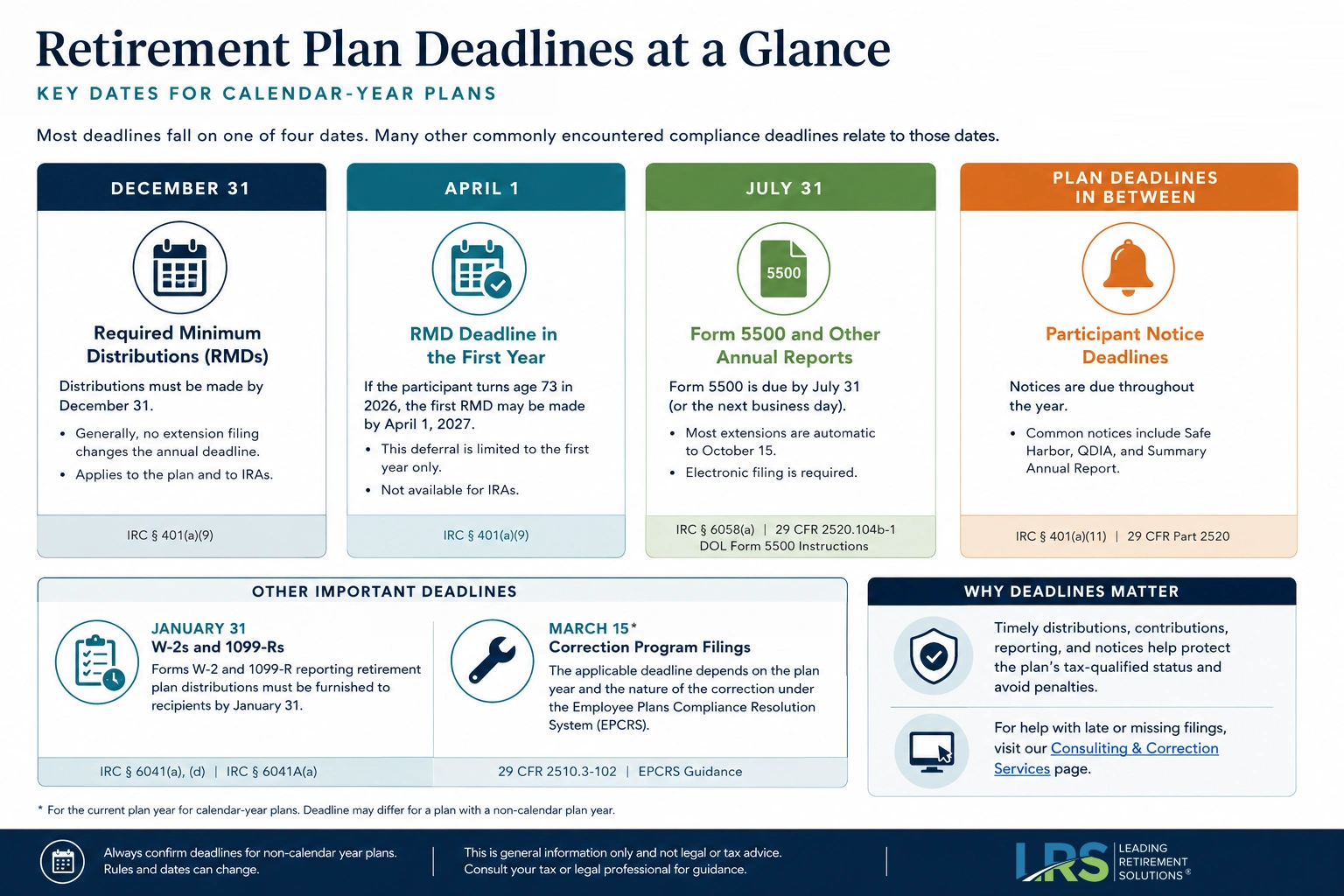
For many calendar-year plans, the most commonly referenced deadlines fall on four dates. December 31 is when required minimum distributions are due for every year after the first. April 1 is the deadline for the first one only. July 31 is when the Form 5500 is due for a calendar-year plan, and October 15 is the extended date. Many other commonly encountered compliance deadlines relate to those dates.
The confusion usually comes from the two RMD dates. April 1 applies once, in the year after a participant reaches the required beginning age. Every distribution after that is due by December 31. A participant who uses the April 1 deadline for the first one takes two distributions in the same calendar year.
What follows sets out the deadlines that apply to a workplace retirement plan and where each one comes from. Dates are given for a calendar-year plan, and the section on non-calendar plan years explains how to convert them. It is general information rather than a determination about any particular plan.
The Deadlines at a Glance
| Date | What is due | Applies to |
|---|---|---|
| January 31 | Form 1099-R to participants who took a distribution in the prior year | Any plan that made distributions |
| March 15 | Corrective distributions for a failed ADP or ACP test, to avoid the 10 percent excise tax | Plans that did not pass testing for the prior year |
| April 1 | The first required minimum distribution, for a participant who reached the required beginning age in the prior year | That participant only, once |
| April 15 | Corrective distribution of elective deferrals above the section 402(g) limit for the prior calendar year | Participants who exceeded the deferral limit |
| July 31 | Form 5500 for the prior plan year, or Form 5558 requesting the extension | Calendar-year plans |
| September 30 | Summary Annual Report to participants, where the Form 5500 was not extended | Calendar-year plans |
| October 15 | Extended Form 5500 deadline, where Form 5558 was filed by July 31 | Calendar-year plans that extended |
| December 1 | Safe harbor, automatic enrollment and qualified default investment alternative notices for the coming plan year | Plans with those features |
| December 15 | Summary Annual Report, where the Form 5500 deadline was extended | Calendar-year plans that extended |
| December 31 | Required minimum distributions for the year, for every year after the first | Every participant at or past the required beginning age |
The IRS maintains its own overview of the filing and participant disclosure obligations on its retirement plan reporting and disclosure page. The Department of Labor publishes the fuller reference, its Reporting and Disclosure Guide for Employee Benefit Plans, which sets out every disclosure a plan owes, to whom, and on what timetable, with the regulation citation for each one.
January 31 and March 15: Reporting and Correction Deadlines
January 31: Form 1099-R distribution reporting
Plans that made distributions during the prior calendar year generally furnish Form 1099-R to recipients by January 31. The form reports retirement plan distributions for tax reporting purposes. While preparation and delivery are typically administrative functions handled by recordkeepers or service providers, employers may still encounter this deadline when reviewing annual compliance calendars.
March 15: Corrective distributions after failed testing
A plan that fails the ADP or ACP nondiscrimination tests may make corrective distributions to avoid a 10 percent excise tax. For a calendar-year plan, corrective distributions following certain ADP or ACP test failures are commonly completed by March 15 to avoid excise-tax consequences that may apply after the correction period. The applicable deadline depends on the plan year and the nature of the correction. These corrections are generally coordinated by the plan administrator, TPA, or recordkeeper rather than the employer directly, but the deadline often appears on annual retirement plan compliance calendars. Where a correction is needed, our consulting and correction services cover the routes available.
Required Minimum Distribution Deadlines
This is the deadline asked about most often, and the two dates are the reason.
December 31, for every year after the first
Once a participant has taken a first required minimum distribution, every later year’s distribution is due by December 31 of that year. Generally, no extension filing changes the annual deadline. The amount is calculated from the account balance as of December 31 of the preceding year and a life expectancy factor, and the IRS sets out the calculation on its required minimum distributions pages.
April 1, for the first one only
The first required minimum distribution may be deferred to April 1 of the year following the year the participant reaches the applicable age, which SECURE 2.0 set at 73 and which rises to 75 for later birth years. That date is the required beginning date.
Which accounts the deadline applies to
Required minimum distributions reach most tax-deferred retirement accounts: traditional IRAs, SEP and SIMPLE IRAs, and workplace plans including 401(k), 403(b) and governmental 457(b) plans. Roth IRAs are not subject to them during the original owner’s lifetime, and designated Roth accounts inside a workplace plan are no longer subject to lifetime distributions either.
Whether the amounts can be combined
This is where the December 31 deadline becomes harder than it looks. Someone with several traditional IRAs may total the required amounts and take the whole figure from any one of them. That aggregation is not available across qualified plans: each plan calculates its own required amount and each amount is distributed from that plan. A participant with two former employers’ 401(k) plans has two separate distributions to take, and taking both from one of them does not satisfy the other.
The still-working delay, and who does not get it
A participant who is still working past the applicable age can delay distributions from their current employer’s plan until they retire, where the plan permits it. The IRS states the limit on that in its required minimum distribution FAQs: the delay is not available to a participant who is a 5 percent owner of the business sponsoring the plan. Where a plan holds private company stock, as in a ROBS arrangement, the interaction is set out in our article on required minimum distributions from a ROBS plan.
What a missed distribution costs
Code section 4974 imposes an excise tax on the payee where less than the required amount is distributed for a year. Section 302 of SECURE 2.0 reduced that tax to 25 percent of the shortfall for taxable years beginning after December 29, 2022, and the IRS confirms the figure in Notice 2024-35. The IRS states in its FAQs that the 25 percent falls to 10 percent where the shortfall is corrected within two years, and that the tax may be waived where the account owner establishes reasonable error and that reasonable steps are being taken to remedy it.
Contribution Deadlines and the 2026 Limits
When contributions are due
Elective deferrals withheld from pay are transmitted to the plan as of the earliest date on which they can reasonably be segregated from the employer’s general assets, under the Department of Labor’s regulation at 29 CFR 2510.3-102. A safe harbor is available for plans with fewer than 100 participants where the deposit is made within seven business days of withholding. That is a per-payroll obligation rather than an annual deadline, and it is a function of how payroll and the plan are connected, which is the subject of our payroll services page.
Employer contributions for a plan year are generally deductible for the taxable year where they are paid by the due date of the employer’s tax return, including extensions. The exact date therefore follows the employer’s entity type and filing status rather than the plan year.
The 2026 limits
| 2026 limit | Amount |
|---|---|
| Elective deferrals, section 402(g) | $24,500 |
| Catch-up, age 50 and over | $8,000 |
| Catch-up, ages 60 to 63 | $11,250 |
| Annual additions, section 415(c) | $72,000 |
| Annual compensation, section 401(a)(17) | $360,000 |
| Highly compensated employee threshold | $160,000 |
| Key employee threshold | $235,000 |
| SIMPLE plan employee contributions | $17,000 |
| IRA contributions | $7,500 |
These figures are from the IRS cost-of-living table for 2026, which reflects Notice 2025-67 and was announced in IR-2025-111. They are adjusted annually, usually in late autumn for the following year. Our summary of the 2026 contribution maximums covers the full set, and how the limits interact is set out in our guide to how defined contribution plans work.
April 15, for excess deferrals
Where a participant’s elective deferrals across all plans exceeded the section 402(g) limit for a calendar year, the excess and its earnings are distributed by April 15 of the following year. This one catches participants who changed jobs mid-year, because the limit follows the individual rather than the plan, and neither employer necessarily sees the total.
IRA Deadlines, and Where They Differ
Searches about retirement account deadlines often turn out to be about an IRA rather than a workplace plan, and several of the dates are different.
The contribution deadline is the tax filing deadline
An IRA contribution for a tax year may be made up to the due date of the individual’s return for that year, generally April 15 of the following year. Unlike the employer contribution deadline for a workplace plan, filing an extension does not extend it. A contribution made between January 1 and April 15 is designated for one year or the other at the time it is made, which is the step most often missed.
The limits are separate from the workplace plan limits
The IRA contribution limit for 2026 is $7,500, with an additional $1,100 catch-up contribution for those aged 50 and over. That limit is separate from the $24,500 elective deferral limit for a workplace plan, so a participant contributing the maximum to a 401(k) may still contribute to an IRA, subject to the deductibility rules that apply where the individual is covered by a workplace plan.
The distribution rules line up, the aggregation rules do not
IRA required minimum distributions run on the same December 31 and April 1 timetable as a workplace plan. What differs is aggregation, as above, and the still-working delay, which has no IRA equivalent: an IRA owner reaches their required beginning date regardless of whether they are working.
The Deadline to Establish a Plan for a Prior Year
An employer that did not have a plan in place during a year is not necessarily out of time for it. The SECURE Act permits an employer to adopt a qualified plan after the close of a taxable year, up to the due date of the employer’s return for that year including extensions, and treat the plan as effective for that year.
The limit worth knowing is that this reaches employer contributions rather than elective deferrals. A participant cannot retroactively defer from compensation that has already been paid, so a plan adopted after year end operates on employer contributions for the retroactive year and on deferrals only from the point the deferral election is in place. What is involved in establishing a new plan is covered separately.
Form 5500 and Reporting Deadlines
The Form 5500 is due the last day of the seventh month after the plan year ends. For a calendar-year plan that is July 31. Filing Form 5558 by that date extends it two and a half months, to October 15. The current forms and instructions are published on the Department of Labor’s Form 5500 series page, and our guide to finding and reading a Form 5500 covers the filing itself.
Plans with 100 or more participants generally include an independent qualified public accountant’s report with the filing, which is the subject of our large plan audit services page. A regulation waives that requirement for smaller plans meeting stated conditions on qualifying plan assets, bonding and participant disclosure. Those bonding conditions are set out in our article on ERISA fidelity bond requirements.
The Summary Annual Report
A Summary Annual Report goes to participants within nine months after the close of the plan year under 29 CFR 2520.104b-10, which is September 30 for a calendar-year plan, or two months after the extended filing date where the deadline was extended by Form 5558, which is December 15.
Participant Notice Deadlines
Several notices run to participants rather than to an agency, and the annual ones cluster at the end of the year because they relate to the plan year about to begin.
- Safe harbor notice. Where a plan uses a safe harbor design that requires a notice, it is generally provided at least 30 days and no more than 90 days before the beginning of the plan year, which is December 1 for a calendar-year plan. The design itself is covered in our overview of safe harbor plans.
- Automatic enrollment notice. Plans with an automatic contribution arrangement provide an annual notice on the same timetable, described in our article on automatic enrollment.
- Qualified default investment alternative notice. Provided annually where contributions are invested in a default fund because a participant made no election.
- Benefit statements. Required at least quarterly for a participant-directed plan and at least annually otherwise.
- Summary plan description. Provided to new participants and reissued periodically, with an updated version required after material changes.
Which notices a particular plan owes, and on what schedule, follows from its design and its plan document. The IRS overview of plan features that carry a notice requirement is on its 401(k) plan overview page, and the Department of Labor’s Reporting and Disclosure Guide gives the timetable and the regulation behind each one. Producing and delivering the notices is generally a recordkeeping function, and which party owns each item on the calendar is one of the questions covered in our overview of how to choose a third-party administrator.
Non-Calendar Plan Years
Every date above assumes a plan year ending December 31. For a plan year ending on any other date the rule rather than the date is what carries over:
- The Form 5500 is due the last day of the seventh month after the plan year ends, with a two and a half month extension available on Form 5558.
- The Summary Annual Report follows two months after that filing deadline.
- Annual participant notices tie to the beginning of the plan year, not to January.
- Required minimum distributions stay on the calendar year regardless of the plan year, because section 401(a)(9) works on the calendar year and the participant’s age.
- The section 402(g) deferral limit is also a calendar-year limit, which is why a plan with a June plan year end still tests deferrals against the calendar year.
That last pair is the one that produces most of the confusion on a non-calendar plan year: the filing deadlines move with the plan year and the distribution and deferral deadlines do not.
What Happens When a Deadline Is Missed
The consequence depends on which deadline, and correction is generally available on better terms when it is addressed before an agency raises it.
- A missed required minimum distribution carries the section 4974 excise tax on the payee, reduced where corrected within the correction window, and the distribution rules are also plan qualification requirements, which is a separate exposure on the plan.
- A late Form 5500 carries separate IRS and Department of Labor penalties that accrue per day for each plan year missed, with the voluntary programme available before a notice arrives.
- A missed notice or a late deposit is generally an operational failure, and the IRS maintains correction programmes described on its correcting plan errors pages.
- A distribution taken before age 59 and a half is a different question from a deadline, and the exceptions are set out on the IRS page covering exceptions to the tax on early distributions.
Where correspondence has already arrived, our note on what an IRS or DOL retirement plan notice means covers what each letter is asking for, and our consulting and correction services cover the formal routes. Where a plan is being wound up rather than corrected, the final filing and the steps around it are set out in our plan termination FAQ.
Keeping the annual calendar on track is the recurring part of plan administration. To review a specific plan’s filing history and upcoming dates, contact our team.
Questions That Come Up on This Requirement
When is the deadline to take a required minimum distribution?
December 31 of the year the distribution is for, in every year after the first. The first distribution only may be deferred to April 1 of the year following the year the participant reaches the applicable age, which SECURE 2.0 set at 73. Deferring the first one means two distributions fall in the same calendar year, because the second is still due by December 31 of that year.
Is the RMD deadline December 31 or April 1?
Both, for different distributions. April 1 is the required beginning date and applies once, to the first distribution. December 31 applies to every distribution after that. A participant who takes the first distribution during the year they reach the applicable age, rather than waiting until the following April 1, has only one distribution in each year.
When is the Form 5500 due?
The last day of the seventh month after the plan year ends, which is July 31 for a calendar-year plan. Filing Form 5558 by that date extends the deadline two and a half months, to October 15. A Summary Annual Report follows to participants within two months after the filing deadline, so September 30, or December 15 where the filing was extended.
What are the 2026 retirement plan contribution limits?
For 2026, elective deferrals are limited to $24,500, with an additional $8,000 catch-up at age 50 and over or $11,250 for participants who turn 60, 61, 62 or 63 during the year. Total annual additions to one account are limited to $72,000, compensation taken into account is capped at $360,000, and IRA contributions are limited to $7,500. The figures come from the IRS cost-of-living table for 2026 and are adjusted annually.
What is the deadline to correct an excess 401(k) deferral?
April 15 of the year following the calendar year in which the excess arose. The excess and its earnings are distributed by that date. This most often affects participants who changed jobs during the year, because the section 402(g) limit follows the individual across employers and neither plan necessarily sees the combined total.
When are safe harbor and automatic enrollment notices due?
Generally at least 30 days and no more than 90 days before the beginning of the plan year, which is December 1 for a calendar-year plan. Which notices a particular plan owes depends on its design and its plan document.
Do the deadlines change for a non-calendar plan year?
Some of them. The Form 5500 deadline, the extension, the Summary Annual Report and the annual participant notices all move with the plan year. Required minimum distributions and the section 402(g) deferral limit stay on the calendar year regardless of the plan year, because both work on the calendar year rather than the plan year.
What is the penalty for missing a required minimum distribution?
Code section 4974 imposes an excise tax on the payee where less than the required amount is distributed. SECURE 2.0 reduced it to 25 percent of the shortfall for taxable years beginning after December 29, 2022, and the IRS states it falls to 10 percent where the shortfall is corrected within two years. It may be waived where the account owner establishes reasonable error and that reasonable steps are being taken to remedy it. Separately, the distribution rules are plan qualification requirements, which is an exposure on the plan rather than the participant.
Can the Form 5500 deadline be extended?
Yes. Filing Form 5558 by the original due date extends it by two and a half months. For a calendar-year plan that moves July 31 to October 15. The extension applies to the filing, not to the underlying obligations, and the Summary Annual Report deadline moves with it.
Sources
Every substantive statement above is drawn from the following. Links were verified at the
time of writing.
- Internal Revenue ServiceRetirement plan reporting and disclosureThe agency’s overview of the filings and participant disclosures a plan owes, with links to each form.
- Internal Revenue ServiceRetirement topics: required minimum distributionsRequired beginning dates, the calculation, and the accounts the rules apply to.
- Internal Revenue ServiceRetirement plan and IRA required minimum distribution FAQsThe still-working delay and its exclusion for 5 percent owners, the excise tax rate, the correction window and the waiver standard.
- Internal Revenue ServiceNotice 2024-35The section 4974 excise tax and its reduction under section 302 of SECURE 2.0.
- Internal Revenue ServiceCOLA increases for dollar limitations on benefits and contributionsThe published annual limits. Every 2026 figure in this article comes from here.
- Internal Revenue ServiceIR-2025-111The announcement of the 2026 cost-of-living adjustments.
- Internal Revenue ServiceFiling notices for Forms 5500, 5500-SF, 5500-EZ and 5558What each late-filing notice means and the penalty amounts behind it.
- Internal Revenue Service401(k) plan overviewPlan features that carry an annual participant notice requirement.
- Internal Revenue ServiceCorrecting plan errorsThe correction programmes available for an operational failure.
- U.S. Department of Labor, Employee Benefits Security AdministrationReporting and Disclosure Guide for Employee Benefit PlansThe Department’s full reference table of every required disclosure, its deadline, and the regulation behind it.
- Electronic Code of Federal Regulations29 CFR 2520.104b-10The Summary Annual Report requirement, including the nine month furnishing deadline and the extended date.
- U.S. Department of Labor, Employee Benefits Security AdministrationForm 5500 series forms and instructionsThe annual return, its schedules and the filing instructions.
- U.S. Department of Labor, Employee Benefits Security AdministrationDelinquent Filer Voluntary Compliance ProgramEligibility, the reduced penalty amounts, and the requirement to come forward first.
- Internal Revenue Code and ERISACode sections 401(a)(9), 402(g), 415(c), 4974 and 6652(e); ERISA section 105; and 29 CFR 2510.3-102The distribution timing, the deferral limit, the annual additions limit, the excise tax, the late filing penalty, benefit statements and the deposit timing rule.