

A ROBS transaction lets you put retirement money to work in a business you own and operate, without taking a distribution, paying income tax on it, or triggering the early withdrawal penalty. It is a real strategy with a real legal basis. It is also a qualified retirement plan that has to be run like one every year for as long as it exists, and that second part is what most of this guide covers.
The short answer
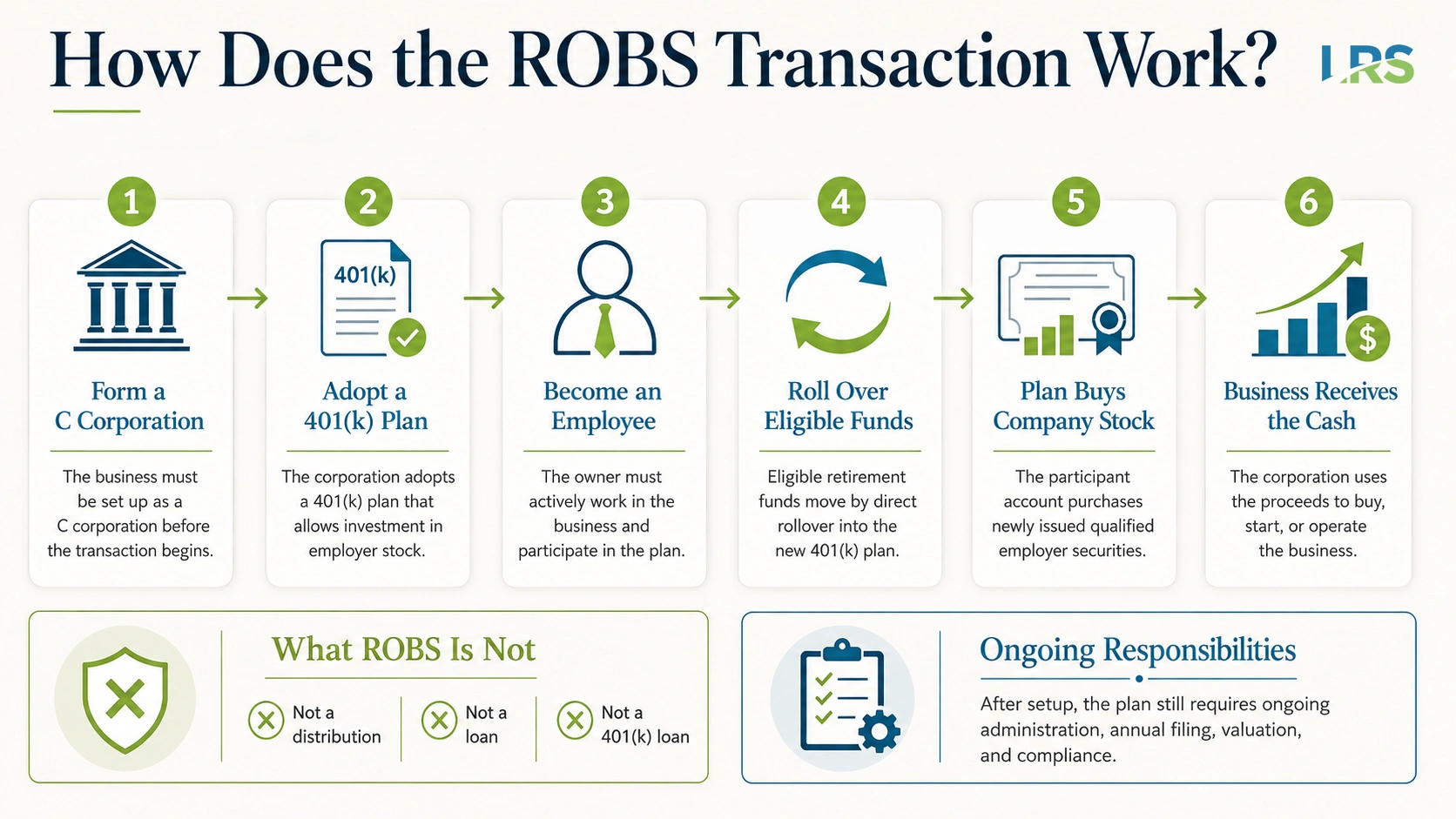
A ROBS transaction works in five moves: you form a C corporation, the corporation adopts a 401(k) plan that permits employer stock, you roll existing retirement funds into that plan, your account buys newly issued stock in the corporation, and the corporation uses the cash to run the business. Because the money is rolled over and then invested rather than withdrawn, there is no income tax and no 10% early distribution penalty. In exchange, you take on a C corporation, an ongoing qualified plan with annual filing and valuation obligations, and concentration risk in a single private business.
This guide covers the mechanics, who qualifies, what the IRS has said, the obligations that repeat every year, the issues that come up most often, and how ROBS compares with the other ways to fund a business. Leading Retirement Solutions has administered ROBS and qualified employer securities plans for well over a decade, and much of what follows reflects that experience.
What is a ROBS transaction?
ROBS stands for rollovers as business start-ups. You will also see it called QES, for qualified employer securities, which describes the asset the plan actually buys. Both terms point at the same arrangement: a retirement plan invests in the stock of the company that sponsors it, and the company uses the money raised to operate a business.
The reason this is worth understanding precisely is that almost every misconception about ROBS comes from thinking of it as a way to get money out of a retirement account. It is not. Nothing comes out. The money moves from one retirement plan to another, and then it changes what it is invested in. Your account balance does not shrink; it stops holding index funds and starts holding shares in your company.
Why it is not a distribution, a loan, or a withdrawal
These three comparisons come up often, and each describes something different from what actually happens.
A distribution is money leaving the retirement system, which is what triggers income tax and, before age 59 and a half, the 10% penalty. In a ROBS transaction the money never leaves. It moves by direct rollover and is then invested.
There is no lender, no interest rate, no repayment schedule, and no personal credit test. There is also no obligation to pay anything back, which is the appeal, and no lender doing diligence on your business plan, which is part of the risk.
A participant loan is capped at the lesser of $50,000 or half your vested balance and has to be repaid with interest, usually within five years. ROBS has no cap other than what you have saved.
The legal basis
A retirement plan buying stock from the employer that sponsors it would normally be a prohibited transaction. It is permitted here because the Internal Revenue Code and ERISA both carve out an exemption for the acquisition of qualifying employer securities by an eligible individual account plan. That exemption is what the entire structure stands on, and it is conditional. The plan has to be a genuine qualified plan, the securities have to be qualifying employer securities, and the purchase has to be for adequate consideration.
Read that last sentence as a maintenance requirement rather than a setup requirement. The exemption is not something you clear once at formation. It describes a condition the plan has to keep satisfying.
How the ROBS transaction works, step by step
The sequence matters. Each step depends on the one before it, so the order is worth following closely.
Form a new C corporation
The business has to be a C corporation, and it has to exist before anything else happens. This is structural rather than a preference. Only a C corporation issues the kind of stock a retirement plan is permitted to buy, and only a C corporation can be owned by a plan without the ownership flowing through to individual tax returns. An S corporation cannot be used, because a qualified retirement plan is not an eligible S corporation shareholder. An LLC cannot be used unless it elects C corporation treatment.
Adopt a 401(k) plan that permits investment in employer securities
The new corporation sponsors a 401(k) plan, and that plan document has to expressly allow participants to direct their accounts into qualified employer securities. Most off-the-shelf 401(k) documents do not. The plan itself is a standard qualified plan with an employer securities provision that the Internal Revenue Code already contemplates.
Become an employee of the corporation and a participant in the plan
You have to be a legitimate employee of the business, performing real work for it. The whole structure rests on you being a plan participant, and you cannot be a participant without being an employee. A ROBS arrangement in which the owner does not actively work in the business presents one of the greatest risks if the plan is ever subject to scrutiny or examination.
Roll eligible retirement funds into the new 401(k) plan
You execute a direct rollover from an existing 401(k), 403(b), traditional IRA, SEP, SIMPLE, or governmental 457(b) into the plan the new corporation sponsors. Done as a direct trustee-to-trustee transfer, this is not a distribution, so there is no income tax and no early withdrawal penalty. The IRS rollover chart is the authoritative reference for which account types can move where. Roth IRAs cannot be rolled into a qualified plan at all, and money sitting in your current employer’s plan is usually unavailable until you separate from service.
The plan purchases qualified employer securities
Your account in the new plan buys newly issued stock in the C corporation. The plan becomes a shareholder. This is the actual transaction, and it is the step that gives the structure its other name, qualified employer securities or QES. The purchase has to be for adequate consideration, meaning a defensible valuation, and the stock has to be available to other eligible participants on the same terms.
The corporation uses the proceeds to operate the business
The corporation now holds cash from the stock sale and uses it to buy a business, buy a franchise, fund operations, or expand. From this point forward the money is corporate capital, not retirement money, and it is governed by corporate rules. The plan holds stock, the corporation holds cash, and the two should not be confused for one another.
Everything above happens once, at the start of the arrangement. What is not always made clear is that step six is not the finish line. The corporation now sponsors a qualified retirement plan that holds a hard-to-value asset, and that plan has obligations every year for as long as it exists. The sections below cover those obligations.
Who qualifies for a ROBS transaction
Which retirement money can be used
Generally, pre-tax balances you control: a former employer’s 401(k) or 403(b), a traditional IRA, a SEP IRA, a SIMPLE IRA that has satisfied its two-year holding requirement, and a governmental 457(b). What cannot be used is a Roth IRA, and in most cases the balance in your current employer’s plan, since it stays locked until you separate from service or the plan permits an in-service rollover.
The bona fide employee requirement
Active participation in the business is essential. Being listed as an owner or officer on paper does not satisfy the requirement. Because a ROBS arrangement is based on the owner participating in the plan as an employee, the owner must actually perform services for the company. When an owner acquires a business through a ROBS arrangement but never works in it, the structure is significantly more difficult to defend under scrutiny.
Why the business has to be a C corporation
A C corporation structure has to be used with a ROBS arrangement because the company must be able to issue stock to the plan. A C corporation is the only entity that allows this type of stock to be purchased by a plan. As long as the plan holds QES shares, the company remains a C corporation.
A qualified retirement plan is also not a permitted shareholder of an S corporation, so an S election is not available while the plan holds stock. Partnerships and LLCs do not issue the kind of stock the exemption contemplates, which means an LLC can only work if it elects C corporation treatment.
The practical consequence usually arrives in year two or three, when a CPA who was not part of the original transaction recommends an S election to reduce self-employment tax. That is ordinarily sound advice, and it does not work here. An S election made while a retirement plan holds the stock can be invalid from the outset, and unwinding it reaches both the corporate return and the plan. If an S election comes up, the plan should be part of that conversation before anything is filed.
What the IRS says about ROBS
The IRS has published its own position on these arrangements, and it is worth reading in the agency’s own words. In its ROBS Compliance Project, the IRS states that they are not considered abusive tax avoidance transactions, and in the same passage that they are questionable because they may solely benefit one individual. The project examined sponsors that had received a favorable determination letter but had not filed a Form 5500, a Form 5500-EZ, or a Form 1120.
What a determination letter does and does not mean
A favorable determination letter is sometimes presented as evidence that the IRS has approved a particular arrangement. It does not do that. A determination letter says the plan’s written terms meet Code requirements. It does not address how the plan is operated, whether the stock was valued properly, whether eligible employees were enrolled, or whether the returns were filed. Most ROBS compliance issues are operational, and a determination letter does not speak to operations. LRS has written previously on the highlights of the IRS ROBS bulletin for a longer discussion.
What the compliance project found
The project also reported on outcomes. While there were some successes, most of the ROBS businesses examined had either already closed or were trending that way. The findings provide useful context for evaluating the risks associated with the arrangement, particularly because retirement funds are being invested in the business.
The obligations that repeat every year
Everything in this section applies for as long as the plan exists.
Form 5500, and why the one-participant exception does not apply
This is one of the most important points in this guide. ROBS owners are sometimes told they do not need to file an annual return, on the basis that a plan with no employees other than the owner and under $250,000 in assets is exempt. That is correct for ordinary solo 401(k) plans, and it does not hold here.
The IRS position is that the one-participant filing exception is unavailable to a ROBS plan, because the plan owns the trade or business through its stock. So the plan files, and it generally files the full Form 5500 rather than the 5500-EZ or the 5500-SF, since a plan holding employer securities cannot use the short forms. The current Form 5500 forms and instructions are published by the Department of Labor, and our Form 5500 guide covers the filing itself in more detail.
Under Internal Revenue Code section 6652(e) the IRS can assess $250 per day for a late Form 5500, up to $150,000 per plan year. The Department of Labor can assess its own penalty per day, adjusted annually for inflation, with no cap. Those are separate exposures for the same missed filing, and they run per year.
The Delinquent Filer Voluntary Compliance Program reduces that to $10 per day, capped at $750 per late return for a small plan and $1,500 per plan no matter how many years are outstanding. The program is available only if the filer comes forward before the Department of Labor issues a notice. Because a ROBS plan files the full Form 5500 under Title I, it is generally eligible.
One-participant filers are not eligible for that program, because their returns are not submitted to the Department of Labor. The IRS operates a separate penalty relief program for late Form 5500-EZ returns, with user fees comparable to those under the Delinquent Filer program.
Annual valuation of the stock
The plan holds an asset with no public market, and its value has to be determined each year and supported if it is questioned. Valuation drives the participant statements, the Form 5500 asset figures, and eventually any distribution or redemption. A figure carried forward unchanged from the original stock purchase is not a valuation, and it is a common subject of questions in an examination.
Employee eligibility, coverage, and testing
The plan starts with one participant and rarely stays that way. As the business hires, employees become eligible under the plan’s own terms, and they have to be notified, enrolled, and included in coverage and nondiscrimination testing. Employer stock has to remain available to them on the same terms it was available to the owner. The IRS has identified restricting it after the fact as a compliance concern, and LRS has written a separate piece on the ROBS mistakes we see most and how to fix them. A growing number of states also require employers above a certain size to offer a qualifying retirement plan or enroll employees in a state-facilitated program, and a ROBS 401(k) is one of the ways that requirement is satisfied; our guide to which states have mandatory retirement plans and the state retirement mandate map cover who is affected and the deadline in each state.
Corporate filings, payroll, and the fidelity bond
The corporation files its own return and runs real payroll for the owner as an employee. The plan needs an ERISA fidelity bond, and a plan holding employer securities has bonding considerations an ordinary plan does not.
Individually, these obligations are straightforward and manageable. They are most often overlooked when the arrangement is treated as a one-time financing transaction instead of a structure that requires ongoing operation and administration.
Required minimum distributions from a ROBS plan
This is one of the most frequently asked questions about ROBS, yet it receives surprisingly little attention. RMD rules apply to a ROBS plan the same way they apply to any qualified plan. Once the owner reaches their required beginning date, a distribution has to come out each year, calculated on the account balance.
The challenge is that the plan’s assets are primarily invested in private company stock. There is no fund to redeem and no public market in which to sell the shares. That leaves three potential options, each carrying its own set of potential consequences.
The plan distributes actual stock to the owner rather than cash. The owner then holds shares personally and owes tax on the value distributed. This requires a defensible valuation, and it changes the ownership picture of the company, which can matter for future transactions.
The company buys some of its stock back from the plan, creating cash inside the plan that can then be distributed. This keeps ownership tidy but requires the corporation to have the cash, and the redemption price has to be supportable.
If the plan holds cash alongside stock, or receives contributions, the distribution can come from there and leave the shares alone. This is the cleanest option and it depends on having planned for it in advance.
All three are workable. Which one suits a particular owner depends on their overall tax picture, and that decision generally belongs with their tax professional. LRS administers whichever route is chosen, and our full guide to required minimum distributions from a ROBS plan covers each route in detail.
A ROBS owner who reaches their required beginning date without available cash in the plan or a current valuation may find themselves facing a compliance challenge under a fixed deadline. The IRS publishes the required beginning date and calculation rules, so the harder part is usually liquidity rather than arithmetic. If a distribution is on the horizon for any reason, our overview of distributions before retirement covers the general framework.
Where ROBS arrangements run into trouble
Search for information about ROBS, and you will quickly encounter warnings about arrangements that turned into nightmares. In most cases, however, the problem was not that the structure itself was impermissible. Rather, the qualified retirement plan was not properly administered and maintained over time. A ROBS arrangement is not a one-time transaction. It is an ongoing retirement plan and corporate structure that requires continued attention.
Common problems include:
In our experience, this is one of the most common and costly breakdowns. Required filings go unsubmitted for years, only to be discovered later when penalties and correction costs have accumulated.
The plan holds shares of a privately owned company with no public market price. The value of those shares must be determined periodically and supported with a defensible methodology. A valuation performed only when the arrangement is established is not enough.
In some cases, the plan is amended after the owner’s stock purchase so that other participants can no longer acquire employer securities. The IRS has specifically identified this practice as a compliance concern because it may create benefits, rights, and features issues that jeopardize the plan’s qualified status.
As the business grows, employees may become eligible to participate under the terms of the plan. When they are never informed of their eligibility or offered participation, coverage and nondiscrimination issues can develop, sometimes spanning multiple years before they are identified.
Using corporate funds for personal expenses, routing plan assets through operating accounts, or otherwise blurring the lines between business, plan, and personal finances can create prohibited transaction concerns. Those issues often carry tax consequences in addition to any required corrections.
Plan assets and the funds raised through the stock purchase are not available for personal use. Buying personal property with plan money, a household appliance or a personal vehicle for example, is a prohibited transaction. These carry excise taxes and have to be corrected once identified.
This sometimes occurs on the recommendation of an advisor who is unaware of the retirement plan’s ownership interest. Because a qualified retirement plan cannot be an S corporation shareholder, the election may be invalid from the outset, creating complications for both the company and the plan.
The owner participates in the arrangement as an employee of the company. Maintaining that status generally requires reasonable compensation and proper payroll administration. Owners who take no salary for extended periods, or who rely exclusively on distributions rather than wages, can undermine a key premise of the structure.
Perhaps the most common theme is the belief that the work ends once the transaction closes. A ROBS arrangement is often marketed as a funding solution, but it remains a qualified retirement plan that requires ongoing administration. Many owners discover years later that essential compliance responsibilities were never being handled by anyone.
Each of these is correctable, and correction is generally available on better terms when it is addressed voluntarily. The IRS maintains correction programs for exactly this situation, LRS runs consulting and correction services alongside them, and we have documented the four compliance issues that come up most often in ROBS plans. For an owner who has already received something in the mail, what an IRS or DOL notice means and how to respond is the place to start.
What a ROBS transaction costs
Two numbers matter, and the first is the one usually quoted. Setup is typically a few thousand dollars covering incorporation, the plan document, and the transaction itself. The annual cost covers plan administration, the Form 5500, compliance testing once there are employees, and the stock valuation. Both are real, and the annual cost continues for as long as the plan exists.
Compared against the alternative, interest on a comparable SBA or conventional loan over the same period usually exceeds several years of plan administration, and ROBS carries no monthly payment against early cash flow. What it does carry is retirement savings. Our breakdown of what a ROBS plan costs goes through the line items, and the ROBS transaction and personal guarantees covers a related question that affects how the two options compare.
ROBS compared with other ways to fund a business
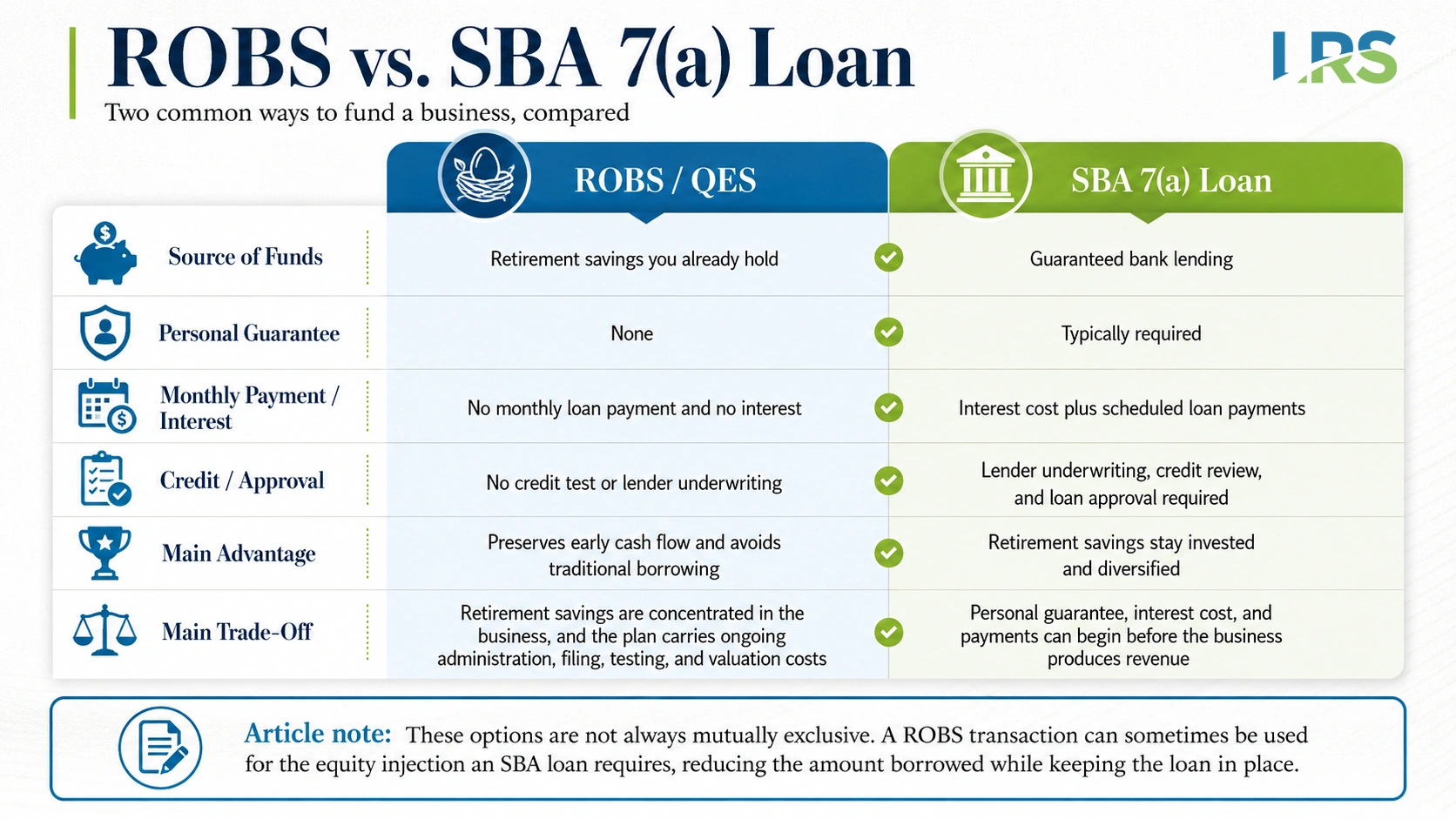
| Option | Source of funds | Personal guarantee | Main advantage | Main trade-off |
|---|---|---|---|---|
| ROBS / QES | Retirement savings you already hold | None | No monthly payment, no credit test, no interest | Retirement savings are concentrated in the business, and the plan carries administration, filing, testing, and valuation costs every year |
| SBA 7(a) loan | Guaranteed bank lending | Typically required | Retirement savings stay invested and diversified | Personal guarantee, interest cost, and payments starting before revenue does |
| Conventional business loan | Bank or credit union | Usually required | Straightforward, no plan to administer | Hardest to obtain without operating history or collateral |
| 401(k) participant loan | Your own vested balance | None | Simple, and the interest is paid back to your own account | Capped at the lesser of $50,000 or half your vested balance, and must be repaid |
| Cash or outside investors | Savings, friends, family, equity | Varies | No debt and no plan obligations | Dilution, or personal savings exposed without tax deferral |
No monthly loan payment is not the same as no cost. A ROBS plan has to be administered, filed, tested, and valued every year for as long as it exists, and those costs continue whether or not the business is profitable. Any comparison against a loan should put the annual plan cost next to the interest cost rather than treating one side as free.
These are not mutually exclusive. A common structure uses a ROBS transaction for the equity injection an SBA loan requires, which reduces the amount borrowed while keeping the loan in place. That combination needs to be built deliberately, because both sets of rules apply at once.
Choosing a provider, and the question to ask first
The ROBS market divides into companies that sell the transaction and companies that administer the plan. Plenty do both well. The situation to avoid is a provider whose engagement effectively ends once the stock is purchased, leaving an owner with a qualified plan and no one running it.
One question sorts this out early: who is preparing the Form 5500 next year, who is valuing the stock, and what does that cost? A provider who can answer precisely is describing an ongoing service. A provider who treats it as a detail to sort out later is describing a transaction. Our guide to selecting a ROBS provider covers the rest of the diligence, and how to choose a TPA applies here too, because that is what you are really hiring.
Exiting a ROBS structure
Every ROBS arrangement ends eventually, through a sale, a wind-down, a buyback, or a conversion once the business can support conventional financing. The tax outcome depends largely on sequencing, because the plan owns the stock and the plan has to be addressed as part of whatever happens next.
Handled properly, the proceeds attributable to the plan’s shares return to the plan and roll to an IRA, and the deferral survives. Handled late in a closing, the same transaction can generate tax that was avoidable. These conversations are usually easier before a letter of intent is in place. Our full walkthrough of how to exit a ROBS plan covers each route in detail.
What to do next
Pricing the whole arrangement over five years rather than setup alone gives a clearer picture, alongside an honest look at what share of retirement savings is going in. A firm that administers these plans can walk through both. LRS ROBS and QES plan services.
Three items cover most of what comes up: whether a Form 5500 has been filed for every plan year, whether a current stock valuation exists, and whether every eligible employee has been offered the plan.
Voluntary correction is generally available on better terms than examination, and the Delinquent Filer program is open only before a notice arrives. Consulting and correction services.
Plan administration and recordkeeping cover the filings, testing, and reporting so the structure stays defensible. Larger plans may also need an annual plan audit.
Talk it through with a firm that administers these plans
Leading Retirement Solutions is a Seattle-based third-party administrator serving business owners in all 50 states, with a practice concentrated in ROBS and qualified employer securities plans. We set these arrangements up, we take over ones that were set up elsewhere, and we help bring quiet ones back into order.
Talk to a retirement plan consultant · ROBS plan services · Non-traditional investments
Frequently asked questions
How does the ROBS transaction work in simple terms?
You form a C corporation, the corporation sponsors a 401(k) plan that allows employer stock, you roll existing retirement money into that plan, and your account uses the money to buy newly issued stock in the corporation. The corporation ends up with cash it can use to run a business, and your retirement account ends up holding stock instead of mutual funds. Because the money was rolled over and then invested rather than distributed, there is no income tax and no early withdrawal penalty.
Is ROBS legal?
Yes. The IRS states that ROBS arrangements are not abusive tax avoidance transactions. It also describes them as questionable because they may solely benefit one individual, and it has run a dedicated compliance project examining them. Legal and low risk are not the same thing. A ROBS arrangement is legal when the plan is a genuine qualified plan that is operated and reported like one.
Does a ROBS plan have to file a Form 5500?
In almost every case, yes, and it usually has to file the full Form 5500 rather than the 5500-EZ. The one-participant filing exception does not apply, because the plan owns the trade or business through its stock. Employers are frequently told otherwise, and the resulting missed filings are the most common ROBS compliance issue LRS sees.
Can I use a Roth IRA for a ROBS transaction?
No. Roth IRAs cannot be rolled into a qualified plan. Eligible sources are generally pre-tax balances in a former employer’s 401(k) or 403(b), a traditional IRA, a SEP, a SIMPLE that has met its two-year holding requirement, or a governmental 457(b). Money in your current employer’s plan is usually locked until you separate from service or the plan permits an in-service rollover.
Does the business have to be a C corporation?
Yes. A retirement plan cannot be an S corporation shareholder, and only a C corporation can issue the qualified employer securities the plan buys. An LLC can work only if it elects to be taxed as a C corporation. The company remains a C corporation for as long as the plan holds those shares, so an S election later on is not a small tax decision.
How much money do I need to make ROBS worthwhile?
There is no statutory minimum. The practical question is whether the amount being rolled over is large enough to justify the ongoing cost of running a qualified plan, and whether that portion of retirement savings can reasonably be concentrated in a single private business. Many providers suggest a floor somewhere around $50,000. The more useful test is what the retirement picture looks like if the business does not work out.
What happens to the ROBS plan when I want to sell the business?
The plan owns stock, so the plan participates in the sale. Handled correctly, the proceeds attributable to the plan’s shares go back into the plan and can be rolled to an IRA, which keeps the tax deferral intact. Handled late in a closing, the same sale can trigger tax that was avoidable. This is one of the more consequential parts of a ROBS arrangement to plan for, and it benefits from attention well before a letter of intent.
Do required minimum distributions apply to a ROBS plan?
Yes, once the owner reaches their required beginning date. This catches ROBS owners because the plan’s main asset is private stock with no market. The usual routes are an in-kind distribution of shares, a redemption of shares by the corporation to create cash inside the plan, or contributing enough cash to the plan to cover the distribution. Each has valuation and tax consequences, and which one suits a particular owner is a question for their tax professional, ideally before the deadline rather than after.
Can I pay myself a salary from a ROBS-funded business?
Yes, and in most cases it is expected. You are an employee of the corporation, and reasonable compensation with proper payroll tax treatment supports the employee status the structure depends on. What does not work is taking money out of the corporation informally or treating plan assets as personal funds.
What does a ROBS transaction cost?
Setup is typically a few thousand dollars, and there is an annual cost for administering the plan, preparing the Form 5500, and valuing the stock. Judged against the interest on a comparable loan, the ongoing cost is often modest. It is an ongoing cost rather than a one-time fee, so pricing the arrangement over five years gives a more accurate picture than pricing day one.
What if I have already been running a ROBS plan without filing anything?
This is a fixable position, and coming forward first matters. The Department of Labor’s Delinquent Filer Voluntary Compliance Program is available only before a notice of intent to assess a penalty arrives, and it reduces late-filing exposure substantially. One-participant filers use the separate IRS relief program for late Form 5500-EZ returns instead. Correction programs also exist for operational failures.
Sources
Every regulatory statement in this guide traces to a primary government source. Where this guide describes what LRS sees in practice, that is identified as our own experience rather than agency guidance.
- IRSRollovers as Business Start-Ups Compliance ProjectThe agency’s own account of what it examined, what it found, and the specific failures it identified.
- IRSRollovers of Retirement Plan and IRA DistributionsThe rollover chart showing which account types can move into a qualified plan.
- IRSForm 5500 CornerFiling requirements, deadlines, and form selection for qualified plans.
- IRSPenalty Relief Program for Form 5500-EZ Late FilersThe separate relief route available to one-participant filers, who are not eligible for DFVCP.
- IRSRetirement Topics: Required Minimum DistributionsRequired beginning dates and calculation rules that apply to ROBS plans like any other.
- IRSCorrecting Plan ErrorsThe correction programs available where a plan has an operational failure.
- U.S. Department of LaborForm 5500 Series Forms and InstructionsThe annual return, its schedules, and the instructions for each.
- U.S. Department of LaborDelinquent Filer Voluntary Compliance ProgramEligibility, penalty caps, and the filing process for late Form 5500 returns.
- U.S. Small Business AdministrationSBA Loan ProgramsReference point for comparing ROBS against conventional and guaranteed business lending.
Reviewed by the LRS compliance team, August 2026. Leading Retirement Solutions has administered ROBS and qualified employer securities plans since 2011.
Provided for general information only and not legal or tax advice. Rules change and individual circumstances differ; confirm your situation with qualified advisors before acting.