Deadlines, Penalties, and Rules for All 50 States
Employer compliance guide · Reviewed August 2026
If you employ people in California, Oregon, Illinois, Connecticut, Maryland, Colorado, Maine, Delaware, Vermont, or Nevada and you do not sponsor a retirement plan, you are already required to do something about it. Four more states are working through registration waves as you read this, and two more launch inside the next 18 months.
As of the August 2026 review, 10 states have retirement plan mandates in force: California, Oregon, Illinois, Connecticut, Maryland, Colorado, Maine, Delaware, Vermont, and Nevada. Four more are phasing in registration deadlines right now (Virginia, New Jersey, New York, Rhode Island), two are enacted and preparing to launch (Washington, Hawaii), five run voluntary programs, and Minnesota has a program with published penalties that is not currently being enforced.
In every mandate state, sponsoring a qualifying retirement plan such as a 401(k) satisfies the requirement instead of enrolling in the state program. In several states you have to file that exemption through the state portal for it to count. Check your state on the interactive 50-state map.

Free tool · All 22 state programs
Check your state in one click
Pick a state to see who is covered, which deadline applies, what non-compliance costs, and whether a 401(k) files as your exemption.
Or open the interactive state mandate map to see all 50 states at once.
This guide covers all 50 states and the District of Columbia: who is covered, when the deadline lands, what non-compliance costs, and how a qualifying plan changes the arithmetic. Every state name links to a full compliance guide, and the interactive state mandate map lets you jump straight to yours.
Which states have retirement plan mandates in 2026?
Twenty-two states have enacted a retirement savings program. That number gets quoted a lot and it is not the number employers need, because enacted covers everything from California, where every deadline has passed and the Franchise Tax Board assesses penalties, to New Mexico, where the program is on the books and inactive. What matters to you is whether the requirement is in force where your people work.
The complete 50-state status table
Sorted by how urgent the obligation is, not alphabetically. States with a mandate in force come first.
| State | Program | Covered employers | Penalty for non-compliance |
|---|---|---|---|
| CaliforniaActive mandate | CalSavers | 1 or more eligible employees | $250 per eligible employee 90 days after notice, plus an additional $500 per eligible employee if non-compliance continues. Assessed by the Franchise Tax Board and re-applied in later years. |
| OregonActive mandate | OregonSaves | 1 or more employees | $100 per affected employee, capped at $5,000 per calendar year, enforced through the Oregon Bureau of Labor and Industries. |
| IllinoisActive mandate | Illinois Secure Choice | 5 or more employees in every quarter of the prior calendar year, and at least two years in business | $250 per employee in the first year of non-compliance and $500 per employee in each following year, enforced by the Illinois Department of Revenue. |
| ConnecticutActive mandate | MyCTSavings | 5 or more employees | Since July 1, 2025 the State Comptroller may assess civil penalties after a three-notice process and a cure period: $500 for 5 to 24 employees, $1,000 for 25 to 99, and $1,500 for 100 or more, for each year of continued non-compliance. |
| MarylandActive mandate | MarylandSaves | 1 or more employees, at least two years of operations, and an automated payroll system | No monetary penalty at present. Compliant employers receive a waiver of the $300 SDAT annual report filing fee. |
| ColoradoActive mandate | Colorado SecureSavings | 5 or more employees and at least two years in business | Up to $100 per unenrolled eligible employee per year, capped at $5,000. |
| MaineActive mandate | MERIT (Maine Retirement Investment Trust) | 5 or more covered employees and at least two years of operations | A scheduled escalation: $20 per employee from 7/1/2025 to 6/30/2026, $50 from 7/1/2026 to 6/30/2027, and $100 on or after 7/1/2027. |
| DelawareActive mandate | Delaware EARNS | 5 or more covered employees in the prior calendar year, and at least six months in business in Delaware | $250 per unenrolled eligible employee, capped at $5,000 per calendar year. |
| VermontActive mandate | VT Saves | 2 or more employees and at least two years in business. The threshold dropped from 5 employees to 2 in 2026. | Treasurer-adopted civil penalties on a phased schedule: up to $10 per employee before 10/1/2025, up to $20 from 10/1/2025 through 9/30/2026, and up to $75 on or after 10/1/2026. |
| NevadaActive mandate | Nevada Employee Savings Trust (NEST) | 6 or more employees and at least 36 months of operations | Nevada law authorizes enforcement, but specific employer penalty amounts have not been finalized. Monitor NEST and State Treasurer guidance. |
| VirginiaPhasing in | RetirePath Virginia | Dropping from 25 employees to 5 employees effective July 1, 2026 | Up to $200 per eligible employee per year for employers that fail to register or certify after notice. |
| New JerseyPhasing in | RetireReady NJ | Reduced from 25 employees to 10 employees. The implementation schedule for the lower tier is expected during 2026. | Enforcement provisions apply under the statute. Updated schedules and amounts for the new tier are pending. |
| New YorkPhasing in | New York Secure Choice | 10 or more employees and at least two years in business, with no qualified plan in the preceding two years | Enforcement and penalty detail flows from the statute and Secure Choice Board guidance. Amounts have not been published in the form other states use. |
| Rhode IslandPhasing in | RISavers | 5 or more employees | After a non-compliance notice, employers that fail to comply within 30 days may face a civil penalty of $250 per eligible employee under R.I. Gen. Laws § 35-23-15, enforced by the Office of the General Treasurer with the Department of Labor and Training. |
| WashingtonLaunching | Washington Saves, plus the voluntary Retirement Marketplace | To be set for Washington Saves. The Retirement Marketplace is open to all small employers on a voluntary basis. | None today. Auto-IRA enforcement detail will be issued closer to launch. |
| HawaiiLaunching | Hawaii Retirement Savings Program (HRSP) | Employers that do not offer a qualified retirement plan. The program is not yet open for registration. | The statute provides for penalties of up to $5,000 per calendar year and includes a civil action provision. Operational enforcement detail is pending launch. |
| MinnesotaNot enforced | Minnesota Secure Choice | 5 or more employees, with registration phased by employer size | The program’s published schedule is graduated: $100 per employee (capped at $4,000), then $200 per employee (capped at $6,000), then $300 per employee, then $500 per employee with no cap. As of the LRS review, none of it is being assessed. |
| MassachusettsVoluntary | Massachusetts Defined Contribution CORE Plan | Nonprofit organizations with up to 100 employees, expanded from a smaller cap in 2025 | None. The program is voluntary. |
| UtahVoluntary | Utah voluntary retirement exchange (HB 250) | Voluntary participation. No employer mandate. | None. The program is voluntary. |
| MississippiVoluntary | Mississippi voluntary payroll-deduction IRA (HB 4073) | Voluntary participation. No employer mandate. | None. The program is voluntary. |
| MissouriVoluntary | Show-Me MyRetirement Plan (HB 1732) | Voluntary participation. No employer mandate. | None. The program is voluntary. |
| New MexicoVoluntary | New Mexico Work & $ave | Voluntary. No employer mandate. | None. The program is inactive and voluntary. |
| AlabamaBill pending | None enacted | Not applicable | None |
| AlaskaBill pending | None enacted | Not applicable | None |
| ArizonaBill pending | None enacted | Not applicable | None |
| ArkansasBill pending | None enacted | Not applicable | None |
| FloridaBill pending | None enacted | Not applicable | None |
| GeorgiaBill pending | None enacted | Not applicable | None |
| IndianaBill pending | None enacted | Not applicable | None |
| IowaBill pending | None enacted | Not applicable | None |
| MichiganBill pending | None enacted | Not applicable | None |
| North CarolinaBill pending | None enacted | Not applicable | None |
| PennsylvaniaBill pending | None enacted | Not applicable | None |
| South CarolinaBill pending | None enacted | Not applicable | None |
| TennesseeBill pending | None enacted | Not applicable | None |
| West VirginiaBill pending | None enacted | Not applicable | None |
| WisconsinBill pending | None enacted | Not applicable | None |
| District of ColumbiaNo program | None | Not applicable | None |
| IdahoNo program | None | Not applicable | None |
| KansasNo program | None | Not applicable | None |
| KentuckyNo program | None | Not applicable | None |
| LouisianaNo program | None | Not applicable | None |
| MontanaNo program | None | Not applicable | None |
| NebraskaNo program | None | Not applicable | None |
| New HampshireNo program | None | Not applicable | None |
| North DakotaNo program | None | Not applicable | None |
| OhioNo program | None | Not applicable | None |
| OklahomaNo program | None | Not applicable | None |
| South DakotaNo program | None | Not applicable | None |
| TexasNo program | None | Not applicable | None |
| WyomingNo program | None | Not applicable | None |
State names link to the full LRS compliance guide for that state. Status reflects the LRS compliance review of official state program sites and statutes, updated August 2026.
Found your state in the table?Open its full compliance guide for deadlines, exemption filing steps, and what a qualifying plan changes.
Free download · No email required
The 2026 Employer State Mandate Guide
Every state on one page, plus a printable reference for each of the 22 programs: covered employers, deadlines, penalties, and plan design. Built for the person who has to actually track this.
Download the free guideHow state retirement mandates actually work
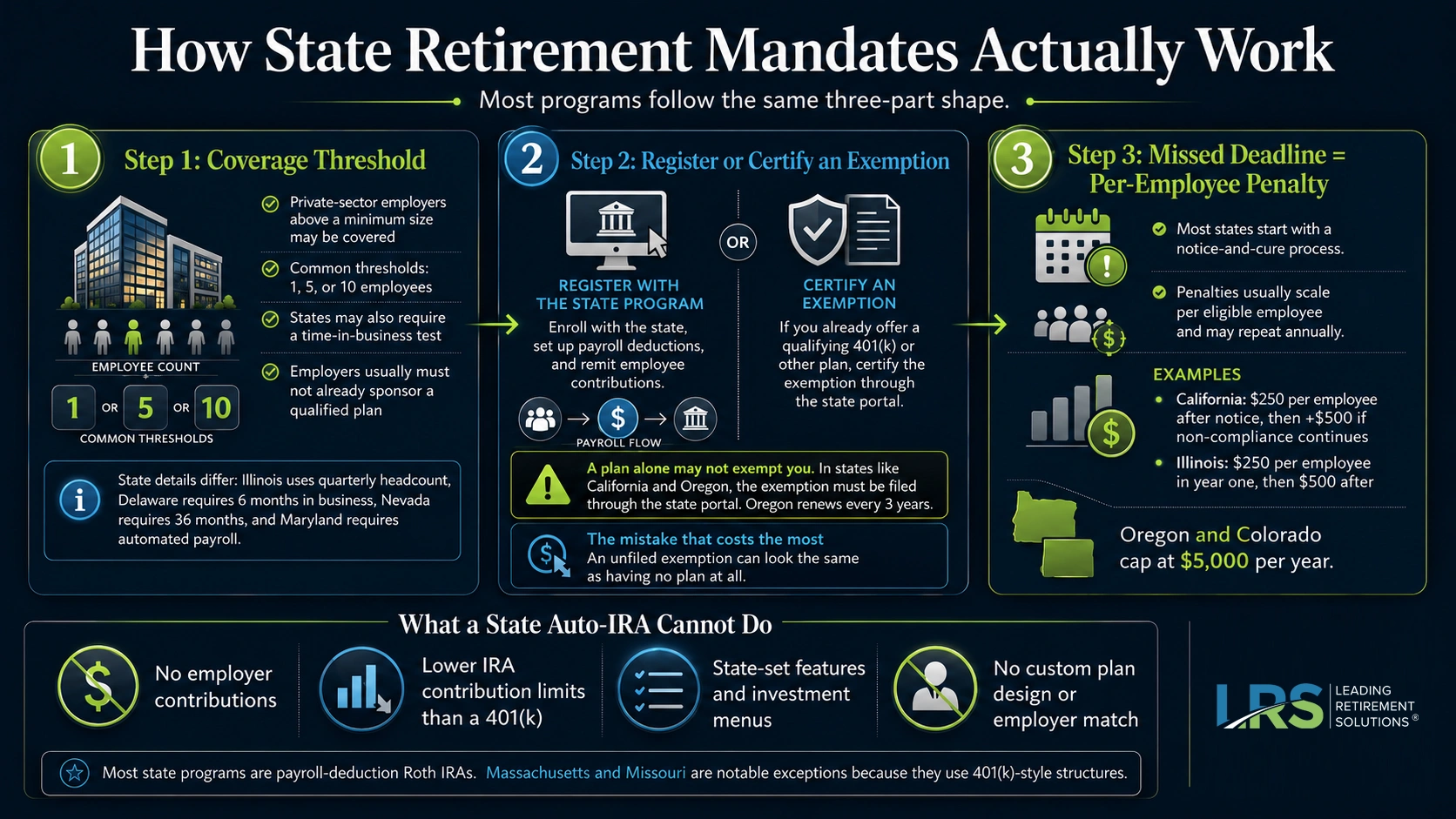
The programs differ in their details and they all share the same three-part shape. Once you recognize it, a new state takes about five minutes to evaluate.
Step one: the state sets a coverage threshold
Nearly every program applies to private-sector employers above a minimum size that have been in business for a set period and do not already sponsor a qualified plan. One, five, and ten employees are the common thresholds. The tests are not identical: Illinois measures headcount in every quarter of the prior year, Delaware asks for six months in business, Nevada asks for 36 months, and Maryland adds a requirement that you run an automated payroll system.
Thresholds have moved in one direction. Virginia went from 25 employees to five, New Jersey from 25 to ten, Vermont from five to two, and California from five to one. If you checked your state a year ago and concluded you were too small, that conclusion has a shelf life. Watch your long-term part-time employee counts too, since they can affect eligibility in ways employers do not expect.
Step two: you register, or you certify an exemption
Covered employers register with the state program by their deadline and facilitate payroll deductions, or they certify that they sponsor a qualifying plan. The second path is where employers get caught. In several states, including California and Oregon, having a 401(k) does not exempt you on its own. You have to file the exemption through the state portal, and in Oregon you have to renew it every three years.
An unfiled exemption and no plan at all look identical from the state’s side. Employers who sponsor a perfectly good 401(k) receive non-compliance notices every year because nobody completed a two-minute certification. If you sponsor a plan in a mandate state, confirm the exemption is on file and calendar the renewal.
Step three: a missed deadline becomes a per-employee penalty
Penalties are almost always assessed per eligible employee per year, which means the number scales with your headcount and repeats annually until you fix it. California assesses $250 per eligible employee 90 days after notice and adds $500 per employee if non-compliance continues. Illinois charges $250 per employee in year one and $500 in every year after. Oregon and Colorado cap at $5,000 a year. Maine and Vermont published escalation schedules that step up on a fixed date each year.
Most states run a notice-and-cure process before assessing anything, so the first letter is an opportunity rather than a bill. If you have already received something from a state program or a federal agency, here is how to read a retirement plan notice and what to do about it.
What a state auto-IRA cannot do
State programs are payroll-deduction Roth IRAs in almost every case, and that structure has hard limits built into it. Employers cannot contribute. Contribution ceilings are IRA ceilings, well below what a 401(k) allows. Investment menus, default rates, and features are set by the state. There is no plan document to design and no match to offer.
Two states chose differently and it is worth knowing why. Massachusetts built the CORE Plan as a multiple employer 401(k) for nonprofits, and Missouri authorized a voluntary multiple employer 401(k) as well. Both can accept employer money precisely because they are not IRAs. If a pooled employer plan structure appeals to you, that is available in the private market in every state.
States with retirement plan mandates in force
These ten states have live requirements today. If you have employees here and no qualifying plan on file, you have an open compliance item, not a future one.
California: CalSavers
Active mandate
California runs the largest auto-IRA program in the country and it now reaches every employer in the state. The original 5-employee threshold was dropped to a single eligible employee, and the last compliance date passed at the end of 2025. That makes California binary today: a covered employer is registered, exempt on file, or exposed.
The part employers miss is that sponsoring a 401(k) does not exempt you automatically. You have to report the exemption through the CalSavers portal. A plan you never certified looks identical to no plan at all from the state’s side of the transaction.
- Covered employers
- 1 or more eligible employees
- Deadlines
- All deadlines have passed. The 5+ employee tier closed 6/30/2022; the final 1+ employee tier closed 12/31/2025.
- Penalties
- $250 per eligible employee 90 days after notice, plus an additional $500 per eligible employee if non-compliance continues. Assessed by the Franchise Tax Board and re-applied in later years.
- Plan design
- Roth IRA by default, with the option to recharacterize to a traditional IRA.
Full California mandate guide · Program: CalSavers
Oregon: OregonSaves
Active mandate
OregonSaves launched in 2017 as the first program of its kind and it remains one of the broadest. There is no small-employer carve-out: one employee and no qualified plan means you are covered.
Oregon also has a requirement that catches employers who think they are finished. The exemption certification has to be renewed every three years. A plan sponsor who filed once in 2022 and never looked again may be out of compliance right now without any change to the business.
- Covered employers
- 1 or more employees
- Deadlines
- All deadlines have passed, including the final 1+ employee tier.
- Penalties
- $100 per affected employee, capped at $5,000 per calendar year, enforced through the Oregon Bureau of Labor and Industries.
- Plan design
- Roth IRA, auto-enrollment at 5% with automatic escalation to 10%.
Full Oregon mandate guide · Program: OregonSaves
Illinois: Illinois Secure Choice
Active mandate
Illinois measures its threshold across every quarter of the prior year, not on a single headcount date. Seasonal businesses that cross five employees for part of the year should check the quarterly test rather than assuming a December number settles it.
The penalty structure is one of the sharper ones: it doubles in year two and keeps applying annually, so the cost of ignoring a notice compounds rather than capping out.
- Covered employers
- 5 or more employees in every quarter of the prior calendar year, and at least two years in business
- Deadlines
- Rolling. Register or certify an exemption on becoming eligible or on receiving notice.
- Penalties
- $250 per employee in the first year of non-compliance and $500 per employee in each following year, enforced by the Illinois Department of Revenue.
- Plan design
- Roth IRA with automatic enrollment.
Full Illinois mandate guide · Program: Illinois Secure Choice
Connecticut: MyCTSavings
Active mandate
Connecticut moved from an encouragement posture to a real enforcement posture in 2025. The Comptroller now has statutory authority to assess penalties, the state widened its definition of a covered employee, and it aligned certain defaults with federal rules for new participants.
Connecticut is also the administrative backbone of a growing multistate partnership. Hawaii’s board voted in February 2026 to join MyCTSavings rather than build its own platform, which is a signal worth watching: smaller states are likely to buy into an existing program instead of standing one up, which shortens the runway between enactment and enforcement.
- Covered employers
- 5 or more employees
- Deadlines
- August 31 of the year after meeting the eligibility test.
- Penalties
- Since July 1, 2025 the State Comptroller may assess civil penalties after a three-notice process and a cure period: $500 for 5 to 24 employees, $1,000 for 25 to 99, and $1,500 for 100 or more, for each year of continued non-compliance.
- Plan design
- Roth IRA with automatic enrollment.
Full Connecticut mandate guide · Program: MyCTSavings
Maryland: MarylandSaves
Active mandate
Maryland is the one state that uses a carrot instead of a stick. There is no fine for ignoring MarylandSaves, but registering or certifying a qualified plan waives the $300 State Department of Assessments and Taxation annual report fee.
That makes Maryland a rounding error on its own and a useful argument in a broader conversation. An employer already paying for plan administration in another state can pick up the Maryland waiver as a side effect of doing the paperwork correctly.
- Covered employers
- 1 or more employees, at least two years of operations, and an automated payroll system
- Deadlines
- December 31 annually. Register or certify an exemption.
- Penalties
- No monetary penalty at present. Compliant employers receive a waiver of the $300 SDAT annual report filing fee.
- Plan design
- Roth IRA with automatic enrollment.
Full Maryland mandate guide · Program: MarylandSaves
Colorado: Colorado SecureSavings
Active mandate
Colorado has been live statewide since 2023, so the interesting question here is not the launch but the annual re-test. Employers that grow into the five-employee threshold, or cross two years in business, become newly covered and owe a registration by the following May 15.
Colorado is also the anchor of a shared-administration arrangement with several smaller states, which means its operational choices tend to show up elsewhere.
- Covered employers
- 5 or more employees and at least two years in business
- Deadlines
- May 15 of the year after becoming eligible.
- Penalties
- Up to $100 per unenrolled eligible employee per year, capped at $5,000.
- Plan design
- Roth IRA with automatic enrollment.
Full Colorado mandate guide · Program: Colorado SecureSavings
Maine: MERIT (Maine Retirement Investment Trust)
Active mandate
Maine wrote its penalties as a published ramp rather than a flat number, and the ramp steps up on July 1 each year. An employer weighing whether to deal with MERIT this quarter or next quarter is making a decision with a date attached to it.
The per-employee amounts are small compared with California or Illinois. The exposure is the pattern: a state that publishes an escalation schedule in advance is telling you it intends to use it.
- Covered employers
- 5 or more covered employees and at least two years of operations
- Deadlines
- June 30 following the year the thresholds are met. Program opened January 2024.
- Penalties
- A scheduled escalation: $20 per employee from 7/1/2025 to 6/30/2026, $50 from 7/1/2026 to 6/30/2027, and $100 on or after 7/1/2027.
- Plan design
- Roth IRA with automatic enrollment.
Full Maine mandate guide · Program: MERIT (Maine Retirement Investment Trust)
Delaware: Delaware EARNS
Active mandate
Delaware’s six-month operating test is the shortest runway of any active program. A business incorporated in the spring can be a covered employer before its first full year closes, which catches newly formed companies that assume mandates are a problem for established firms.
EARNS opened in 2024 and coordinates registration windows through the Office of the State Treasurer, so the notice you receive is the clock that matters, not the calendar year.
- Covered employers
- 5 or more covered employees in the prior calendar year, and at least six months in business in Delaware
- Deadlines
- Generally October 15 of the applicable year following notification.
- Penalties
- $250 per unenrolled eligible employee, capped at $5,000 per calendar year.
- Plan design
- Roth IRA with automatic enrollment.
Full Delaware mandate guide · Program: Delaware EARNS
Vermont: VT Saves
Active mandate
Vermont now has the second-lowest threshold in the country. Cutting it from five employees to two in 2026 pulled in a large share of the state’s smallest businesses, including many that had correctly concluded they were exempt a year earlier.
If you looked at Vermont before 2026 and moved on, look again. The exemption you relied on may no longer exist.
- Covered employers
- 2 or more employees and at least two years in business. The threshold dropped from 5 employees to 2 in 2026.
- Deadlines
- The initial registration deadline was February 2025. Newly covered employers onboard on a rolling basis.
- Penalties
- Treasurer-adopted civil penalties on a phased schedule: up to $10 per employee before 10/1/2025, up to $20 from 10/1/2025 through 9/30/2026, and up to $75 on or after 10/1/2026.
- Plan design
- Roth IRA with automatic enrollment.
Full Vermont mandate guide · Program: VT Saves
Nevada: Nevada Employee Savings Trust (NEST)
Active mandate
Nevada is the outlier on thresholds: six employees and three full years of operations, both higher than the norm. That excludes a meaningful slice of small businesses that would be covered in a neighboring state.
The registration date has passed but the penalty schedule has not been finalized, so Nevada today is a documentation exercise. Register or certify, keep the record, and watch for the enforcement rules to catch up with the requirement.
- Covered employers
- 6 or more employees and at least 36 months of operations
- Deadlines
- Covered employers were initially required to register or certify an exemption by September 1, 2025.
- Penalties
- Nevada law authorizes enforcement, but specific employer penalty amounts have not been finalized. Monitor NEST and State Treasurer guidance.
- Plan design
- Roth IRA with automatic enrollment, administered by the Nevada Treasury.
Full Nevada mandate guide · Program: Nevada Employee Savings Trust (NEST)
States phasing in registration deadlines now
The requirement exists and the calendar is still unfolding. Some of these deadlines have already passed for larger employers and are still ahead for smaller ones.
Virginia: RetirePath Virginia
Phasing in
Virginia is the clearest example of the direction these programs move. RetirePath launched in 2023 for employers with 25 or more employees. As of July 1, 2026 the threshold is five, which multiplies the number of covered businesses in the Commonwealth several times over.
Any Virginia employer between five and 24 employees that concluded it was out of scope needs to revisit that conclusion now. The program is administered by Commonwealth Savers, formerly Virginia529.
- Covered employers
- Dropping from 25 employees to 5 employees effective July 1, 2026
- Deadlines
- Ongoing registration for covered employers. The lower threshold brings a new population in as of July 1, 2026.
- Penalties
- Up to $200 per eligible employee per year for employers that fail to register or certify after notice.
- Plan design
- Roth IRA, auto-enrollment with a 30-day window for employees to customize or opt out.
Full Virginia mandate guide · Program: RetirePath Virginia
New Jersey: RetireReady NJ
Phasing in
New Jersey finished its first wave in 2024 and then amended the law to reach employers with as few as 10 employees. The implementation calendar for that lower tier has not been published in full, which puts a large group of employers in a defined but not-yet-dated obligation.
The practical move for a 10 to 24 employee New Jersey business is to decide now what it wants to do, because the decision is easier to make before a deadline arrives than after a notice does.
- Covered employers
- Reduced from 25 employees to 10 employees. The implementation schedule for the lower tier is expected during 2026.
- Deadlines
- Initial rollouts for employers with 25 or more employees completed in 2024. Additional waves follow as the threshold drops.
- Penalties
- Enforcement provisions apply under the statute. Updated schedules and amounts for the new tier are pending.
- Plan design
- Roth IRA with automatic enrollment.
Full New Jersey mandate guide · Program: RetireReady NJ
New York: New York Secure Choice
Phasing in
New York’s registration waves are already closing. The 30-plus tier passed in March 2026, the 15 to 29 tier in May, and the smallest covered tier in July. For most covered New York employers, the deadline is behind them rather than ahead.
Penalty amounts have not been published the way California or Illinois publish theirs. That is a reason to register, not a reason to wait: the obligation is in force whether or not the fine schedule is.
- Covered employers
- 10 or more employees and at least two years in business, with no qualified plan in the preceding two years
- Deadlines
- Registration waves: 30 or more employees by March 18, 2026; 15 to 29 by May 15, 2026; 10 to 14 by July 15, 2026.
- Penalties
- Enforcement and penalty detail flows from the statute and Secure Choice Board guidance. Amounts have not been published in the form other states use.
- Plan design
- Roth IRA with automatic enrollment.
Full New York mandate guide · Program: New York Secure Choice
Rhode Island: RISavers
Phasing in
RISavers launched in October 2025 and its first real deadline lands in October 2026 for employers with more than 100 employees. Smaller employers have another year or two, which makes Rhode Island one of the few states where an employer genuinely has planning time.
Rhode Island also builds in a notice-plus-30-days structure before any penalty, so the enforcement path is predictable rather than sudden.
- Covered employers
- 5 or more employees
- Deadlines
- Phased: more than 100 employees by October 15, 2026; 50 to 99 by October 15, 2027; 5 to 49 by October 15, 2028.
- Penalties
- After a non-compliance notice, employers that fail to comply within 30 days may face a civil penalty of $250 per eligible employee under R.I. Gen. Laws § 35-23-15, enforced by the Office of the General Treasurer with the Department of Labor and Training.
- Plan design
- Roth IRA with automatic enrollment.
Full Rhode Island mandate guide · Program: RISavers
States enacted and preparing to launch
Nothing is required yet, and the window to choose your own path rather than be enrolled into a default one is open. This is the cheapest time to make the decision.
Washington: Washington Saves, plus the voluntary Retirement Marketplace
Launching
Washington is in the window that matters most for planning. Washington Saves is enacted with a 2027 target, which means employers have roughly a year to decide whether they want to be enrolled into a state Roth IRA by default or arrive at the launch already sponsoring a plan of their own.
In the meantime the state runs the voluntary Retirement Marketplace through the Department of Financial Institutions, which lists verified private plans for small employers and individuals. It is a directory, not a program: using it does not create a compliance obligation and it will not satisfy the Washington Saves mandate on its own.
Leading Retirement Solutions is headquartered in Seattle and administers plans for employers across all 50 states, so Washington employers weighing the 2027 date can work through it with a local team.
- Covered employers
- To be set for Washington Saves. The Retirement Marketplace is open to all small employers on a voluntary basis.
- Deadlines
- Washington Saves targets a 2027 launch. The Retirement Marketplace is available now.
- Penalties
- None today. Auto-IRA enforcement detail will be issued closer to launch.
- Plan design
- Washington Saves is legislated as an auto-IRA. The Retirement Marketplace lists verified private plans rather than administering one.
Full Washington mandate guide · Program: Washington Saves, plus the voluntary Retirement Marketplace
Hawaii: Hawaii Retirement Savings Program (HRSP)
Launching
Hawaii enacted its program in 2022 as an opt-in arrangement, then amended it in 2025 to the automatic enrollment with opt-out structure that every other state uses. That change matters more than it sounds: opt-in programs collect almost nobody, and auto-enrollment programs collect almost everybody.
In February 2026 the Hawaii Retirement Savings Board voted to join Connecticut’s MyCTSavings multistate partnership rather than build its own platform. Borrowing a working program shortens implementation considerably, so Hawaii employers should not read “not yet open” as “years away.”
- Covered employers
- Employers that do not offer a qualified retirement plan. The program is not yet open for registration.
- Deadlines
- Not yet open to employers as of mid-2026. Board-led implementation and multistate coordination are underway.
- Penalties
- The statute provides for penalties of up to $5,000 per calendar year and includes a civil action provision. Operational enforcement detail is pending launch.
- Plan design
- Amended in 2025 to move from opt-in to automatic enrollment with employee opt-out.
Full Hawaii mandate guide · Program: Hawaii Retirement Savings Program (HRSP)
Enacted, published penalties, not currently enforced
One state sits in a category of its own, and describing it accurately matters more than simplifying it.
Minnesota: Minnesota Secure Choice
Not enforced
Minnesota needs to be described precisely, because the honest answer is not a clean yes or no. Minnesota Secure Choice became operational in January 2026, the statute sets registration waves by employer size, and the program publishes a graduated penalty schedule that ends at $500 per employee with no cap.
None of it is currently being enforced. The LRS compliance review found no penalties being assessed, which is why this guide lists Minnesota separately from the states with mandates in force rather than folding it in with them.
What that means for a Minnesota employer is straightforward. Do not treat the requirement as fictional, because the schedule exists and enforcement postures change without much notice. Do document your position, calendar your wave, and decide whether you would rather register with the state or arrive at enforcement already sponsoring a plan.
- Covered employers
- 5 or more employees, with registration phased by employer size
- Deadlines
- Soft launch ran January 19 to March 30, 2026. Program materials set waves at 100+ by June 30, 2026; 50 to 99 by December 31, 2026; 25 to 49 by June 30, 2027; 10 to 24 by December 31, 2027; 5 to 9 by June 30, 2028.
- Penalties
- The program’s published schedule is graduated: $100 per employee (capped at $4,000), then $200 per employee (capped at $6,000), then $300 per employee, then $500 per employee with no cap. As of the LRS review, none of it is being assessed.
- Plan design
- Roth IRA by default, with the option to contribute pre-tax.
Full Minnesota mandate guide · Program: Minnesota Secure Choice
States with voluntary programs and no employer requirement
No obligation in any of these five. They are included because employers search for them, deserve a clear answer, and because voluntary frameworks have a habit of becoming mandatory ones.
Massachusetts: Massachusetts Defined Contribution CORE Plan
Voluntary
Massachusetts is the structural exception in this whole landscape. The CORE Plan is a multiple employer 401(k) rather than a payroll-deduction IRA, it is voluntary rather than mandated, and it is open only to nonprofits.
Because it is a 401(k), it can accept employer contributions, which no state auto-IRA can. For a Massachusetts nonprofit under 100 employees, the real comparison is not CORE against a mandate but CORE against a standalone plan with its own design control and provider relationship.
Note for for-profit employers: Massachusetts has no mandate on you today. Legislation has been proposed more than once, and the state already operates the administrative machinery, which is usually the harder part.
- Covered employers
- Nonprofit organizations with up to 100 employees, expanded from a smaller cap in 2025
- Deadlines
- None. Available now, and nonprofits opt in at any time.
- Penalties
- None. The program is voluntary.
- Plan design
- A state-facilitated multiple employer 401(k) plan, not an IRA. Once adopted, eligible employees receive a 60-day notice and are auto-enrolled unless they opt out.
Full Massachusetts mandate guide · Program: Massachusetts Defined Contribution CORE Plan
Utah: Utah voluntary retirement exchange (HB 250)
Voluntary
Utah passed HB 250 to create a voluntary exchange with a platform date of November 2, 2026. No Utah employer is required to do anything.
Utah belongs in a pillar guide anyway, for two reasons. Employers searching “Utah retirement mandate” deserve a clear no rather than silence, and voluntary frameworks are frequently the first step toward a mandatory one.
- Covered employers
- Voluntary participation. No employer mandate.
- Deadlines
- The platform carries a November 2, 2026 implementation date.
- Penalties
- None. The program is voluntary.
- Plan design
- A voluntary exchange arrangement rather than a state-run auto-IRA.
Mississippi: Mississippi voluntary payroll-deduction IRA (HB 4073)
Voluntary
Mississippi enacted HB 4073 on April 8, 2026, creating a voluntary payroll-deduction IRA. Nothing is required of employers.
Mississippi is worth noting because of who passed it. State retirement programs started on the coasts, and their spread into states with no prior activity in this area is the clearest evidence that the trend is national rather than regional.
- Covered employers
- Voluntary participation. No employer mandate.
- Deadlines
- Enacted April 8, 2026. Implementation is in progress.
- Penalties
- None. The program is voluntary.
- Plan design
- A voluntary payroll-deduction IRA.
Missouri: Show-Me MyRetirement Plan (HB 1732)
Voluntary
Missouri’s Show-Me MyRetirement Plan is a voluntary multiple employer 401(k), authorized under HB 1732. Like Massachusetts, Missouri chose a 401(k) structure over an IRA, which means the vehicle can take employer contributions.
For a Missouri employer, this is an option rather than an obligation, and it sits alongside a standalone plan rather than replacing the decision.
- Covered employers
- Voluntary participation. No employer mandate.
- Deadlines
- Implementation in progress following HB 1732.
- Penalties
- None. The program is voluntary.
- Plan design
- A voluntary multiple employer 401(k) plan rather than a state IRA.
New Mexico: New Mexico Work & $ave
Voluntary
New Mexico authorized Work & $ave as a voluntary marketplace, and the State Treasurer reports the program as inactive as of 2025. There is no employer registration to complete.
New Mexico is the useful counterexample to the assumption that enacted means active. A statute on the books is not a program in operation, and employers should verify status rather than legislation.
- Covered employers
- Voluntary. No employer mandate.
- Deadlines
- Implementation has been delayed. There is no active employer registration at this time.
- Penalties
- None. The program is inactive and voluntary.
- Plan design
- Established as a voluntary marketplace and IRA concept.
Full New Mexico mandate guide · Program: New Mexico Work & $ave
States with no retirement mandate today
Twenty-nine states and the District of Columbia have no program requirement. That is the correct answer to give an employer in Texas or Ohio, and it comes with one important qualifier: no mandate in your state does not mean no mandate for your business. If you pay an employee who works in a mandate state, you can be covered there. Check every state you employ in against the state mandate map, then see the multi-state section below.
Legislation under consideration (15 states)
Alabama, Alaska, Arizona, Arkansas, Florida, Georgia, Indiana, Iowa, Michigan, North Carolina, Pennsylvania, South Carolina, Tennessee, West Virginia, Wisconsin. Bills in these states have been introduced or are moving without an enacted program. Watching this list is how you see the next Virginia coming.
No state program identified (14 jurisdictions)
District of Columbia, Idaho, Kansas, Kentucky, Louisiana, Montana, Nebraska, New Hampshire, North Dakota, Ohio, Oklahoma, South Dakota, Texas, Wyoming. No enacted program and no active legislation identified in the August 2026 review.
State auto-IRA or a 401(k): what you are actually choosing between
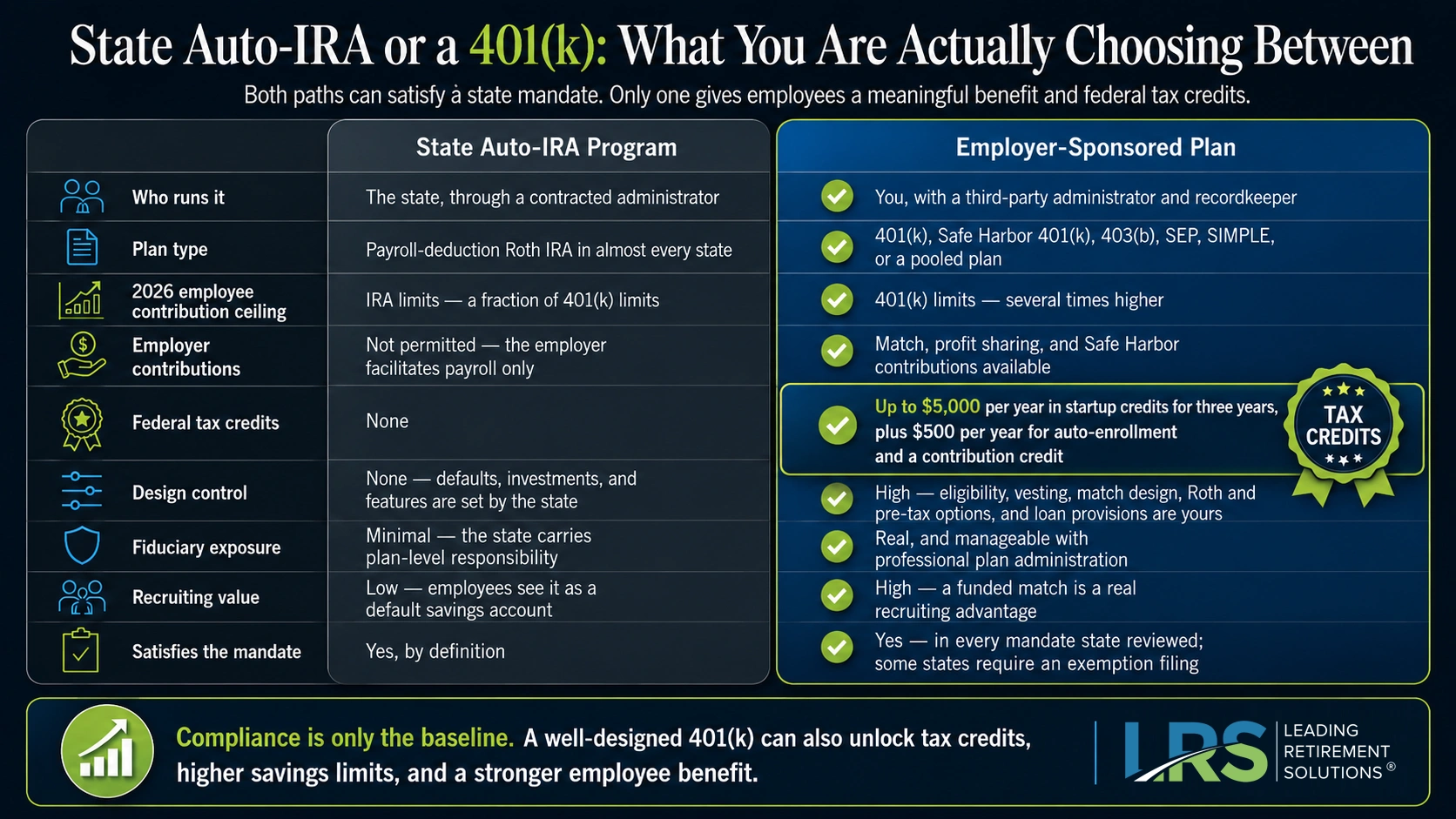
Employers usually frame this as compliance versus cost, and that framing loses money. Both paths satisfy the mandate. Only one of them produces a benefit your employees value and a tax credit you can claim, and the price gap between them is smaller than most owners assume.
Side by side on the things that matter
| Feature | State auto-IRA program | Employer-sponsored plan |
|---|---|---|
| Who runs it | The state, through a contracted administrator | You, with a third-party administrator and recordkeeper |
| Plan type | Payroll-deduction Roth IRA in almost every state | 401(k), Safe Harbor 401(k), 403(b), SEP, SIMPLE, or a pooled plan |
| 2026 employee contribution ceiling | IRA limits, which are a fraction of 401(k) limits | 401(k) limits, several times higher. See the 2026 IRS contribution maximums |
| Employer contributions | Not permitted. The employer facilitates payroll and nothing else | Matching, profit sharing, and Safe Harbor contributions all available |
| Federal tax credits | None. There is no plan to claim credits against | Up to $5,000 a year in startup credits for three years, plus $500 a year for auto-enrollment and a contribution credit |
| Design control | None. Defaults, investments, and features are set by the state | Eligibility, vesting, matching formula, Roth and pre-tax options, and loan provisions are yours |
| Fiduciary exposure | Minimal. The state carries plan-level responsibility | Real, and manageable with professional plan administration |
| Recruiting value | Low. Employees recognize it as a default savings account | High. A funded match is a benefit candidates compare offers on |
| Satisfies the mandate | Yes, by definition | Yes, in every mandate state reviewed. Several states require the exemption to be filed |
The federal tax credits that change the math
This is the part missing from most mandate coverage, and it is the part that flips the decision. A state auto-IRA generates no tax credit because there is no plan to claim one against. Starting a qualifying plan does, under Internal Revenue Code section 45E as amended by SECURE 2.0.
- Startup cost credit. Employers with 1 to 50 employees can claim 100% of qualified startup costs, limited to the greater of $500 or the lesser of $250 per eligible non-highly compensated employee or $5,000. It runs for the first credit year and the two years after. Employers with 51 to 100 employees claim 50% under the same limit.
- Auto-enrollment credit. $500 a year for three years for adding an eligible automatic contribution arrangement. Worth knowing that automatic enrollment lifts participation substantially on its own, credit aside.
- Employer contribution credit. Up to $1,000 per employee, on a percentage that declines over five years, for contributions you make on behalf of participants earning under the statutory threshold. Elective deferrals do not count.
- How you claim it. All of it goes on IRS Form 8881. Eligibility generally requires no more than 100 employees who received at least $5,000 in compensation in the prior year, and no plan covering substantially the same employees in the previous three tax years.
Run the numbers before you assume the state program is the cheap option. For a small employer, three years of startup credits plus the auto-enrollment credit can cover a meaningful share of the cost of a real plan. More detail on the small business tax credit and on why retirement plans cost less than most owners expect.
When the state program is the right call
Sometimes it is. If you have two or three employees, no capacity to contribute, thin administrative bandwidth, and no near-term hiring plan, registering with the state gets you compliant at close to zero cost and almost no fiduciary exposure. That is a legitimate answer and worth saying plainly.
The calculation changes when any of the following is true: you want to contribute, you are competing for staff, you operate in more than one mandate state, you have owners who want to save more than IRA limits allow, or you expect to grow past the thresholds anyway. At that point a plan is not the expensive option, it is the one that does something for you. If you already sponsor a plan, the question is whether it is designed well, and you can upgrade an existing plan without starting over.
Multi-state employers: one workforce, several mandates
This is the fastest-growing version of the problem and the least covered. Remote hiring means a 15-person company can easily be covered by three programs with three deadlines, three exemption filings, and three penalty schedules.
Which state’s rule applies to a remote employee
Coverage generally follows where the employee works and is paid rather than where the company is incorporated. A Texas-headquartered business with one employee in Portland and two in Sacramento is not exempt because Texas has no program. It is looking at OregonSaves and CalSavers, both of which reach employers with a single eligible employee.
Headcount tests add a wrinkle, because states differ on whether they count your total workforce or only employees in that state. Verify the counting rule state by state rather than applying one answer everywhere, and confirm it against the specific state guide before you conclude you are under a threshold.
A tracking approach that holds up
One qualifying plan can satisfy every mandate you are subject to. That is the strongest argument for a plan over piecemeal state registrations, and it is why most multi-state employers land there eventually. What still needs managing is the filing layer.
- Keep a standing list of every state where you pay a W-2 employee, and re-check it whenever you hire remotely.
- Record which states require an affirmative exemption filing and which accept the plan itself, then calendar the renewals. Oregon runs on a three-year cycle.
- Re-run coverage annually. Several programs re-assess employers every year.
- Keep registration confirmations and exemption certificates with your plan documents, next to your Form 5500 filings.
- Tie deductions to your payroll system rather than a manual process. Payroll integration removes most of the recurring error risk, and LRS offers integration services for exactly this.
Check every state you employ in, not just the one you are headquartered in
Coverage follows where your employees work. The interactive map shows all 50 states side by side, so you can confirm each one in a single pass instead of hunting them down separately.
Open the state mandate mapMandates in force right now
What to do next
List every state where you pay an employee, then check each one against the state mandate map. Thresholds and counting rules differ. The free 2026 guide has a printable page for every state if you would rather work from paper.
If you sponsor a plan in a mandate state, verify the certification went through and find out when it renews. This is the single most common gap.
Compare the state program against a plan with the section 45E credits applied. Ask what a Safe Harbor 401(k) or a 403(b) would cost you net of credits, not gross.
Every option is cheaper and calmer with time on the clock. States with 2027 and 2028 dates, Washington and Rhode Island in particular, are giving you that time on purpose.
Registrations, renewals, deposits, testing, and filings are ongoing. Plan administration and recordkeeping exist so this does not live in someone’s inbox. If you are choosing a provider, here is how to evaluate a TPA.
Leading Retirement Solutions is a Seattle-based third-party administrator serving employers in all 50 states. We design and administer plans that satisfy state mandates, confirm whether an existing plan already qualifies, and track multi-state deadlines and exemption filings so you do not have to.
Frequently asked questions
Which states have retirement plan mandates in 2026?
Ten states have mandates in force: California, Oregon, Illinois, Connecticut, Maryland, Colorado, Maine, Delaware, Vermont, and Nevada. Virginia, New Jersey, New York, and Rhode Island are actively phasing in registration deadlines. Washington and Hawaii have enacted programs preparing to launch. Massachusetts, Missouri, Mississippi, New Mexico, and Utah operate voluntary programs with no employer requirement. Minnesota has an operational program with a published penalty schedule that is not currently being enforced.
Does my business have to use the state program?
No. In every mandate state reviewed by LRS, sponsoring a qualifying retirement plan satisfies the requirement. A 401(k), Safe Harbor 401(k), 403(b), SEP, SIMPLE, or a pooled employer plan all qualify. What varies is the paperwork: several states, California among them, require you to certify the exemption through the state portal. Having a plan is not the same as having filed.
What is the smallest business a mandate can reach?
One employee. California and Oregon both cover employers with a single eligible employee, Maryland covers employers with one employee that meet a payroll-system test, and Vermont dropped to two employees in 2026. The five-employee threshold is common but it is no longer the floor.
What happens if we missed a registration deadline?
Register or certify your exemption now, and expect a notice rather than an immediate fine in most states. Penalties are generally per employee and per year: $100 per employee capped at $5,000 in Oregon and Colorado, $250 rising to $500 per employee in Illinois, and $250 plus a further $500 per employee in California after extended non-compliance. Several states run a notice-and-cure process first, which is the window you want to use.
We have employees in several states. Which mandates apply?
Generally all of them. Coverage usually follows where an employee works and is paid, not where the business is incorporated, so a company headquartered in a state with no program can still be covered by two or three mandates through remote staff. A single qualifying plan can satisfy all of them at once, which is the main reason multi-state employers tend to sponsor a plan rather than register in each state separately.
Can we contribute to a state auto-IRA on behalf of employees?
No. State auto-IRA programs do not accept employer money. If you want to match contributions, share profits, or use a Safe Harbor design, you need an employer-sponsored plan. This is the single biggest functional difference between the two paths.
Do the federal tax credits still apply if we set up a plan because of a mandate?
Yes. The reason you start a plan does not affect eligibility. Under Internal Revenue Code section 45E, employers with 1 to 50 employees can claim 100% of qualified startup costs, limited to the greater of $500 or the lesser of $250 per eligible non-highly compensated employee or $5,000, for the first credit year and the two following years. Employers with 51 to 100 employees claim 50%. A separate $500 per year credit applies for adding an eligible automatic contribution arrangement, and a contribution credit of up to $1,000 per employee is available on a declining scale. All of it is claimed on IRS Form 8881.
Is the Minnesota mandate real or not?
Both parts are true and they need to be stated together. Minnesota Secure Choice is operational, the statute sets registration waves by employer size running from June 2026 to June 2028, and the program publishes a graduated penalty schedule that reaches $500 per employee with no cap. As of the August 2026 LRS review, no penalties are being assessed. Minnesota employers should document their status and calendar their wave rather than treat the requirement as either urgent or fictional.
Do exemptions expire?
In some states, yes. Oregon requires exemption certifications to be renewed every three years. Several other programs re-assess covered employers annually, which means a business that was exempt last year on headcount or tenure can become covered this year without doing anything differently. Treat the exemption as a recurring filing, not a one-time task.
How current is this information?
The dataset behind this guide was verified by the LRS compliance team against official state program sites, statutes, and the Georgetown Center for Retirement Initiatives tracker, and it is on a quarterly re-verification cycle with interim updates when legislation changes. Each state guide carries its own last-reviewed date.
Sources and review
Every figure in this guide traces to a primary source: the official program site or administering agency for each state, and IRS or statutory text for every federal tax figure. No competitor sites, aggregators, or secondary summaries were used. Sources are listed in full below so any number here can be checked at its origin.
Federal tax and fiduciary sources
| Internal Revenue Service | Instructions for Form 8881, Credit for Small Employer Pension Plan Startup Costs, Auto-Enrollment, and Military Spouse ParticipationSource for every startup credit, auto-enrollment credit, and employer contribution credit figure in this guide, and the form on which all three are claimed. |
| Internal Revenue Service | Retirement Plans Startup Costs Tax CreditPlain-language eligibility rules for the section 45E credit, including the 100-employee test and the three-year lookback. |
| Internal Revenue Service | Publication 560, Retirement Plans for Small BusinessContribution limits, plan types, and deduction rules for SEP, SIMPLE, and qualified plans. |
| Cornell Law School, Legal Information Institute | 26 U.S. Code § 45E, Small employer pension plan startup cost creditThe statutory text behind the startup credit as amended by SECURE 2.0. |
| U.S. Department of Labor, EBSA | Meeting Your Fiduciary ResponsibilitiesThe fiduciary duties that attach to sponsoring an employer plan, referenced in the auto-IRA comparison. |
| Georgetown University, Center for Retirement Initiatives | State Program Performance Data and State Initiatives TrackerIndependent cross-check on program status, enactment dates, and legislative activity across all 50 states. |
State program sources
Status, thresholds, deadlines, and penalty amounts for each state were verified against the official program site or the administering agency named below. Where a program is enacted but has no public employer site yet, the authorizing legislation is cited instead.
| State | Program | Administering agency | Official source |
|---|---|---|---|
| California | CalSavers | CalSavers Retirement Savings Board, Office of the California State Treasurer | www.calsavers.com |
| Oregon | OregonSaves | Oregon Savings Network, Office of the Oregon State Treasurer | www.oregonsaves.com |
| Illinois | Illinois Secure Choice | Office of the Illinois State Treasurer | www.ilsecurechoice.com |
| Connecticut | MyCTSavings | Office of the Connecticut State Comptroller | www.myctsavings.com |
| Maryland | MarylandSaves | Maryland Small Business Retirement Savings Program Board | www.marylandsaves.com |
| Colorado | Colorado SecureSavings | Colorado Department of the Treasury, Secure Savings Program Board | coloradosecuresavings.com |
| Maine | MERIT (Maine Retirement Investment Trust) | Maine Retirement Savings Board, Office of the State Treasurer | www.meritsaves.com |
| Delaware | Delaware EARNS | Office of the Delaware State Treasurer | www.delawareearns.com |
| Vermont | VT Saves | Office of the Vermont State Treasurer | www.vtsaves.com |
| Nevada | Nevada Employee Savings Trust (NEST) | Office of the Nevada State Treasurer | www.nvnest.com |
| Virginia | RetirePath Virginia | Commonwealth Savers, formerly Virginia529 | www.retirepathva.com |
| New Jersey | RetireReady NJ | New Jersey Secure Choice Savings Board, Department of the Treasury | www.retirereadynj.com |
| New York | New York Secure Choice | New York State Secure Choice Savings Program Board | www.ny.gov/programs/new-york-state-secure-choice-savings-program |
| Rhode Island | RISavers | Office of the Rhode Island General Treasurer | risavers.com |
| Washington | Washington Saves, plus the voluntary Retirement Marketplace | Washington State Department of Commerce; Retirement Marketplace via the Department of Financial Institutions | www.washingtonsaves.org |
| Hawaii | Hawaii Retirement Savings Program (HRSP) | Hawaii Department of Labor and Industrial Relations | labor.hawaii.gov/hrsp |
| Minnesota | Minnesota Secure Choice | Minnesota Secure Choice Retirement Program Board | mn.gov/securechoice |
| Massachusetts | Massachusetts Defined Contribution CORE Plan | Office of the Massachusetts State Treasurer | www.mass.gov/core-plan |
| Utah | Utah voluntary retirement exchange (HB 250) | Utah State Treasurer, under HB 250 | No public employer site yet |
| Mississippi | Mississippi voluntary payroll-deduction IRA (HB 4073) | Mississippi State Treasurer, under HB 4073 | No public employer site yet |
| Missouri | Show-Me MyRetirement Plan (HB 1732) | Missouri State Treasurer, under HB 1732 | No public employer site yet |
| New Mexico | New Mexico Work & $ave | Office of the New Mexico State Treasurer | www.nmworkandsave.org |
Statutes and legislation cited
- Internal Revenue Code § 45E. Small employer pension plan startup cost credit, as amended by the SECURE 2.0 Act of 2022.
- R.I. Gen. Laws § 35-23-15. Rhode Island civil penalty of $250 per eligible employee following a non-compliance notice and a 30-day cure period.
- Utah HB 250 (2025). Establishes Utah’s voluntary retirement exchange with a November 2, 2026 platform date.
- Mississippi HB 4073 (2026). Enacted April 8, 2026, creating a voluntary payroll-deduction IRA.
- Missouri HB 1732. Authorizes the Show-Me MyRetirement Plan as a voluntary multiple employer 401(k).
How this guide is maintained
The dataset behind this guide is re-verified quarterly against every source listed above, with interim updates whenever a state changes a threshold, deadline, or penalty. Each of the 22 individual state guides carries its own last-reviewed date, which may be more recent than the date on this page. Where a state has authorized enforcement without publishing amounts, this guide says so rather than estimating.
Reviewed by the LRS compliance team, August 2026. Next scheduled review: November 2026. Leading Retirement Solutions is a third-party administrator serving employers in all 50 states.
Provided for general information only and not legal or tax advice. State programs change their thresholds, deadlines, and penalties regularly, and federal tax outcomes depend on facts specific to your business. Confirm requirements with the official state program or your advisors before acting.